Name/Title
Feast of Kau-Mee, Native American Myth by Mary Alicia OwenEntry/Object ID
AM2013.3.65Scope and Content
Feast of Kau-Mee, Native American Myth by Mary Alicia Owen.
Native American myth about a crazed trapper searching for his daughter among the tribes and finding her at Wahwah-lenawah (later site of St. Joseph) about to be sacrificed to fish-god. Signed by author. 6 pages, Typewritten.
For Transcript, click on the Multimedia button on top menu, then open the Word File.Context
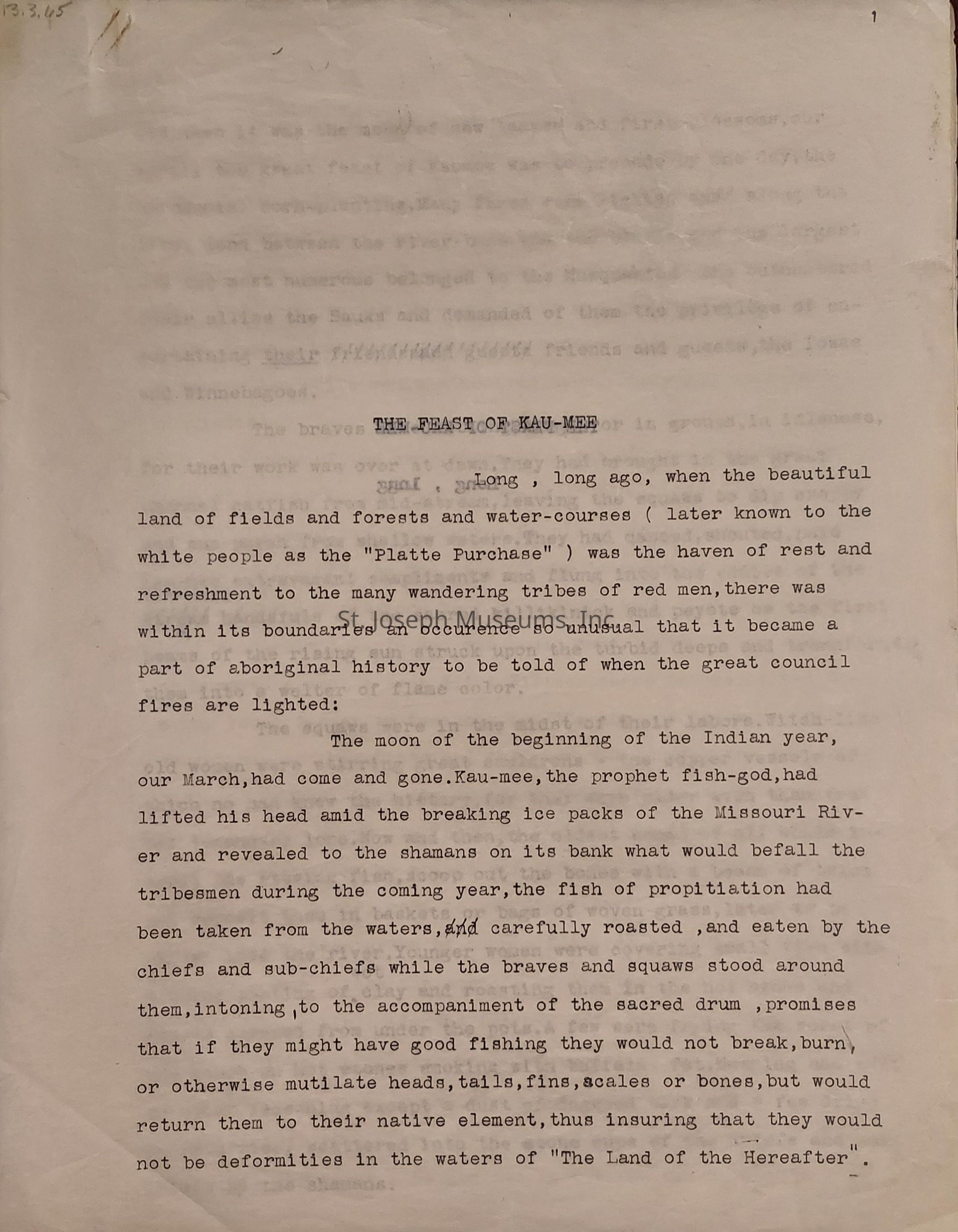
The Feast of Kau-Mee
Long, long ago, when the beautiful land of fields and forests and water-courses (later known to the white people as the "Platt Purchase") was the haven of rest and refreshment to the many wandering tribes of red man, there was within its boundaries an occurrence so unusual that it became a part of aboriginal history to be told of when the great council fires are lighted:
The moon of the beginning of the Indian year, our March, had come and gone. Kau-mee, the prophet fish-god, had lifted his head amid the breaking ice packs of the Missouri River and revealed to the shamans on its banks what would befall the tribesmen during the coming year, the fish of propitiation had been taken from the water, carefully roasted, eaten by chiefs and sub-chiefs while the braves and squaws stood around them, intoning, to the accompaniment of the sacred drum, promises that if they might have good fishing they would not break, burn, or otherwise mutilate heads, tail, fins, scales or bones, but would return them to their native element, thus insuring that they would not be deformities in the water of "The Land of the Hereafter".
Now, when it was the moon of new leaves and first blossoms, our April, the great feast of Kaumee was to precede by one day, the ceremonial corn-planting. Many fires were lighted along the level land between the river-bank and the bluffs, and the largest and the most numerous belonged to the Musquakies, who outnumbered their allies the Sauks and demanded one of them the privilege their friends and guests, the Iowas and Winnebagoes.
The braves were sitting, singly or in groups, in idleness, for their work work was over at dawn. They had brought in the greatest channel catfish from mid-stream, leaving the squaws to dip croppy and sun-perch from shallow waters. They had danced, shouted, paid Kau-mee extravagant compliments and flung into the eddies of the Missouri handfuls of the sacred killilinick and peyote as the first beams of the rising sun struck upon the turbid deeps and transformed them into a welter of flame color.
The squaws were in the midst of their labors. Witch-like old women were stirring great cauldrons- the copper vessels of which no man knew the history, for they were older even than tribal legendary lore. Now and then, the oldest woman of all would inspect the stewing fish, scoop put the bones with a besom of twigs and deposit them in baskets or bags of woven grass, later to be thrown into the river. Younger women were covering small fish with a thick coating of wet clay and roasting them in the hot ashes and embers scraped from under the pots. A few were frying the worst of the catch on hot stones smoking with buffalo-fat. Nothing had salt or other seasoning except a dust of dogwood bark and a few dried bearberrys scattered in the stone cups of the chiefs and sub-chiefs by the shaman. The young girls had no part in the labors of their elders, they stood near the fires, giggling, whispering exchanging gossip, casting shy glances at the unmarried youth, pushing each other to attract attention from the males they were not permitted to have speech with. This last exhibition of primitive coquetry has a sequel that was not tragic only because Kau-mee was kindly as never before- so the red men though, although the two white men, who arrived opportunely, had different conviction.
One of the men, whose name Gilbert Rayner, known from St. Louis to the Pacific coast as "Crazy Gil", was a trapper of the American Fur Company. He alone could go among hostile tribes unmolested, for the life of the demented is sacred to the Indian. Have not the gods kept his spirit with them while his body wanders the earth, and who would dare touch the shell of so honored a soul? Poor Gil! Fifteen years before, he had been a gay young farmer in Kentucky, but the lure of adventure had caught him and his bride and they had set out for the new farms north of Brunswick, in the new state of Missouri. At the Government agency on Bear Creek, they stopped to rest, for the little wife, unaccustomed to rough travel, was weary. There, she sickened and dies, leaving a girl baby to the ministration of the squaw wife of the agent. His dream of a home faded, Gil took the advice of the agent and joined the company of the trappers. When he returned to the Agency, his child was fat and fair, "the very image of her mother", while the papoose, her foster-sister, lay buried under the path the squaw took to the creek. Again he went away and again returned. This time there was a new agent, the old one had died. Where was the squaw? He did not know. Where was the child? He did not know. Gone with the squaw, probably, squaws generally went back to their own tribe if they lost their men by death or desertion. What tribe? The young Kentuckian did not know one tribe from another. He could tell by the make and ornamentation of the moccasins. He had not noticed how the woman was shod. His child, precious legacy of his dead Lila, was lost, and there was half a continent of trackless wilderness in which to search for her!
Body and soul he had given himself to the task. In the heat of the desert, in glacial snows, through tempests and sandstorms, under pitiless sunshine that kindled the prairie-fires, famishing at times, fevered at times, be numbered with cold or shaken with ague, hastened on. From Mexico to Vancouver, they knew that wild figure that wont to plunge into the midst of any pow-pow or potlatch, stare about him and stalk away. The wildest and remotest had heard of him or seen him and were glad to give him food and raiment and robes for shelter and bed, the fiercest and unfriendlist stayed their hands from him, for he belonged to the gods.
From the shores of the Pacific Ocean, he had beaten back to the head water where three insignificant rivers join to form the great Missouri, and, in a wooden canoe, a present from an awestruck Arickaree, he dared it doubtful current, taking on as he reached the channel deepened by the flow from the Yellowstone, a passenger, the intrepid missionary Father de Smet.
"I go", said the Belgian zealot, "to a favorite rendezvous of the Indians, a beautiful spot they call Wahwah-lenawah, on the east bank of this most unruly river. There is to be a feast in honor of the fish-god of some heathen tribes, and I am afraid that my Winnebagoes, their guest, may be tempted beyond their strength if I am that not there to uphold them."
As they landed, a terrific clamor assaulted their ears.
"What have the fiends inspired these people to do?" the priest inquired of a Winnebago who he recongnized.
"The girls were playing and kicked a bag of bones into the fire", the Winnebago answered in his own language. "One of our bucks married a Blackfoot squaw and brought her here. She has a white daughter and the girls are blaming her about the fishbones."
"Why the clamor?"
"The Musquakies think the luck in fishing is spoiled and sickness and shame will be visited on them by the angry fish-god. The girls are screaming that Lah-la did it because they are frightened, the shamans are demanding that the girl be drowned as an offering to appease Kau-mee and the mother squaw is howling with grief."
"She is of your tribe, now", said the priest.
"We are guest, we cannot quarrel here, and what matters one small squaw, we have many", answered the brave, indifferently.
"White! That Lah-la may be my Lila!" cried Gil, running to where a veritable mob surrounded the prisoner, and trying to press his way through the throng.
Screaming and gesticulating, the mob swayed in that curious way that packed humanity has smong the civilized, and by a common impulse moved toward the river.
Divining their intention, Gil ran ahead and loosed his boat.
At a shrill command from one of the shamans, two of the braves caught the girl by the wrist, swung her back and forth and tossed her into the waters.
Instantly, Gil was after her, caught her by her hair as she came up the first time and, by a miracle dragged her into the boat.
"Te Deum Landamus!" cried Father de Smet.
It was a holiday gathering, there was no arrow to stop him, no boat to pursue, Gil raced with the current, but as he raced he shouted,
"It is my Lila, she looks like her mother. Father, I never prayed before; I cured, but I'll pray hereafter. God is good."
"God is good", repeated the priest, "and I thank him for the state of that man's soul.
Many supplicate in the hour of need, but few return thanks when they have achieved the desire of the heart."
He turned to the baffled Indians, "Go back to your fires, my children, and ere you feast on the bounties Heaven has vouch-safed you, give thanks that you were foiled when you would have sacrificed a life to a false god."
"The bag scorched, nothe bones. Kau-mee not angry", muttered the squaw who held the weeping Blackfoot by the arm. "Have the good heart, maybe you have a son, a girl is nothing."Lexicon
LOC Thesaurus for Graphic Materials
MythsSearch Terms
Wahwah-lenawah, Feast of Kau-Mee, St. Joseph History, Owen Sisters, St. Joseph Authors, Native AmericanRelationships
Related Person or Organization
Person or Organization
Mary Alicia Owen