Name/Title
Gooseberry (Ribes missouriense)Entry/Object ID
2021.1.51 BScope and Content
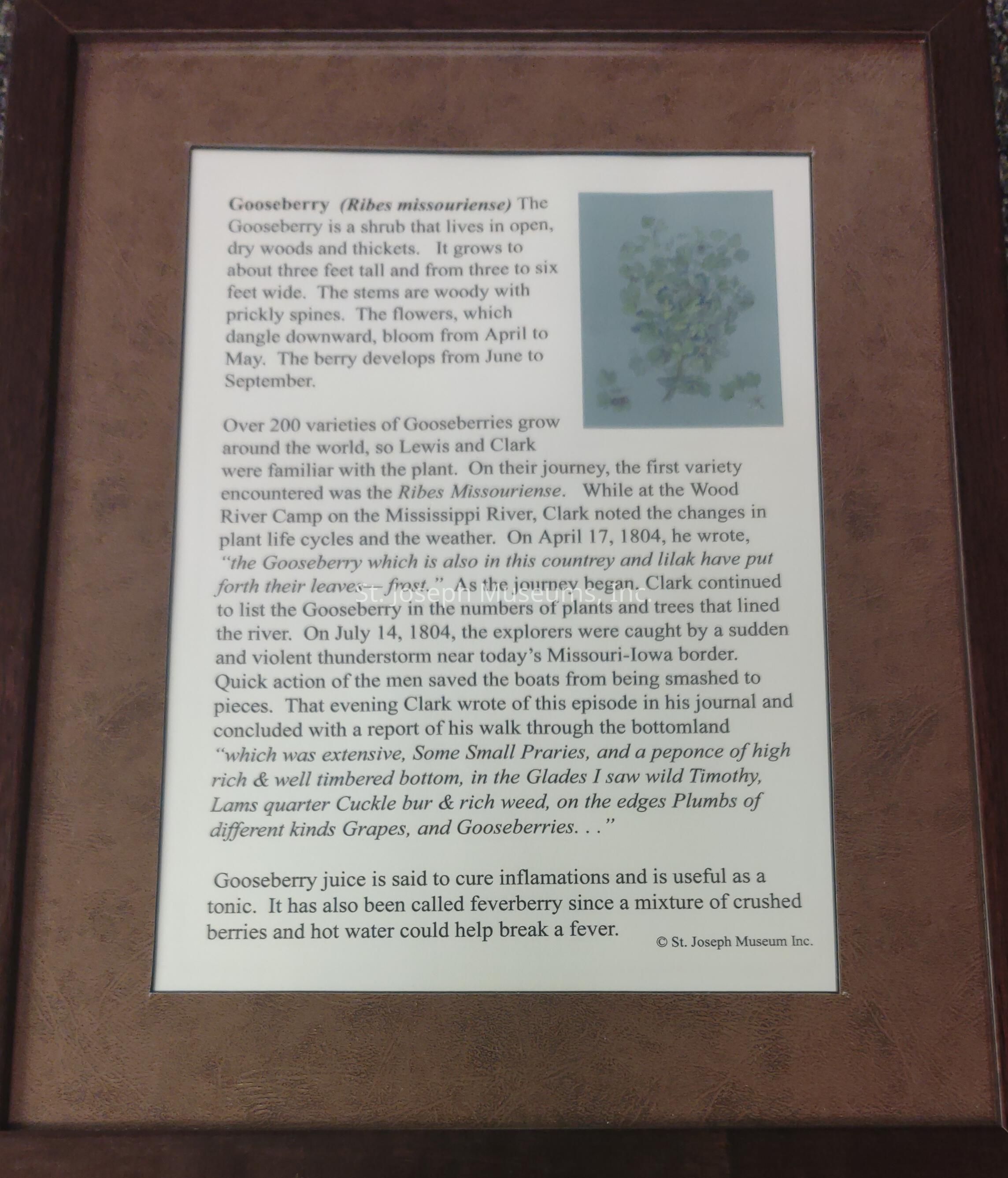
Gooseberry (Ribes missouriense) plant description, framed.
The Gooseberry is a shrub that lives in open, dry woods and thickets. It grows to about three feet tall and from three to six feet wide. The stems are woody with prickly spines. The flowers, which dangle downward, bloom from April to May. The berry develops from June to September.
Over 200 varieties of Gooseberries grow around the world, so Lewis and Clark were familiar with the plant. On their journey, the first variety encountered was the Ribes Missouriense. While at the Wood River Camp on the Mississippi River, Clark noted the changes in plant life cycles and the weather. On April 17, 1804, he wrote, "the Gooseberry which is also in this countrey and lilak have put forth their leaves - frost." As the journey began, Clark continued to list the Gooseberry in the numbers of plants and trees that lined the river. On July 14, 1804, the explorers were caught by a sudden and violent thunderstorm near today's Missouri-Iowa border. Quick action of the men saved the boats from being smashed to pieces. That evening Clark wrote of this episode in his journal and concluded with a report of his walk through the bottomland "which was extensive, Some Small Praries, and a peponce of high rich & well timbered bottom, in the Glades I saw wild Timothy, Lams quarter Cuckle bur & rich weed, on the edges Plumbs of different kinds Grapes, and Gooseberries..."
Gooseberry juice is said to cure inflammations and is useful as a tonic. It has also been called feverberry since a mixture of crushed berries and hot water could help break a fever.Context
Originally designed by the St. Joseph Museum in the fall of 2004. Titled "Botanical Wonders of the Uncharted West. The Recorded Flora of the Lewis & Clark Expedition."Collection
Lewis and ClarkLexicon
LOC Thesaurus for Graphic Materials
Botanical drawings, Expeditions & surveysArchive Items Details
Title
Gooseberry (Ribes missouriense)Creator
Mary L. FletcherDate(s) of Creation
2004Subjects
Plants, Watercolor paintingsParts
Count
2Parts
Watercolor of plant and descriptive label, both framed.Condition
Overall Condition
Very GoodProvenance
Notes
"Botanical Wonders of the Uncharted West" visually depicts how well Lewis followed Jefferson's instructions. In recognition of this achievement, The S. Joseph Museums, Inc. commissioned accomplished artist Mary Fletcher to create fifty (50) selected paintings of flora documented by the Corps during their Journey. These framed watercolor originals are accompanied by similarly framed labels, generated by former Head of Research Jackie Lewin, which describe the corresponding plants with appropriate quotations from the Journals. This collection makes available for study and appreciation plants that were new to Lewis and Clark, but which Native Peoples already recognized as valuable sources of food, medicine, and tools. Some of these still remain a mystery to many, but all will enjoy their beauty, their diverse uses, and their accomplished renderings.