JACKET

Object/Artifact

-

St. Joseph Museums

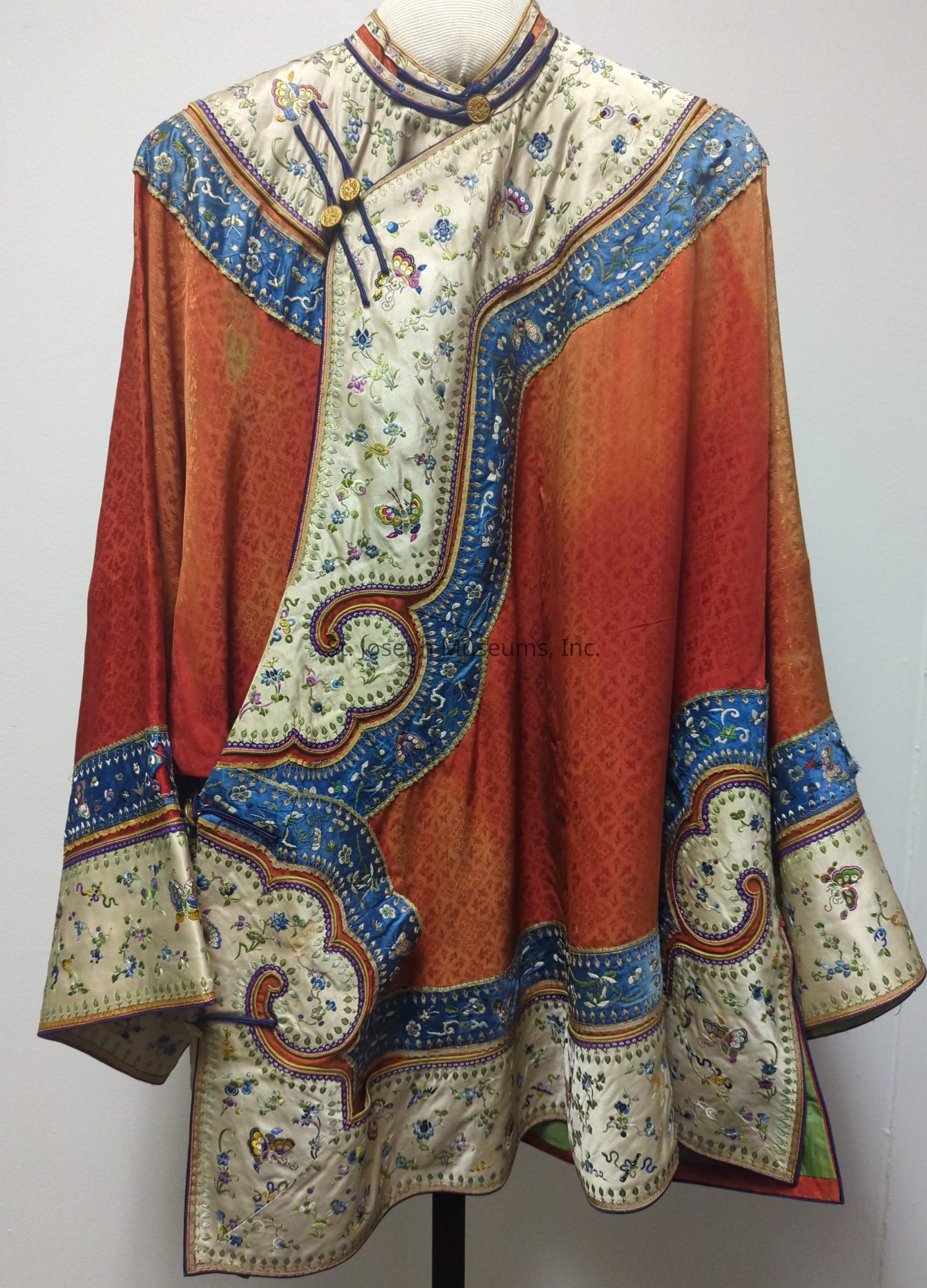
The image depicts an intricately designed garment featuring a rich blend of red, blue, and cream colors, adorned with elaborate floral embroidery and swirling patterns. The garment's upper portion is a cream-colored area with detailed flower and butterfly motifs, bordered by a striking blue section that highlights similar decorative elements. The majority of the fabric is a deep, warm red, covered in subtle geometric designs that add texture and depth. Golden buttons and trim punctuate the piece, enhancing its luxurious and traditional aesthetic.

The image depicts an intricately designed garment featuring a rich blend of red, blue, and cream colors, adorned with elaborate floral embroidery and swirling patterns. The garment's upper portion is a cream-colored area with detailed flower and butterfly motifs, bordered by a striking blue section that highlights similar decorative elements. The majority of the fabric is a deep, warm red, covered in subtle geometric designs that add texture and depth. Golden buttons and trim punctuate the piece, enhancing its luxurious and traditional aesthetic.

Name/Title

JACKET

Entry/Object ID

1975.1.37

Description

RED/BLUE/WHITE/GREEN LINING/EMB. FORAL DES. & BUTTERFLIES/GOLD BUTTONS

Collection

ETHNOGRAPHIC/CHINA

Made/Created

Place

Continent

Asia

Ethnography

Cultural Region

Country

China

Culture/Tribe

Chinese
Asian

Lexicon

Nomenclature 4.0

Nomenclature Primary Object Term

Jacket

Nomenclature Sub-Class

Main Garments

Nomenclature Class

Clothing

Nomenclature Category

Category 03: Personal Objects

Parts

Count

1

Material

Silk

Condition

Overall Condition

Good

Interpretative Labels

Label Type

Cultural/Historical Context

Label

Ancient China is divided into distinct dynasties, each ruled over by a specific family. The guiding principle for the government of ancient China was called the Mandate of Heaven. The Mandate of Heaven was a philosophy that established whether rulers had the right to rule China. The rulers of ancient China were given vast amounts of power, but they had a moral obligation to use it for the good of their people. If a ruler did not do this, then the country would experience natural disasters. These natural disasters would be a sign to the peasants that the ruler lost the blessing of the gods to rule, and thus it was allowed to overthrow the existing government and install a new dynasty. Each dynasty saw specific achievements and major events. The Zhou dynasty (1046 BCE-256 BCE), for example, saw the formalization of their writing system and the rise of such important philosophers like Confucious, Lao-Tzu, and Sun-Tzu. The Qin Dynasty (221 BCE-206 BCE) began construction on the Great Wall of China. Shi Huangdi, the first emperor of the Qin dynasty, built for himself an enormous tomb which he filled with over 8,000 terracotta warriors to serve him in the afterlife. The Han Dynasty (206 BCE-220 CE) saw the invention of paper, established Confucianism as the exclusive philosophy of the government (a practice that has continued through to modern times), opened the Silk Road which opened trade routes to the rest of Asia and into Europe. The Sui Dynasty (589-618 CE) built the Grand Canal, enlarged the Great Wall, standardized coins across the country, built the army to its largest size, and encouraged the development of literature. The famous story Legend of Hua Mulan is thought to have been written during this time. The Tang Dynasty (618-907 CE) is considered the Golden Age of China, where the country saw an elongated period of peace, during which art, culture, and innovation could flourish. During this time, China also saw its first and only female monarch - Wu Zetian. The Song Dynasty (960 - 1279 CE) saw massive strides in artistic forms, characterized by large landscape paintings. Paper money was used for the first time, movable type was invented to make books and literature widely available and easier to print, traditional Chinese pottery was refined and the quintessential blue and white “China” was made popular, and public schooling was made available to all during this time. The Song Dynasty ended when the Mongols, led by Kublai Khan conquered the area, who established the Yuan Dynasty. There were only two more imperial dynasties that followed, and in 1911 the Republic of China was established.
Research Notes

Person

Tori Zieger

Notes

This jacket and the matching skirt would have been worn by a Han Chinese woman in the late 1800s or early 1900s. Han Chinese refers to indigenous Chinese people who are native to the country of China. This is opposed to the Manchu people. Manchu refers to the people that conquered China in 1644 and established a dynasty/migrated into the country. This group of people originated from Manchuria in Northeast Asia. When the Manchu conquered China, they established what would come to be known as the Qing dynasty and would remain in power until World War I. Under the Qing dynasty, China produced some of its most splendid porcelain. The Qing emperors established imperially backed workshops where artisans of all kinds could work and produce artwork of beauty. The Manchu people were a separate cultural identity than the native Chinese people. To help create a unified sense of cultural identity, the Qing government created and implemented a specific dress code. Manchu women would wear a full length robe (though trousers would often be worn under the robe). The St. Joseph Museums has such a robe (83.31.12), though it is not on display at this moment. This shorter jacket seen here would have been worn by an upper class Chinese woman with the long skirt under the jacket. This common pairing is called a ruqun or an aoqun. The Chinese people living under the Qing dynasty were known as the Han. The traditional clothing worn by the Han is called hanfu (simplified Chinese: 汉服; traditional Chinese: 漢服). Hanfu often consisted of these jacket/skirt combos (compared to the Manchu style of long outer robes covering shirts and trousers) but would also include accessories like headwear, footwear, belts, jewelry, and fans. Hanfu does not just refer to the style of the Han Chinese under the Qing dynasty. Rather this term encompasses all traditional clothing for the last three millenia. The clothing is often made of silk, which was a staple of Chinese trade for more than four millenia. This red jacket is embroidered with butterflies and flowers. Red is a common color seen in hanfu. The Han Chinese viewed red as a lucky color and would often wear it to auspicious events like weddings. The Manchu, on the other hand, avoided the color red in their clothes and favored the color blue. The embroidery on hanfu was also very specific. The wealth and status of an individual could be ascertained based on the intricacy and quality of the embroidery on their clothing. While still limited due to social and economic factors, the common people still had embroidery on their clothing. Their embroidery, however, was much simpler and would display more common things. The images depicted were often highly symbolic as well. Rarely was the choice of motifs in hanfu random. Garments, particularly for the upper class, would be made for specific people. As such, the embroidery would represent the specific identity, aspirations, and the social position of the person it was meant for. In this garment, we see lots of flowers and butterflies. The lotus flower, which is the dominant flower seen on this jacket and skirt, symbolizes purity and enlightenment. The butterflies represent love and happiness. There are also small cranes, which represent nobility and longevity, as well as cherry and plum blossoms, which represent love and beauty.