Name/Title
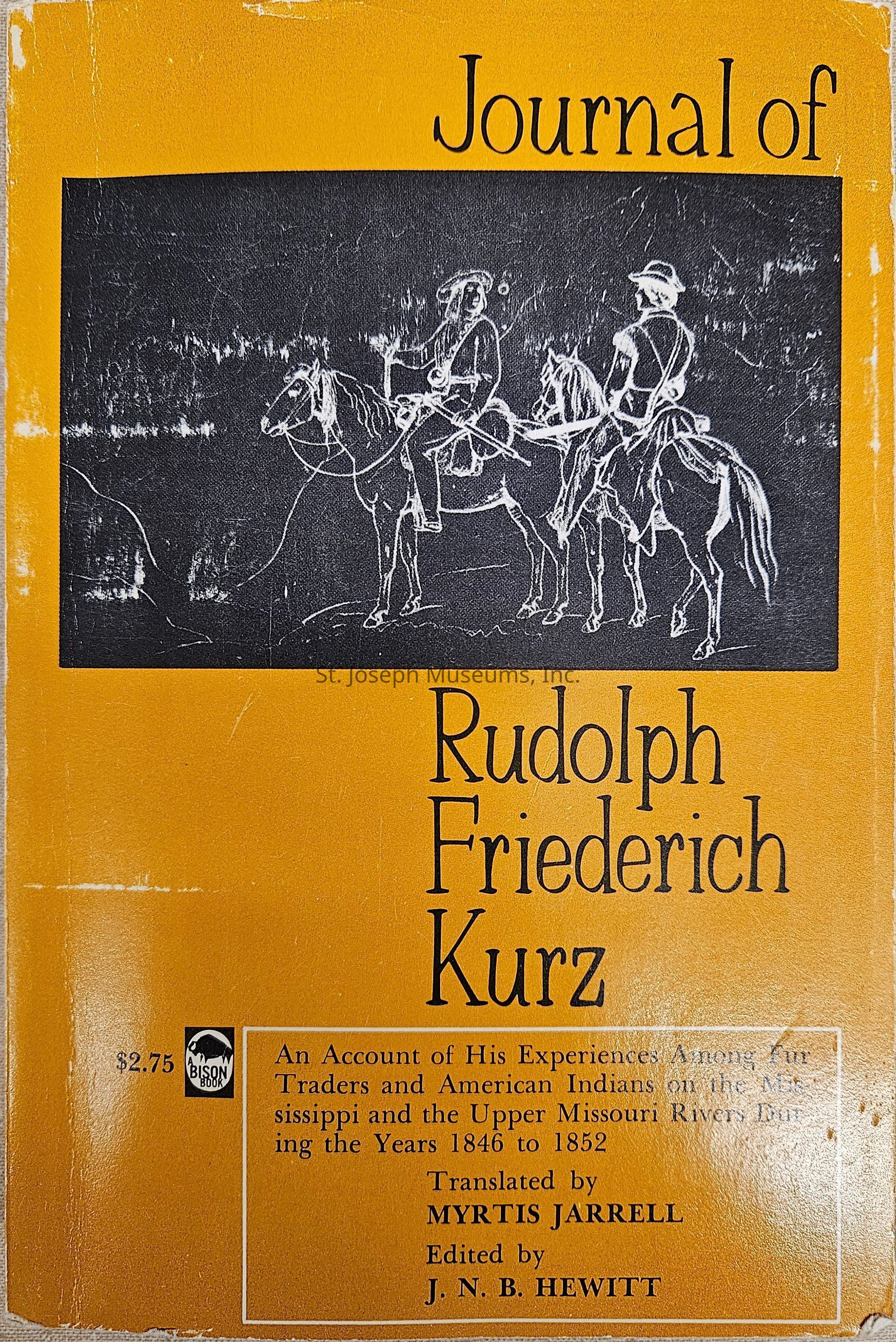
Journal of Rudolph Friederich KurzEntry/Object ID
L2019.13.129Description
Journal of Rudolph Friederich Kurz. An Account of His Experiences Among Fur Traders and American Indians on the Mississippi and the Upper Missouri Rivers During the Years 1846 to 1852. Mr. Kurz was a clerk at Forts Berthold and Union, he came to know intimately Indians, fur traders, and officers, and to understand the conditions of life in the region. Mr. Kurz witnessed a number of historically important events, including the Mormon migration and the California gold rush. This volume includes 93 drawings created by Mr. Kurz.
Hugh Lewis research notation:
Page 29: Joseph Robidoux, entry recorded in 1848. "St. Joseph, once the trading post of Joseph Robidoux, is situated at the foot of the Black Snake Hills on the left bank of the Missouri. Though the town was founded only six years ago there are evidences already of a rapidly expanding and flourishing city. In spite of the fact that there are many new buildings, both of wood and of brick, houses, either for homes or for business purposes, are hard to get. Upon my arrival the principal streets were much enlivened by fur traders and immigrants on their way to regions, as yet little known, in Oregon and California. The rich gold mines were not then discovered. Only the most daring fur traders had penetrated into that far country and, following in their wake, a rough, lawless set of adventurers, eager for gain and best pleased with what the strong hand won, traveled the same trail in armed bands with pack mules and covered wagons."
Page 54: Joseph Robidoux, entry recorded in 1850. "St. Joseph, as well as St. Louis, is indebted to the fur traders for its beginning. In 1834 Joseph Robidoux, as I have mentioned already, bought this trading post from the American Fur Co. and from this point carried on a exchange trade with the neighboring Indian tribes. His first house stood at the end of a ridge near the mouth of the Black Snake, as the stream is called from its tortuous course through the black shadows of the woodland. Canadians called the place at an earlier time, Le Post du Serpent Noir. Robidoux's old storehouse is still standing; it looks like a stall. In fact, the place is now used for that purpose. His dwelling house was on the other side of town. In its site now stands a tavern that was built by County Clerk Fowler.
As soon as the increasing number of country towns and farms began to close in upon Joe Robidoux and to create competition in the fur trade he decided to buy 160 acres to which he held preemption rights and to sell the land for city property. At first he sold lot for lot at very reasonable prices, in order to induce people to buy them; for instance, he would sell a lot for $10 or for a yoke of oxen. Then, according to the convenient location of the plots in question, he steadily advanced prices. He is now an immensely wealthy property holder, but his 60 papooses, his seven white children, and several brothers in rags and tatters continually consume his substance. Two years ago the city lots had advanced threefold in value.
Now a building lot with 40 feet front and a depth of 140 feet, abutting in the river on an alley, is worth from $300 to $600."
Page 67: Joseph Robidoux, recorded in 1851. "Decatur told me a good joke that old Robidoux played, many years ago, on a competitor of his in these parts named Manuel Lisa. Both were traders with the Pawnee. Each of them tried to acquire by trade as many pelts as possible for himself without being at all squeamish as to the means he employed, and, for that reason, they often quarreled. In order to prevent such wrangles and under the conviction that neither had the power to ruin the other, they pledged reciprocally to be "loyal", i. e., if a band of Indians arrived at their trading posts for the purpose of exchange and barter, neither would attempt to take advantage of the other. Manuel Lisa, however, had no intention of trading on honorable terms for any length of time; accordingly, upon an occasion when both of them expected a band of Pawnee he tried to circumvent Robidoux. While he ordered his post supplied in secret with commodies to barter to the Pawnee, he went over to see Robidoux by way of putting him off his guard, by his own presence there to hinder preparations, and to see what was really going on in the other storehouse. Robidoux played the part of unsuspecting host just as well as his opponent played his role; acted just as though he had allowed himself to be really duped. He invited Lisa to drink a glass of champagne to the success of prospective trade; but regretted that on account of his gout he was not able to stoop down, and therefore would have to ask Lisa to fetch the flask from the cellar himself. The latter obligingly raised the trapdoor in the room and went down the steps. Joe let fall the door, rolled a cask upon it, and with mocking words left his opponent imprisoned, in order that he might trade alone with the Pawnee."
Page 68: Joseph Robidoux's youngest son, recorded in 1851. "In the summer of 1848 the youngest son of old Robidoux met his death in a tragic manner. When he finished his course at a college in St. Louis he came direct to St. Joseph. As too frequently happens, his entrance into the world of affairs was a protracted "spree." In his father's town he thought he might give himself up to the convivial life without restraint. Now it happened that just at this time the citizens of St. Joseph were in a state of great excitement over hooded bands of thieves that took away their horses and cattle. A number were caught and, to avoid legal procedure, the inhabitants let them be lynched. In consequence of those occurrences, any one who gave rise to the slightest suspicion after dark had to be prepared for any fate. One night young Robidoux, in exuberant spirits, heightened still more by many a "pop", was leaving the grocery in the dark, at midnight, to go home, when he conceived the desire to play a poor joke on a counting-house clerk, left in charge of the store, by frightening him up with noise. MacD., having no idea who was beating on the storehouse door so late, and having only thieves in mind, opened the window and called, again and again, "Who's there?" Young Robidoux, instead of answering him, pressed close against the lintel to avoid being seen, for neither was Mac D. His friend nor Mac's employer one of his father's; both of them were competitors of old Robidoux in trade with the Indians. Recognizing neither the young gentleman nor his companion, in the darkness, but regarding their movements as questionable, he shot young Robidoux from above, directly in the head, and killed him as dead as a rat. Then Robidoux's comrade cried out who they were, but it was too late. I remember perfectly well the scene that followed. Notwithstanding the late hour, everybody on Main Street was up; a crowd gathered about the dead body. Old Robidoux was furious. He declared the murder of his son to be the base act of his competitor in trade and wished to lynch Mac D. -in fact he himself brought a rope for the purpose. With much difficulty he and his adherents were restrained from committing that deed of violence. MacD., protected by his own friends, gave himself up to the constable. The fellow who was with the unfortunate young Robidoux at the time of his death was required to tell the facts and his statement prevented further bloodshed. Mac D.'s employer stood bail for him, so that during the legal proceedings he need not remain in St. Joseph. As was just, he was later acquitted, and then he returned to the town."
382/Softbound/Yellow with illustration of two men on horseback/IllustrationsCollection
Robidoux Collection by Hugh LewisLexicon
Nomenclature 4.0
Nomenclature Primary Object Term
BookNomenclature Sub-Class
Other DocumentsNomenclature Class
Documentary ObjectsNomenclature Category
Category 08: Communication ObjectsLOC Thesaurus for Graphic Materials
Trading postsSearch Terms
North American Indians, Missouri River Valley, Fur Trading, Aztecs, Blackfeet, Indian Children, Crow Indians, Fort Laramie, Fort Union, Fox, Mandons, Mormons, Pawnee, St. Joseph, Missouri, St. Louis, Missouri, Sioux, Robidoux, Joseph, Native AmericanBook Details
Author
Rudolph Friederich Kurz, Jarrell, Myrtis, TranslatorPlace Published
City
LincolnState/Province
NebraskaDate Published
1970Call No.
Robidoux KUISBN
0-8032-5713-9LCCN
70-100814Notes
Copy No.: 5Relationships
Related Person or Organization
Person or Organization
Robidoux, JosephPerson or Organization
Manuel LisaPerson or Organization
Edwin T. DenigPerson or Organization
Joe Picotte