Name/Title
KwanzaaEntry/Object ID
9999.BHF.301Scope and Content
Kwanzaa
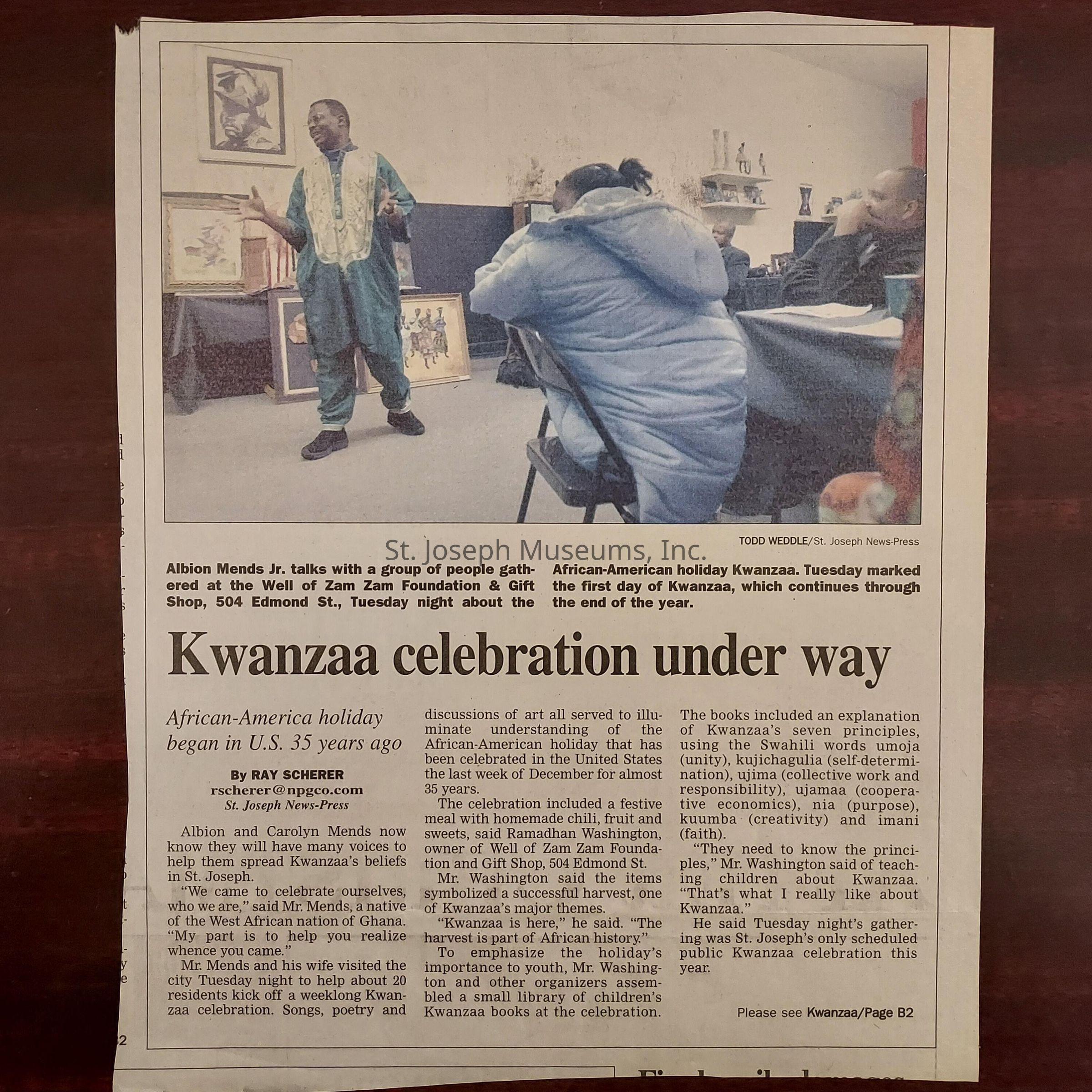
St. Joseph News-Press has a picture of Albion Mends Jr. talking with a group of people gathered at the Well of Zam Zam Foundation & Gift Shop , 504 Edmond St. about the African-American holiday Kwanzaa.
Albion and Carolyn Mends know they will have many voices to help them spread Kwanzaa's beliefs in St. Joseph. They are from the West African nation of Ghana. Songs, poetry and discussions of art serve to illuminate understanding of the African-American holiday that has been celebrated in the United states the last week of December for almost 35 years. The celebration included a festive meal. Mr. Washington said the items symbolized a successful harvest, one of Kwanzaa's's major themes. Organizers assemble a small library of children's Kwanzaa books at the celebration. The books are about Kwanzaa's seven principles. The principles are unity, self determination, collective work and responsibility, cooperative economics, purpose, creativity, and faith.
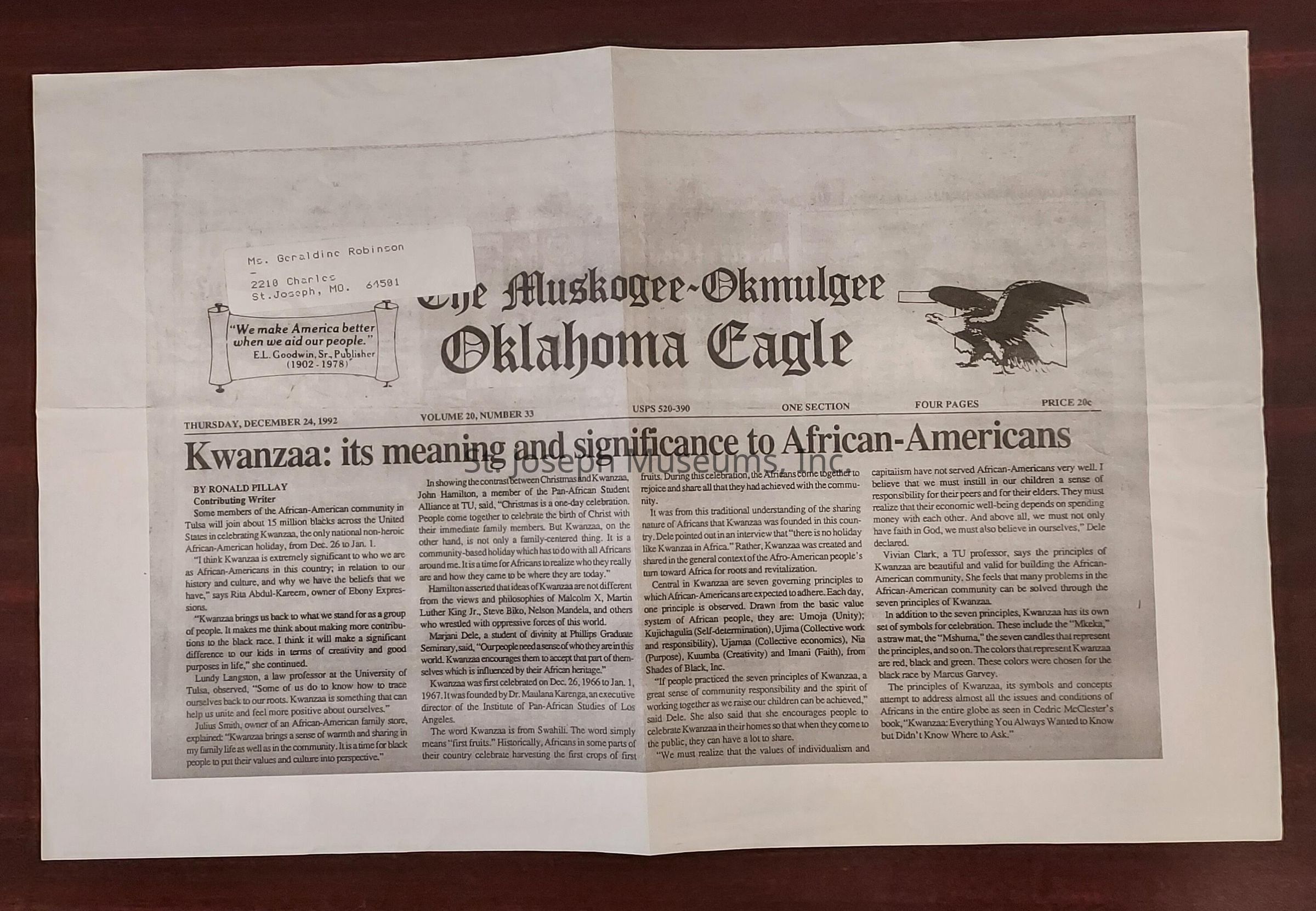
The Muskogee-Okmulgee Oklahoma Eagle December 24, 1992 has an article about Kwanzaa. It makes us think about making more contributions to the black race states Rita Abdul-Kareem, owner of Ebony Expressions. Lundy Langston states that Kwanzaa is something that can help unite and feel more positive about ourselves. Kwanzaa brings a sense of warmth and sharing in family life as well as in the community states Julis Smith.
The word Kwanzaa is from Swahili. It means "first fruits". The Africans come together to rejoice and share all they had achieved with the community.
The principles of Kwanzaa in its symbols and concepts attempt to address almost all the issues and conditions of Africans in the entire globe as seen in Cedric McClester's book "Kwanzaa Everything You Always Wanted to Know But Didn't Know Where to Ask."
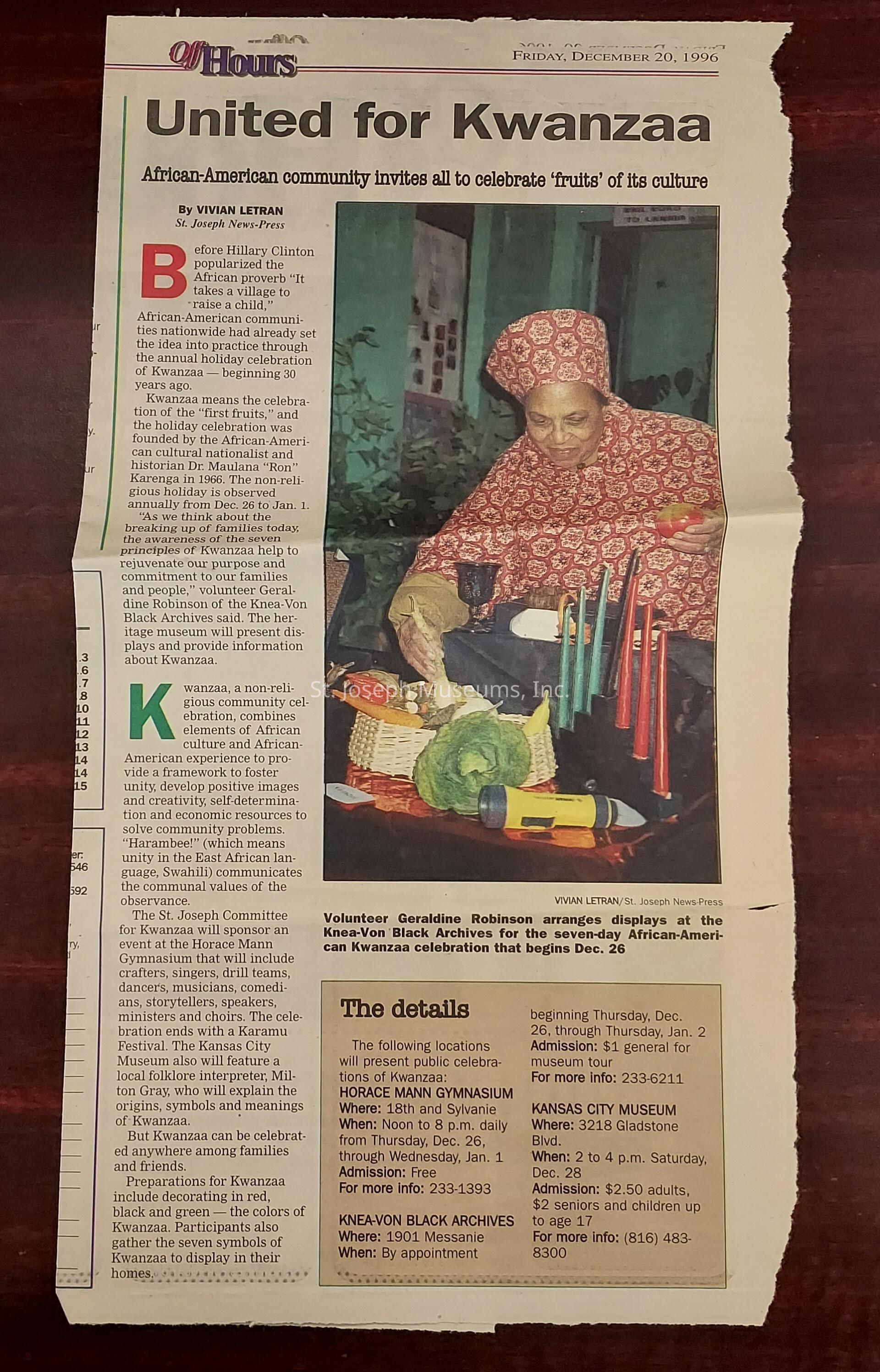
St. Joseph News-Press December 20, 1996 Kwanzaa means the celebration of "first fruits" and the holiday celebration was founded by African-American cultural nationalist and historian Dr. Maulana Ron Karenga in 1966. The non-religious holiday is observed annually from Dec. 26- Jan 1. The newspaper has a picture of Geraldine Robinson as she arranges displays at the Knea-Von Black Archives for the seven-day African-American Kwanzaa celebration that begins Dec. 26.
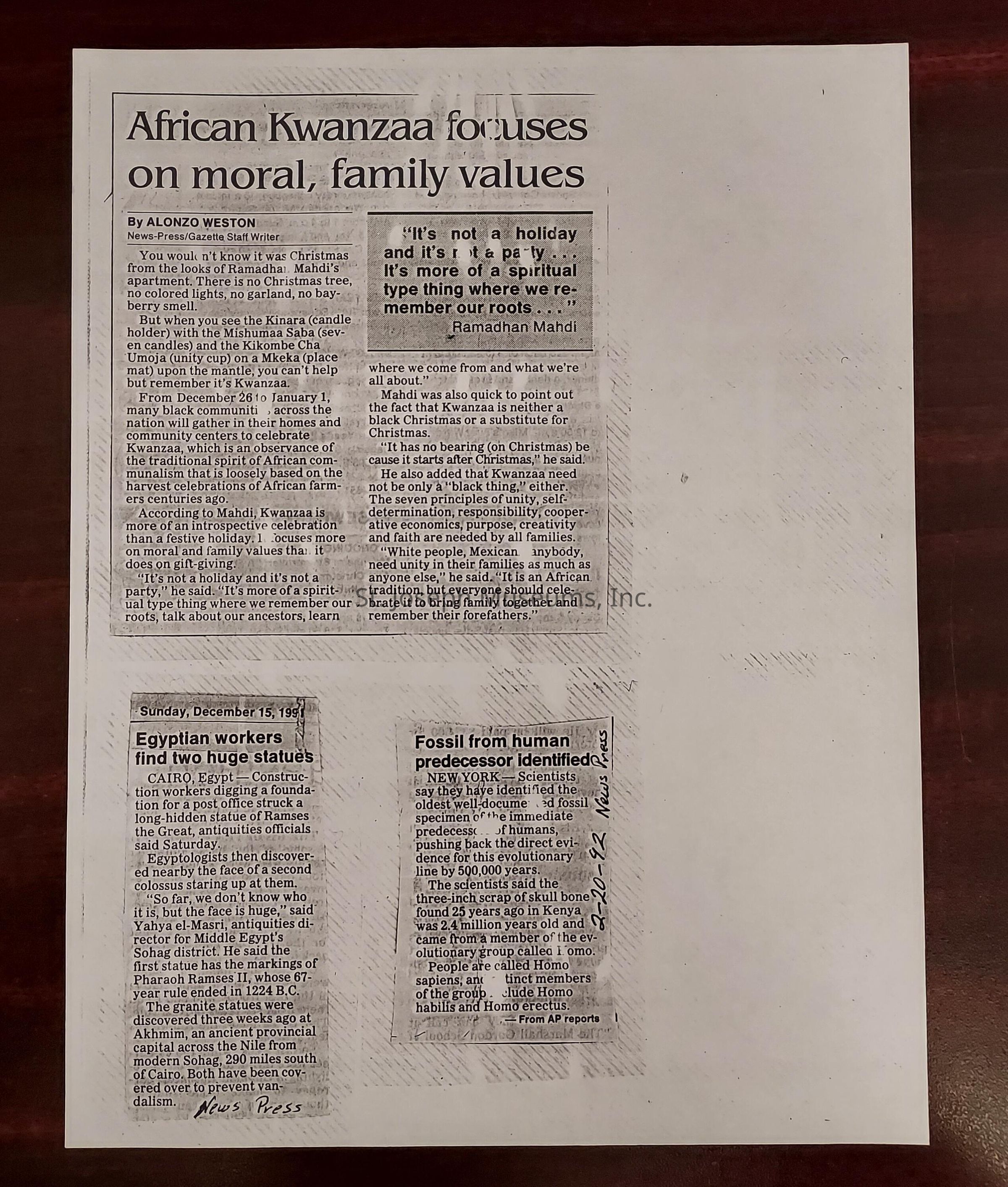
An article written by Alonzo about Kwanzaa appeared in his column of the St. Joseph News-Press. He states that according to Ramadha Mahdi, Kwanzaa is more of an introspective celebration than a festive holiday. It focuses more on moral and family values than it does on gift-giving. It is not a holiday and it is not a party. Its is more of a spiritual type thing where we remember our roots, talk about our ancestors, learn where we come from and what we are all about. Mahdi points our that Kwanzaa is neither a black Christmas or a substitute for Christmas. It has no bearing on Christmas because it starts after Christmas. He says that Kwanzaa need not be only a black thing either. The seven principles are needed by all families. It is an African tradition, but everyone should celebrate it to bring family together and remember their forefathers.Collection
Black ArchivesLexicon
LOC Thesaurus for Graphic Materials
SlaverySearch Terms
Black History, Kwanzaa, Black HolidaysRelationships
Related Person or Organization
Person or Organization
Dr. Ron Maulana KarengaPerson or Organization
Ramadha MahdiPerson or Organization
Geraldine RobinsonPerson or Organization
Weston, Alonzo