Name/Title
Letter from Grace Nicholson to Harry GeorgeEntry/Object ID
Q1430.635.44CDescription
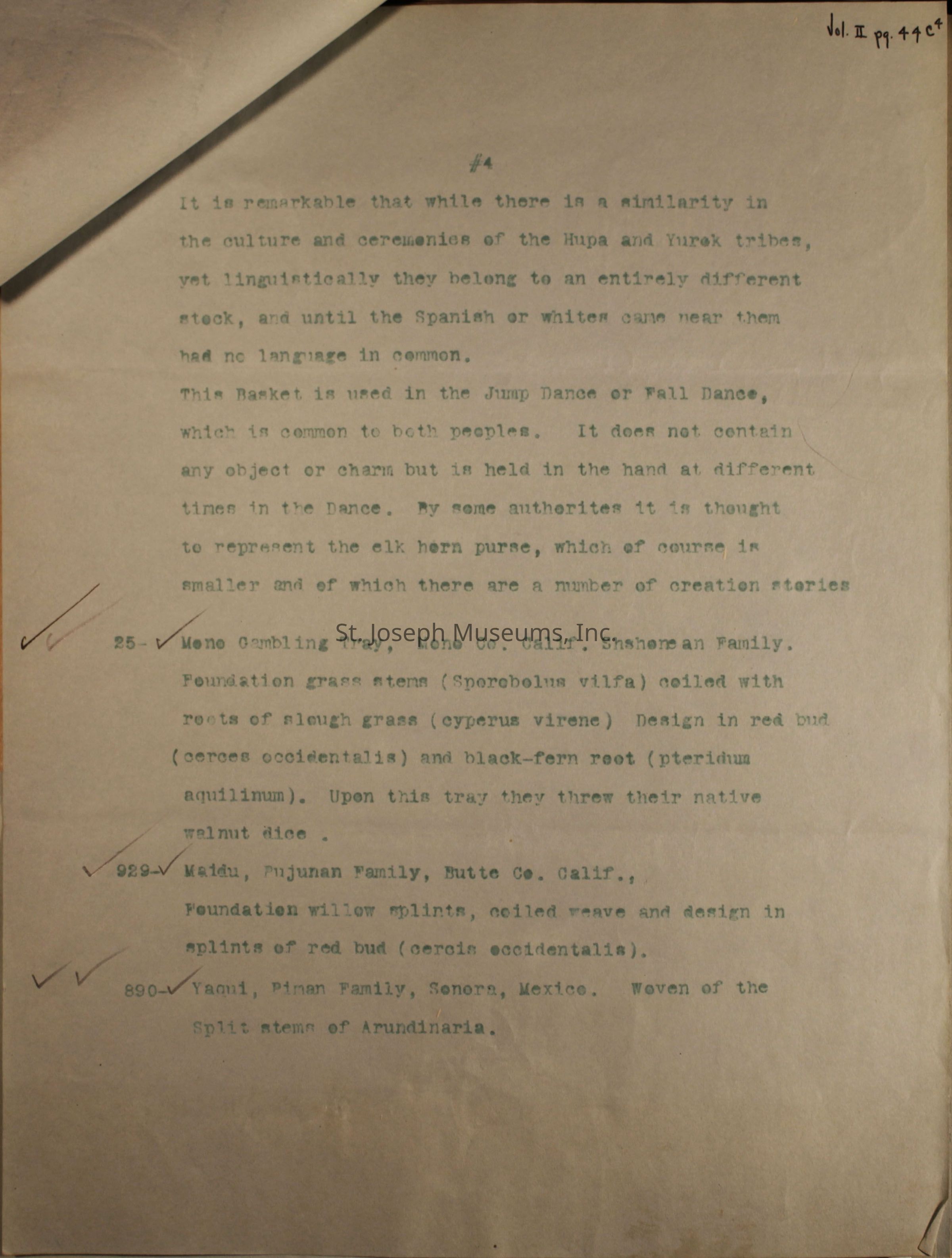
A 4-page typed letter from Grace Nicholson to Harry George. Includes a list of items she was selling, along with prices. Also includes detailed descriptions of baskets, including the origin of and material in each basket. Vol II pg. 44C
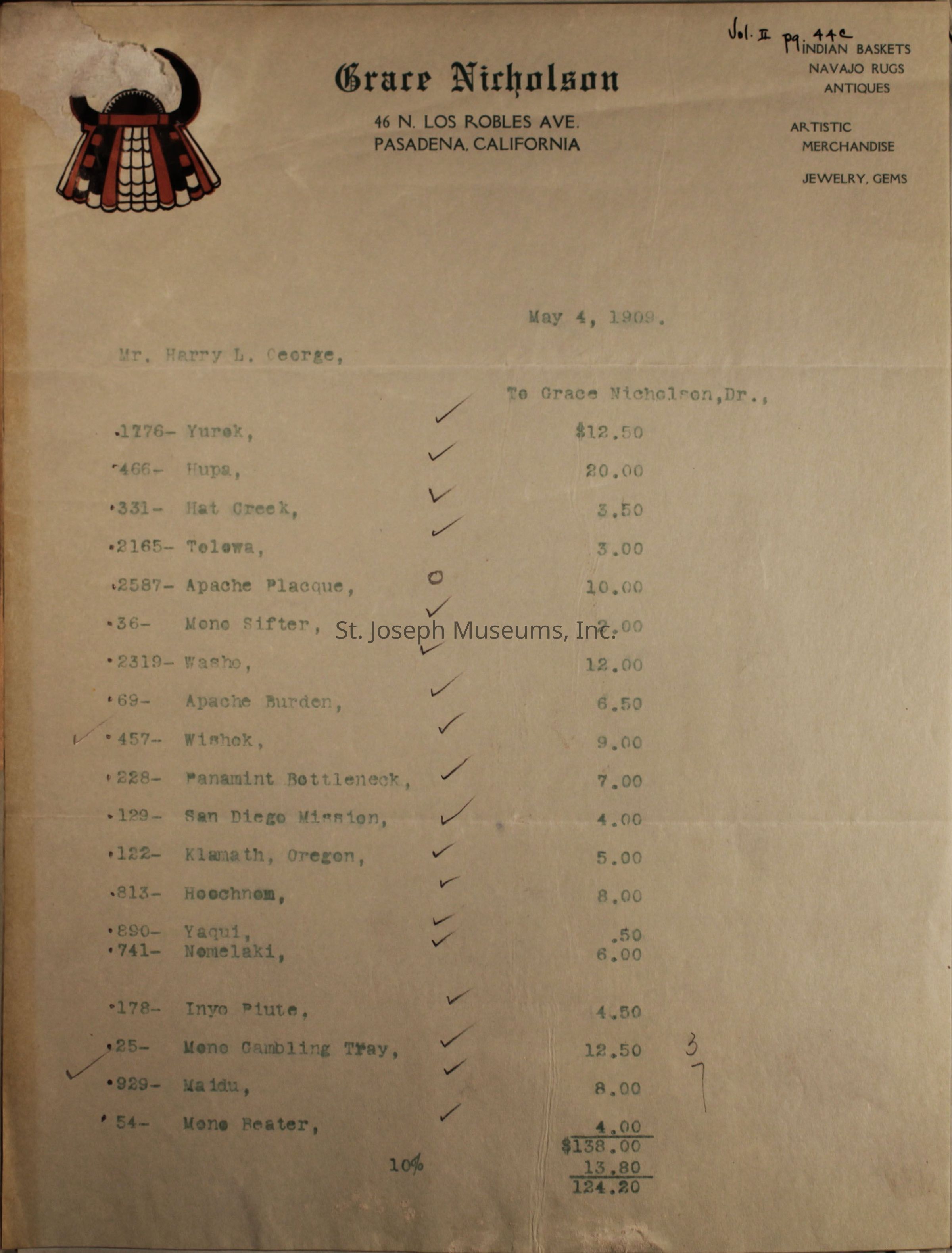
May 4, 1909.
Mr. Harry L. George
To Grace Nicholson, Dr.,
1776 – Yurok, $12.50
466 – Hupa, 20.00
331 – Hat Creek, 3.50
2165 – Tolowa, 3.00
2587 – Apache Placque, 10.00
36 – Mono Sifter, 2.00
2319 – Washo, 12.00
69 – Apache Burden, 6.50
457 – Wishok, 9.00
228 – Panamint Bottleneck, 7.00
129 – San Diego Mission, 4.00
122 – Klamath, Oregon, 5.00
813 – Hoochnom, 8.00
890 – Yaqui, .50
741 – Nomelaki, 6.00
178 – Inyo Piute, 4.50
25 – Nono Gambling Tray, 12.50
929 – Maidu, 8.00
54 – Mono Beater, 4.00
$138.00
10% 13.80
----------
24.20
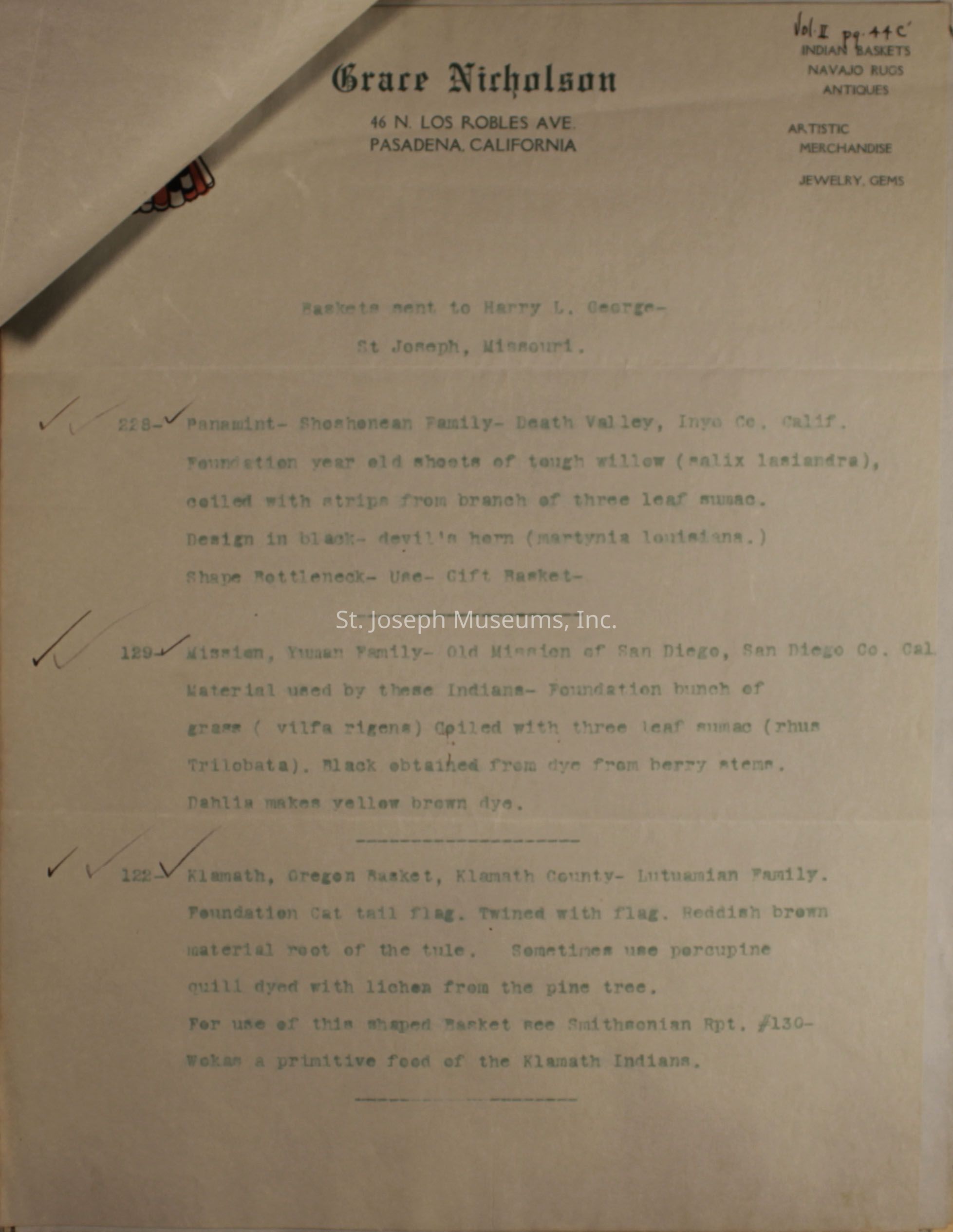
Baskets sent to Harry L. George –
St Joseph, Missouri.
228 – Panamint – Shoshonean Family – Death Valley, Inyo Co. Califor.
Foundation year old shoots of tough willow (salix Lasiandra), ceiled with strips from branch of three leaf sumac. Design in black – devil’s horn (martynia louiiana.)
Shape Bottleneck – Use – Gift Basket–
129 – Mission, Yiuaan Family – Old Mission of San Dieog, San Diego Co. Cal
Material used by these Indians – Foundation bunch of grass (vilfa rigens) Coiled with three leaf suma (rhus Trilobata). Black obtained from dye from berry stems.
Dahlia makes yellow brown dye.
122 – Klamath, Oregon Basket, Klamath County, Lutuamian Family
Foundation Cat tail flag. Twined with flag. Reddish brown material root of the tule. Sometimes use porcupine quill dyed with lichen from the pine tree.
For use of this shaped Basket see Smithsonian rpt. #130–
Women a primitive food of the Klamath Indians.
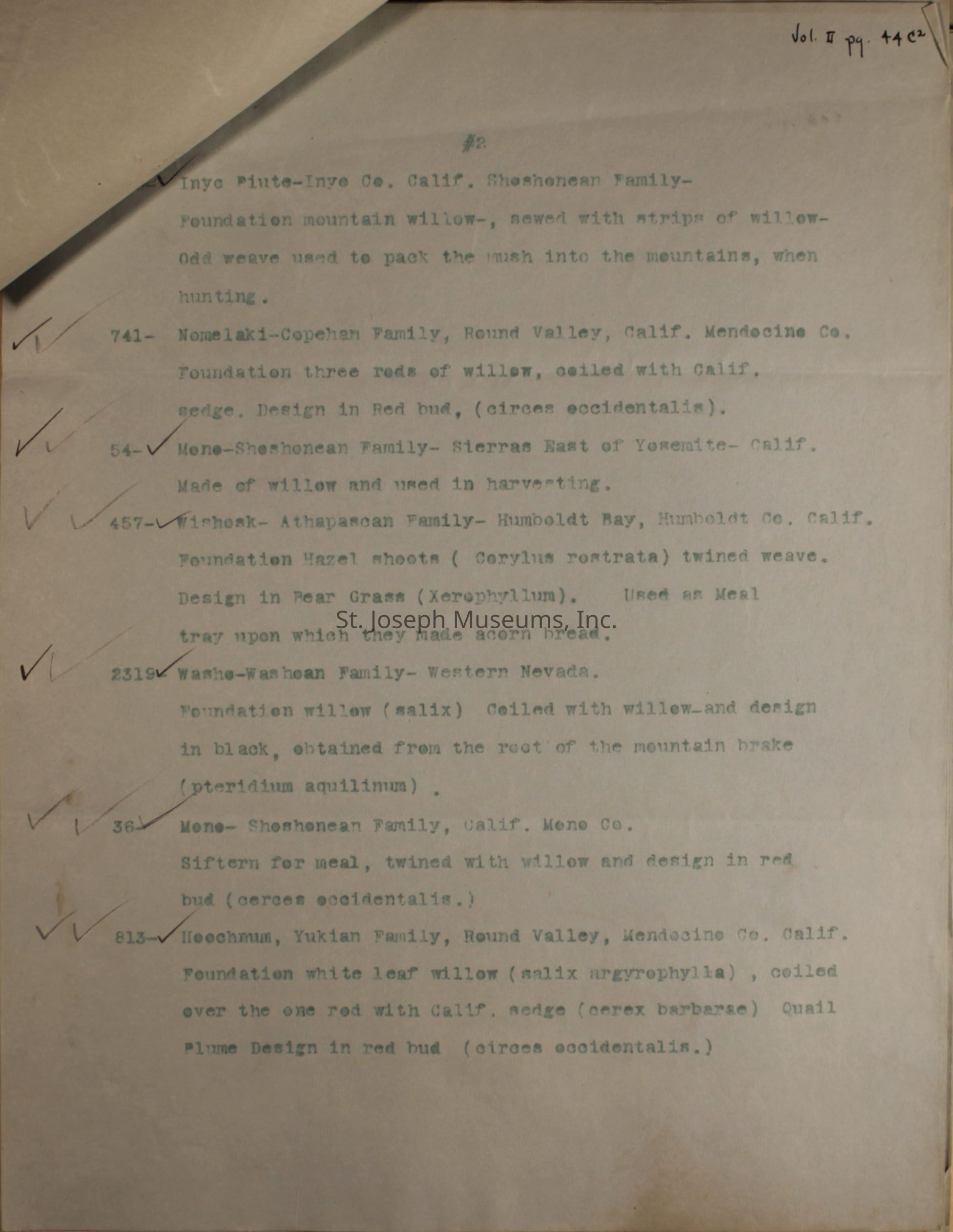
#2
[number hidden] Inyo Piute – Inyo co. Calif. Shoshonean Family –
Foundation mountain illow–, sewed with strips of willow- odd wave used to pack the [mish?] into the mountains, when hunting.
741 – Nomelaki-Copehan Family Round Valley, Calif. Medicine Co.
Foundation three reds of willow, coiled with Calif. Sedge. Design in Red bud, (circes occidentalis).
54 – Wishosk – Athapascan Family – Humboldt Bay, Humboldt Co. Calif.
Foundation Hazel shoots (Corylus rostrata) twined weave. Design in Pear Grass (Xerophyllum). Used as Meal try upon which they made acorn bread.
2319 – Washe-Washean Family – Western Nevada.
Foundation willow (aslix) Ceiled with willow and design in black, obtained from the root of the mountain brake (pteridium aquilinum).
36 – Mono– Shoshonean Family, Calif. Mono Co.
Siftern for meal, twined with willow and design in red bud (cerces occidentalis.)
813 – Ileechmum, Yukian Family, Hound Valley, Medicine Co. Calif.
Foundation white leaf willow (salix argyrophylla), ceiled over the one red with Calif. Sedge (cerex barbecue) quail Plum Design in red bud (circes occidentalis.)
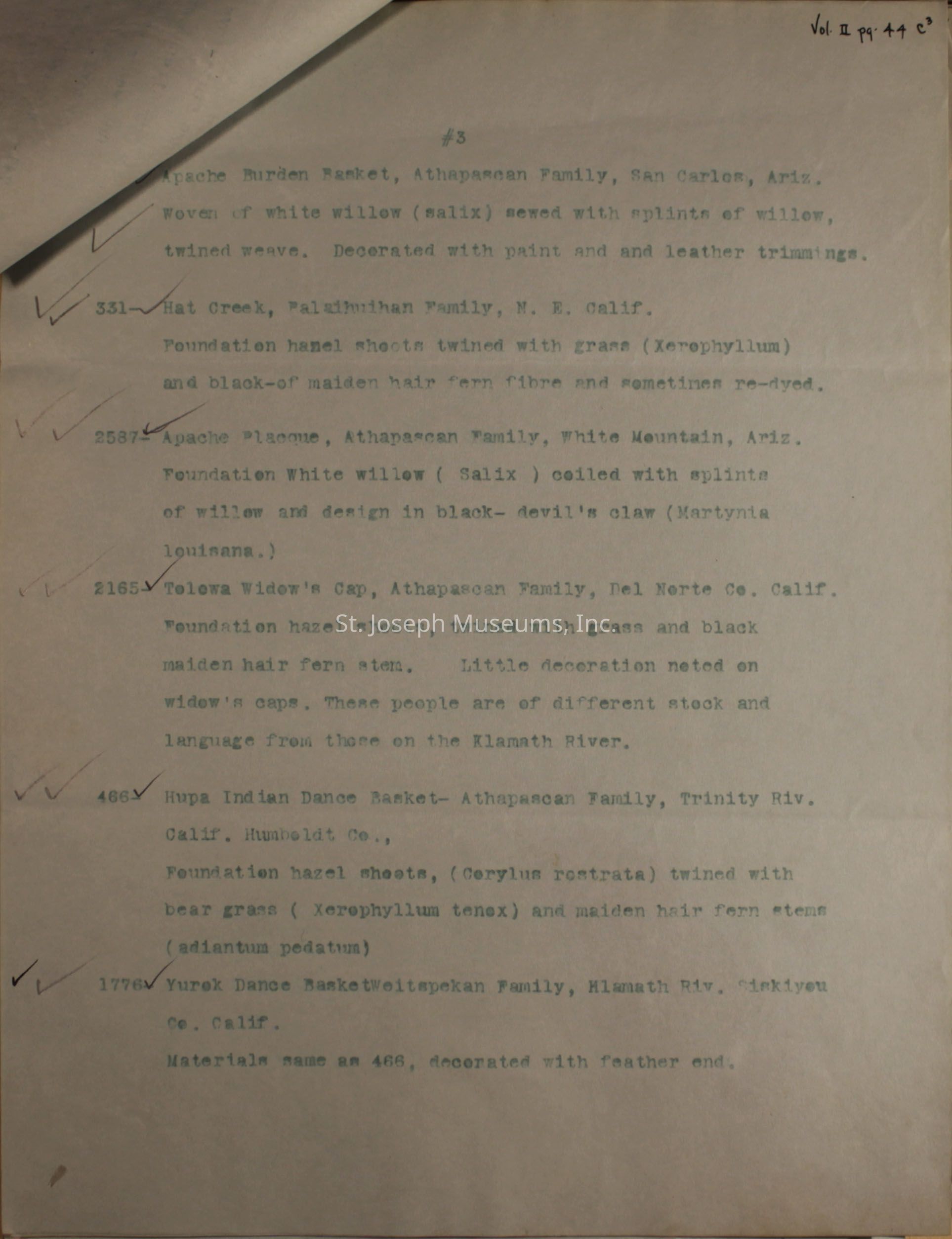
#3
[number hidden] Apache Burden Basket, Athapascan Family, San Carlos, Ariz.
Woven of white willow (salix) sewed with splints of willow, twins weave. Decorated with paint and and leather trimmings.
331 – Hat Creek, Palaihuihan Family, N.E. calif.
Foundation hazel shoots twined with grass (Xerophyllum) and black- of maiden hair fern fibre and sometimes re-dyed.
2587 – Apache Placque, Athapascan Family, White Mountain, Ariz.
Foundation White willow (Salix) coiled with splints of willow and design in black – devil’s claw (Martyrnia louisana.)
2165– Tolowa Widow’s Cap, Athapascan Family, Del Norte Co. Calif.
Foundation hazel shoots, twined with grass and black maiden hair fern stem. Little decoration noted on widow’s caps. These people are of different stock and language from those on the Klamath River.
466– Hupa Indian Dance Basket – Athapascan Family, Trinity Riv. Calif. Humboldt Co.,
Foundation hazel shoots, (Cerylus rostrata) twined with bear grass (Xerophyllum tenox) and maiden hair fern stems (adiantum pedatum)
1776 – Yurok Dance Basket Weitspekan Family, Klamath Riv. Siskiyou Co. Calif.
Materials same as 466, decorated with feather end.
#4
It is remarkable that while there is a similarity in the culture and ceremonies of the Hupa and Yurok tribes, yet linguistically they belong to an entirely different stock, and until the Spanish or whites came near them had no languag ein common.
This Basket is used in the Jump Dance or Fall Dance, which is common to both peoples. It does not contain any object or charm but is held in the hand at different times in the Dance. By some authorities it is thought to represent the elk horn purse, which of course is smaller and of which there are a number of creation stories
25– Mono Gambling Tray, Mono Co. Calif. Shoshonean Family.
Foundation grass stems (Sporobolus vilfa) coiled with roots of slough grass (cyperus virene) Design in red bud (cerces occidentalis) and black-fern root (pteridum aquilinum). Upon this tray they threw their native walnut dice.
929– Maidu, Pujanan Family, Butte Co. Calif.,
Foundation willow splints, coiled weave and design in splints of red bud (cerces acidentalis).
890– Yaqui, Piman Family, Sonora, Mexico. Woven of the Splint stems of Arundinaria.Subject
Grace Nicholson
Pasadena, Cal
Yurok
Hupa
Tolowa
Apache
Mono Sifter
Washoe
San Diego Mission
Klamath, Oregon
Wishok
Hoochnom
Yaqui
Nomelaki
Inyo Piute
Nono
Maidu
NomelakiSubject Person/Organization
Harry L. George Collection