Name/Title
LetterEntry/Object ID
Q2022.21.285Scope and Content
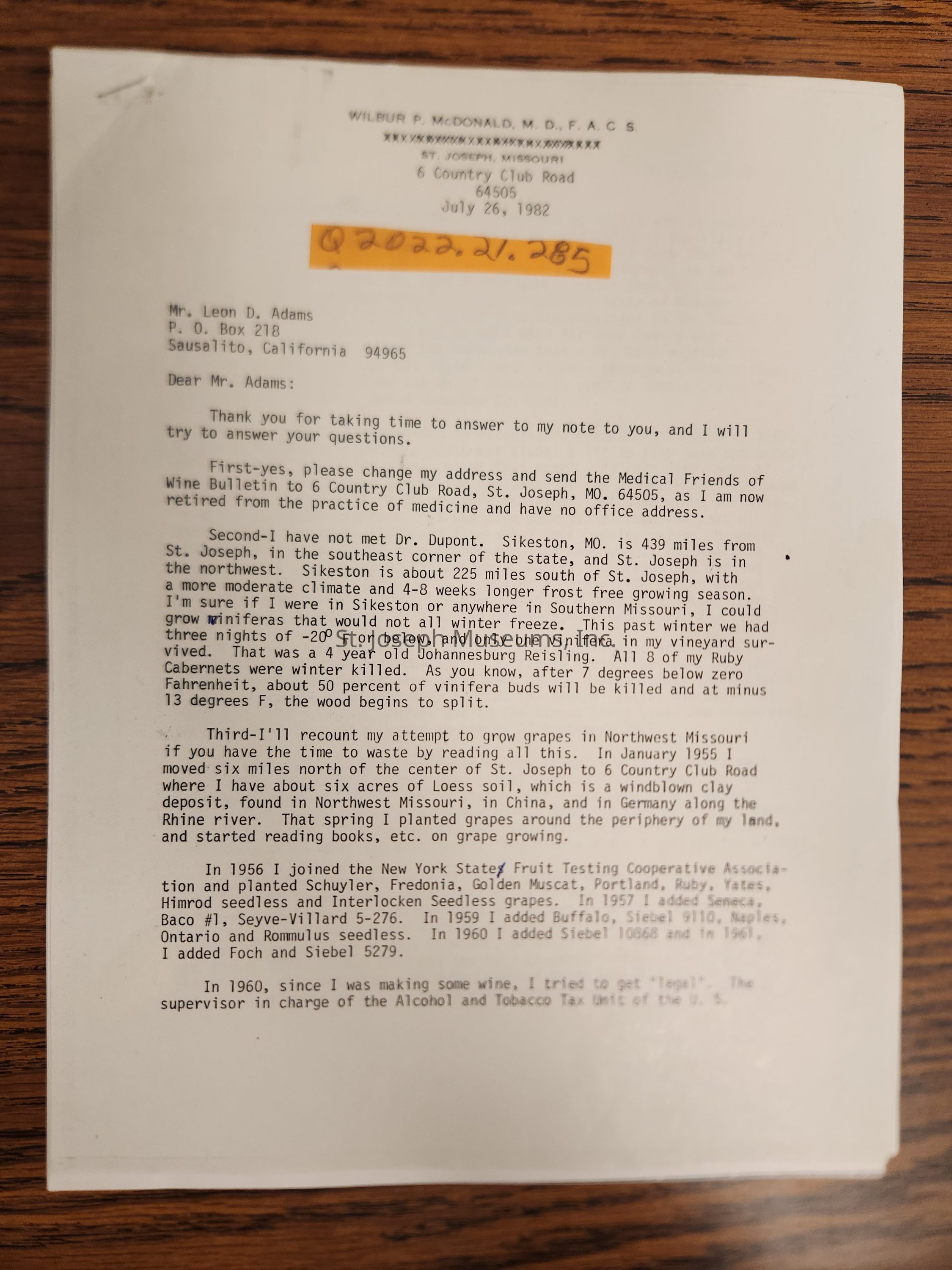
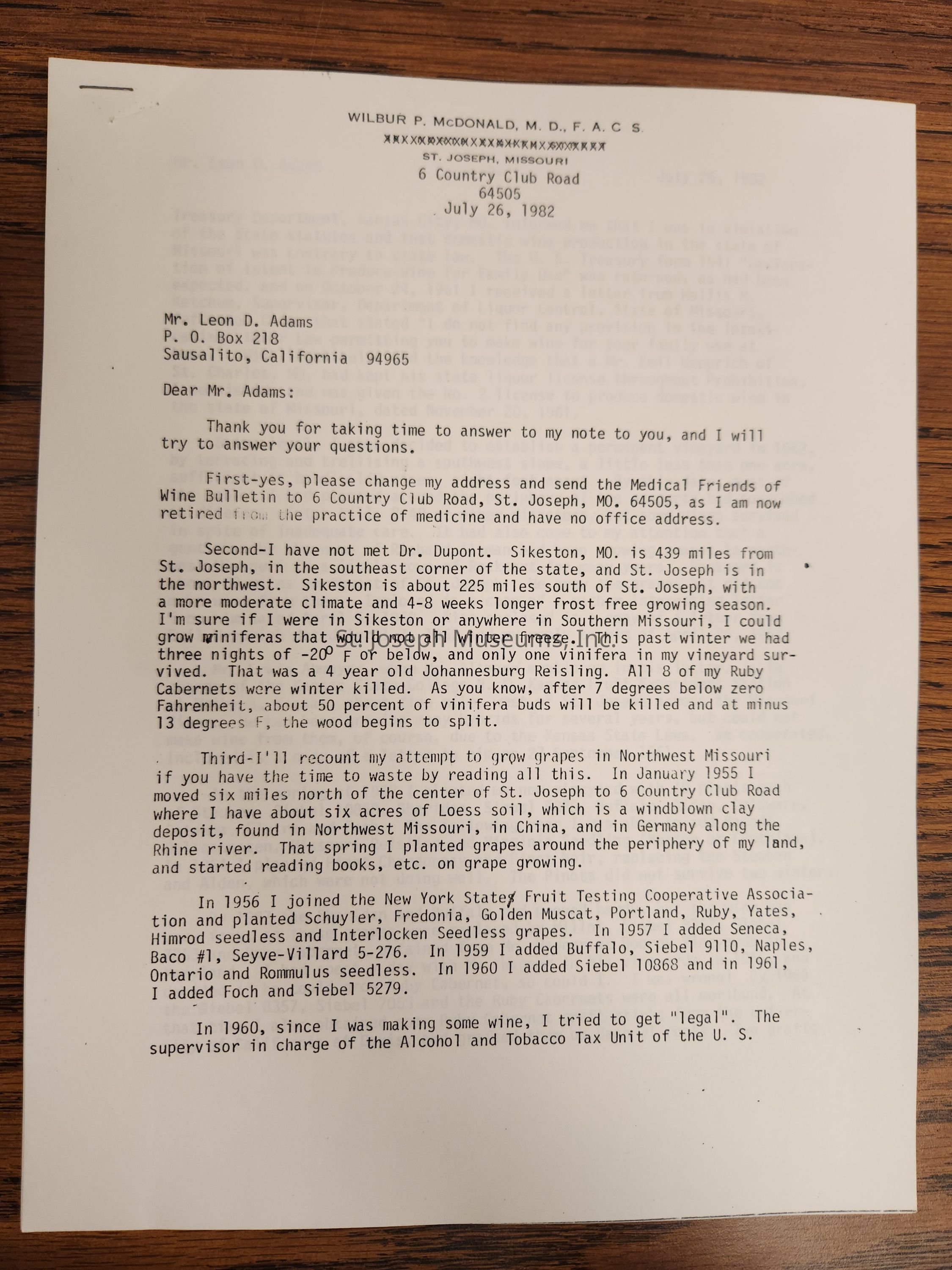
A Xerox copy and the original 4-page letter, from Wilbur P. McDonald, M. D., to Mr Leon Adams, Sausalito, California, dated July 26, 1982. It is written on Dr. McDonald's letterhead, he had crossed out his office address and typed in his residence address.Context
Dear Mr. Adams:
Thank you for taking time to answer my note to you, and I will try to answer your questions.
First-yes, Please change my address and send the Medical Friends of Wine Bulletin to . . . . . . .St. Joseph, MO. . ., as I am now retired from the practice of Medicine and have no office address.
Second-I have not met Dr. DuPont. Sikeston, MO is 439 miles from St. Joseph, . . . . . . . with a more moderate climate and 4-8 weeks longer frost free growing season. I'm sure is I were in . . . or anywhere in Southern Missouri, I could grow viniferas that would not winter freeze. . . . . . As you know after 7 degrees below zero Fahrenheit, about 50 percent of vinifera buds will be killed and at minus 13 degrees F, the wood begins to split.
Third-I'll recount my attempt to grow grapes . . if you have the time to waste reading all this. In January 1955 . . . . I have about six acres of Loess soil, which is windblown clay deposit, . . . That spring I planted grapes around the periphery of my land and stated reading books, etc. . . .
In 1956 I joined the New York State Fruit Testing Cooperative Association and planted . . . . . . . In 1957 I added . . . . . In 1960 I added . . and in 1961 I added . . . .
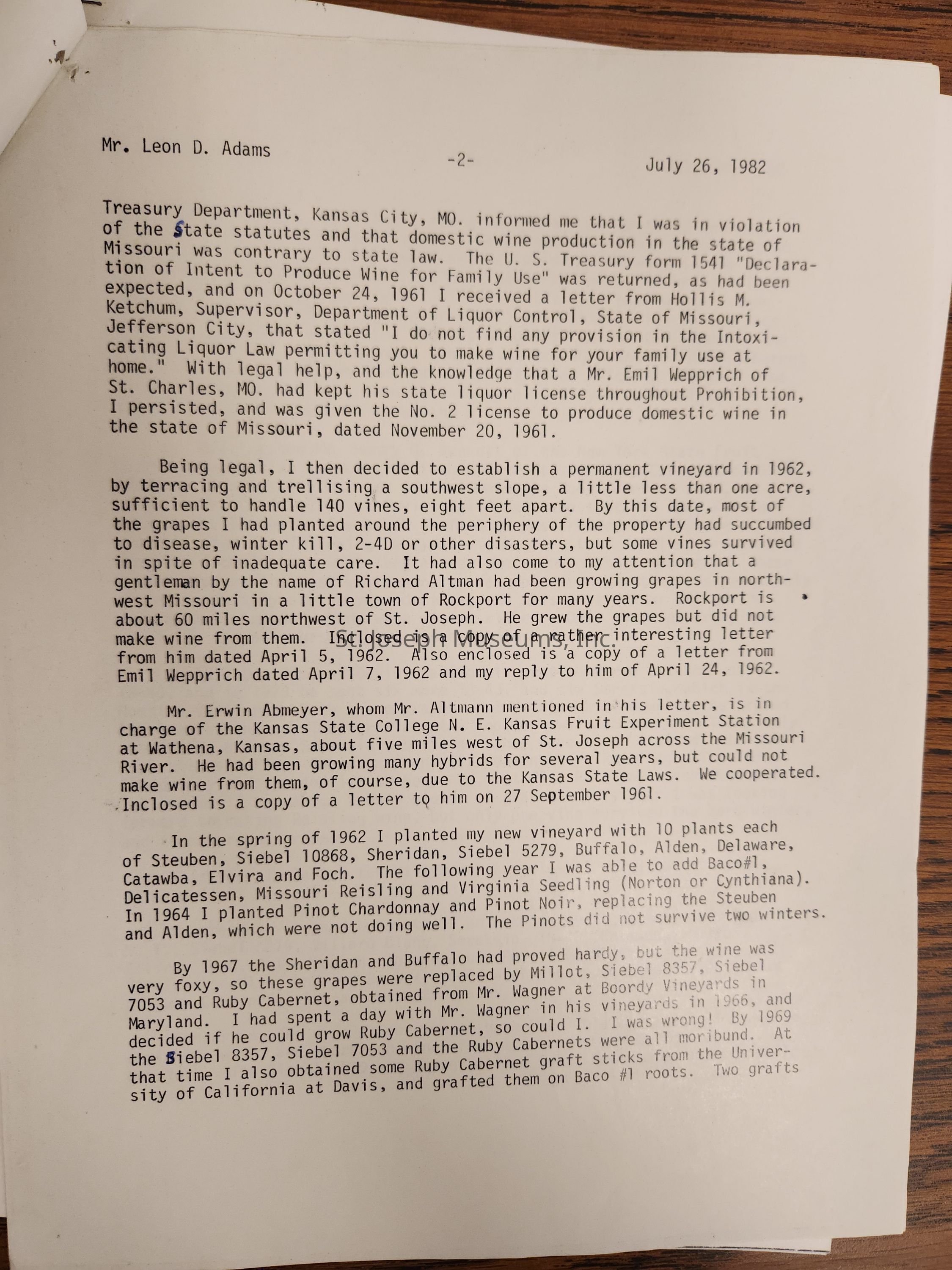
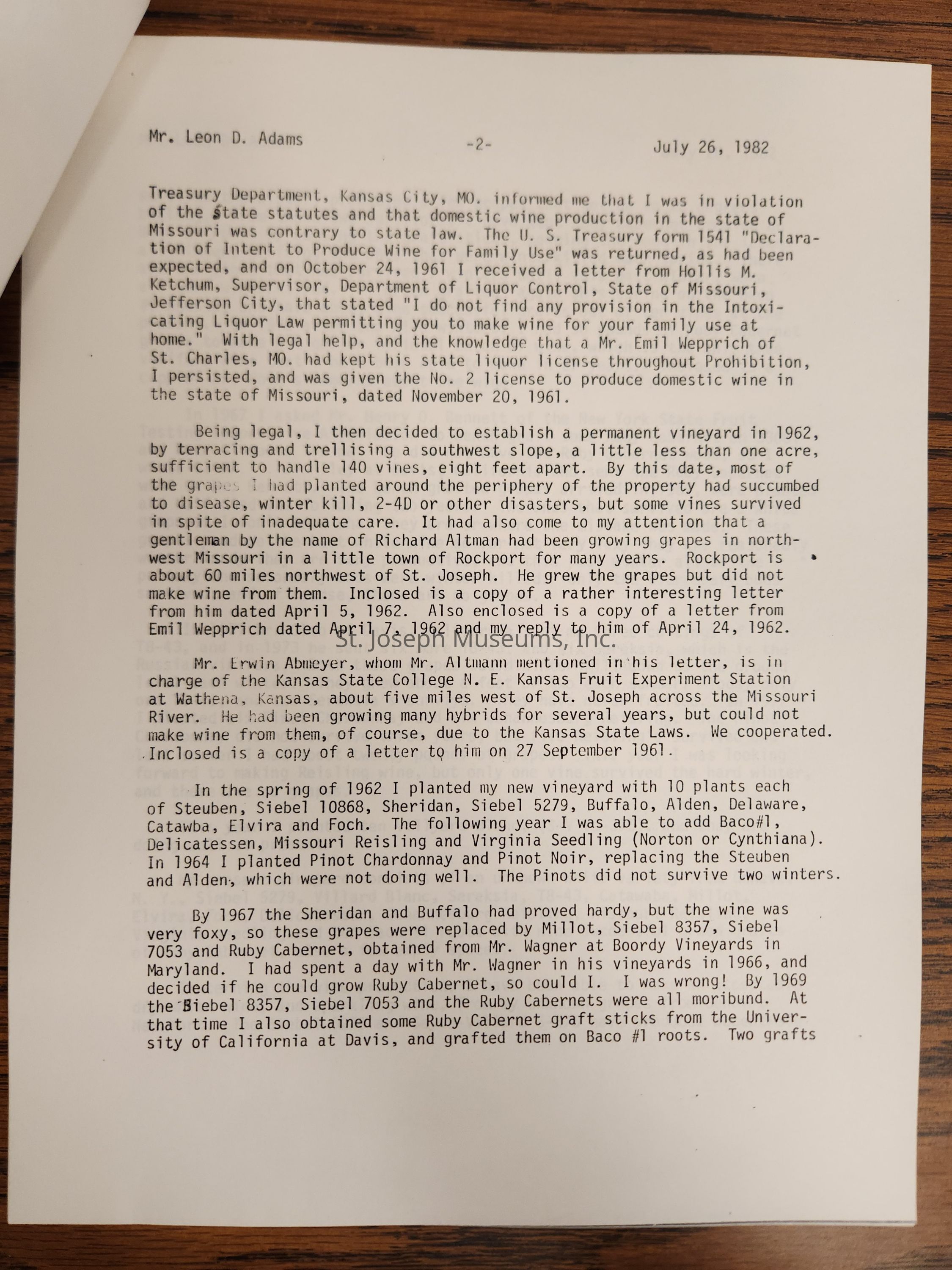
In 1960, since I was making some wine, I tried to get "legit". The supervisor in charge of the Alcohol and Tobacco Tax Unit of the U. S. Treasury . . . informed me that I was in violation of the State statues and that domestic wine production in the state of Missouri was contrary to state law. . . . . . . . With legal help, and the knowledge that Mr . . Wepprich . . . had kept his state license . . . I persisted, and was given the No. 2 license to produce wine , . . .dated November 20, 1961.
Being legal, I then decided to establish a permanent vineyard in 1962, sufficient to handle 140 vines, . . . By this date, most of the grapes I had planted . . . succumbed to disease, winter kill, 2-4D or other disasters. . . . . . It come to my attention that Richard Altman had been growing grapes in northwest Missouri, . . . . but did not make wine from them. Enclosed is a copy of a letter from him dated April 5, 1962. . . . Also . . . a letter from Emil Wepprich, . . and my reply to him . .
Mr. Erwin Abmeyer, . . . is in charge of the Kansas State College . . Fruit Experiment Station. . . . He had been growing many hybrids for several years, but could not make wine from them, due to Kansas State Laws. We cooperated. . . . . Inclosed is a copy of a letter to him on 27 September 1961.
In the spring of 1962 I planted my new vineyard with 10 plants each of . . . ., . . . , . . ., . . , . . . , and . . . The following year I was able to add . . . , . . . , . . ., and. In 1964nIplanted . . . and . . . , replacing the . . . and . . . which were not doing well. The Pinots did not survive two winters.
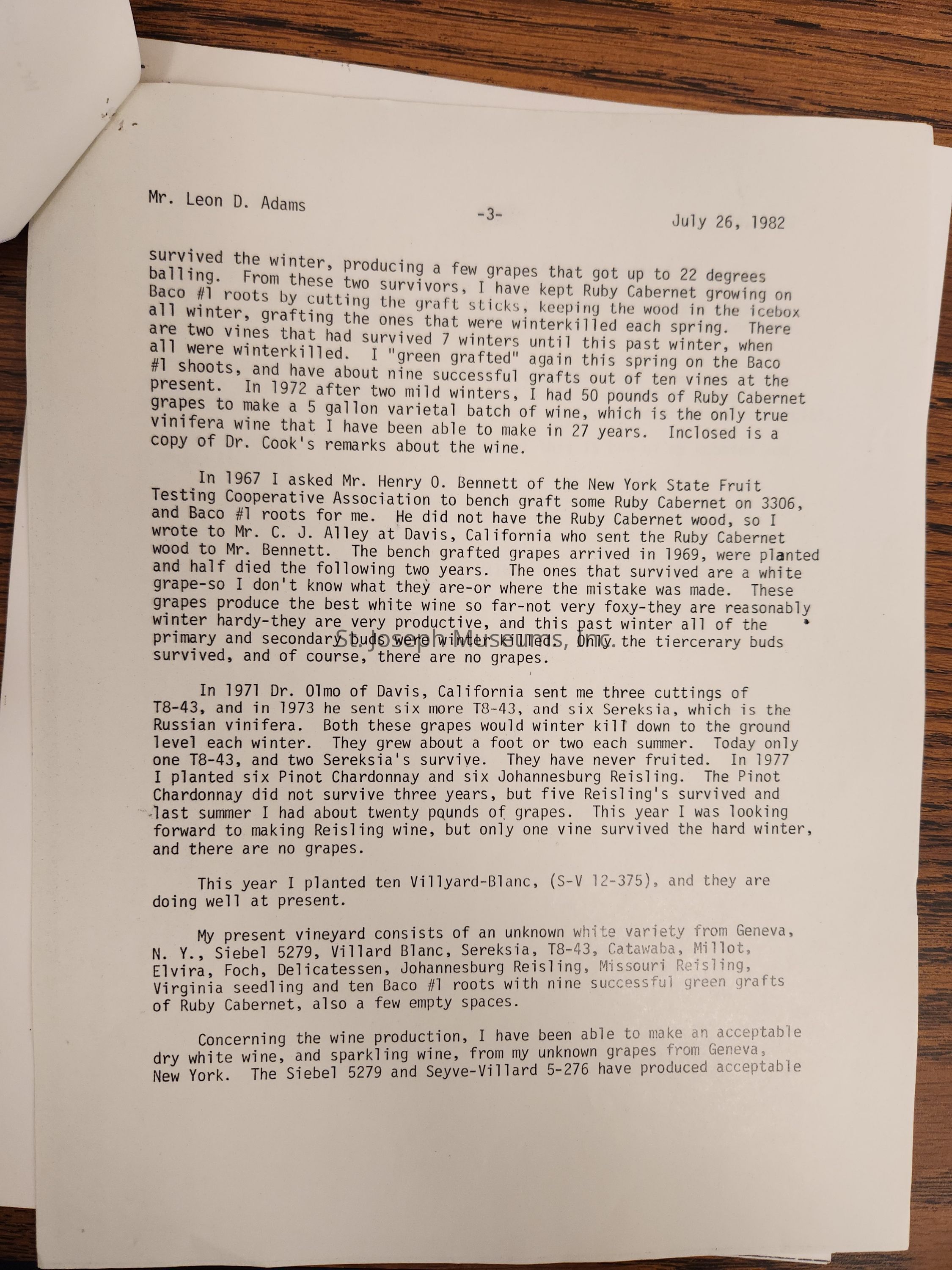
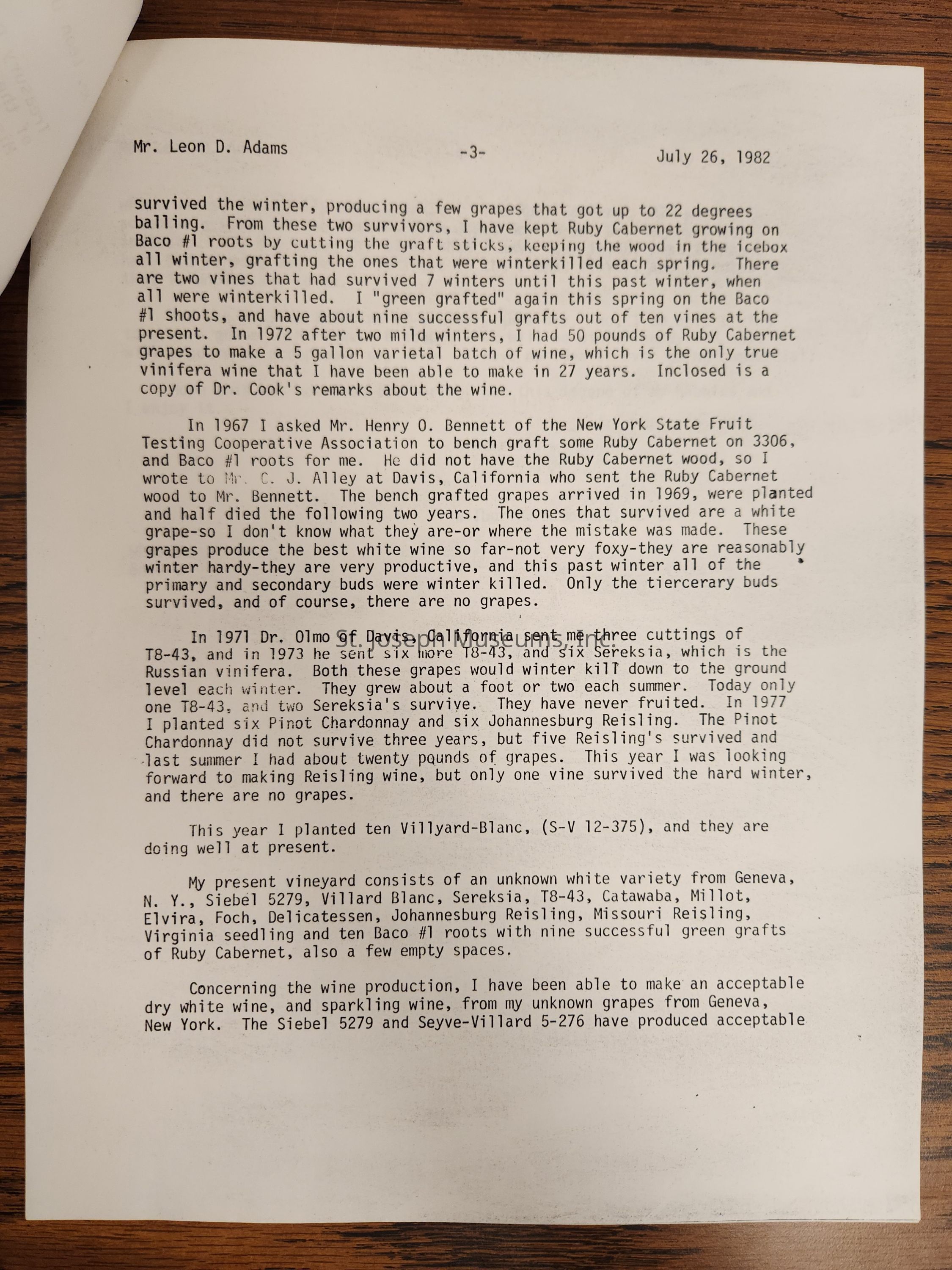
By 1967 the Sheridan and Buffalo had proved hardy, but the wine was very foxy, so these grapes were replaced by . . . . . . . . . obtained from Mr. Wagner at Boordy Vineyards in Maryland. I had spent a day with Mr. Wagner in . . . 1966, and decided if he could grow Ruby Cabernet, so could I. I was wrong! . . . . . . At that time I also obtained some Ruby Cabernet graft sticks from the University of California, . . . . . . . . . . . In 1972 after two mild winters, I had 50 pounds of Ruby Cabernet rapes to make a 5gallon batch of wine. . . . .Inclosed is a copy of Dr. Cook's remarks about the wine.
In 1967 I asked Mr. . . . Bennett . . . . to bench graft some Ruby Cabernet . . . . for me. he did not have Ruby Cabernet wood. . . so Mr. . . . Alley sent to wood to Mr. Bennett. The bench grafted grapes . . . . , were planted and half died . . . The ones that survived are a white grape- . . . . These grapes produced the best white wine so far-not very foxy-they are reasonably winter hardy-. . . very productive, . . . all the primary and secondary buds were winter killed. Only the tiercerary buds survived, . . there were no grapes.
In 1971 Dr. Olmo of Davis, sent me three cuttings of T8-43, and in 19973 . . . six more T8-43, and six Sereksia , . . . Both these grapes would winter kill . . . They grew about a foot or two . . . Today only one T8-43and two Sereksia's survive. They have never fruited. . . . . . . . This year I was looking forward to making Reisling wine, but only one vine survived the hard winter and there were no grapes.
This year I planted ten Villyard-Blanc, . . . , and they are doing well at present.
My present vineyard consists of an unknown white variety from Geneva, N.Y. . , . . , . . , . . and ten Baco #1 roots with nine successful green grafts of Ruby Cabernet, also a few empty spaces.
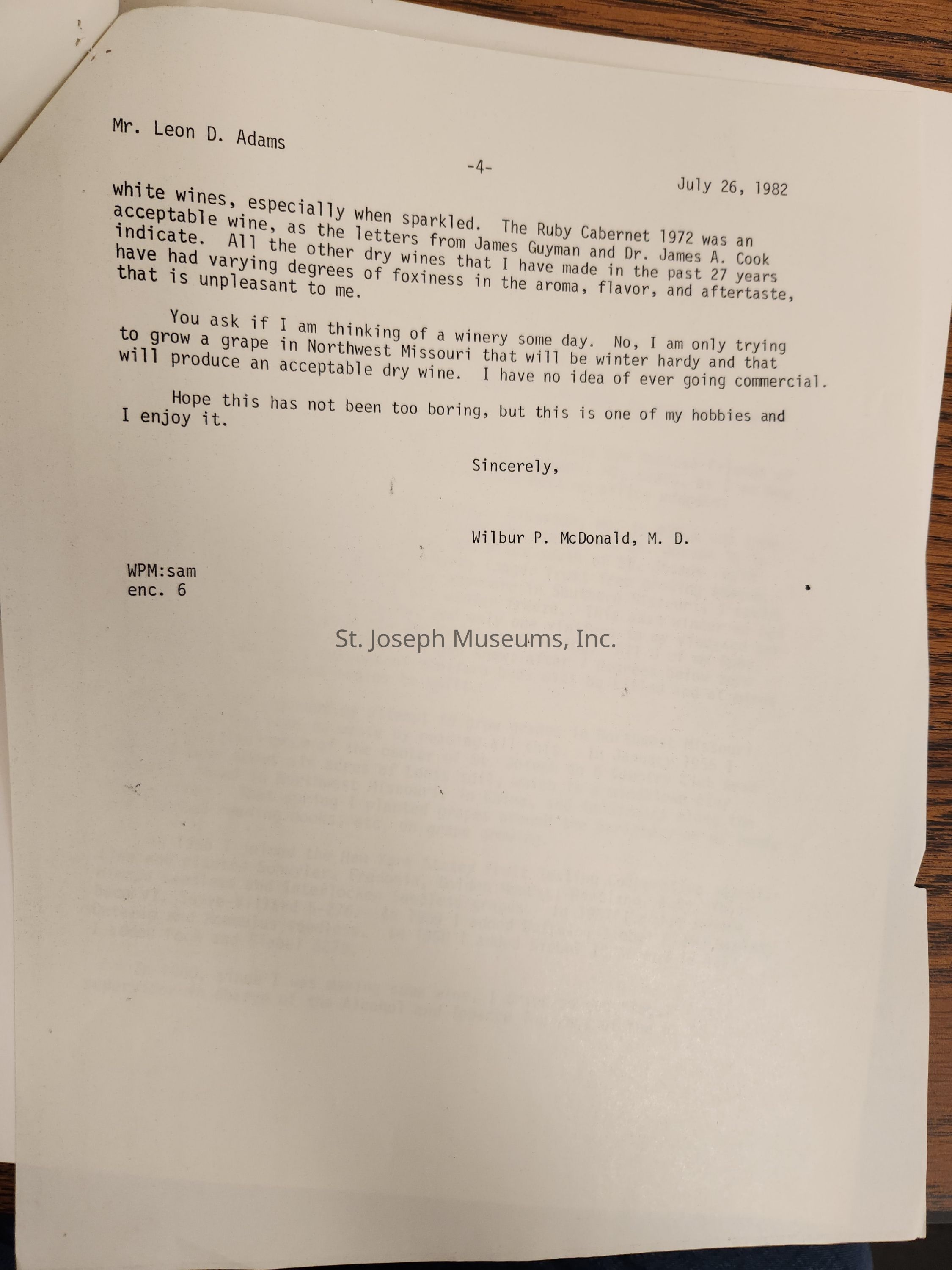
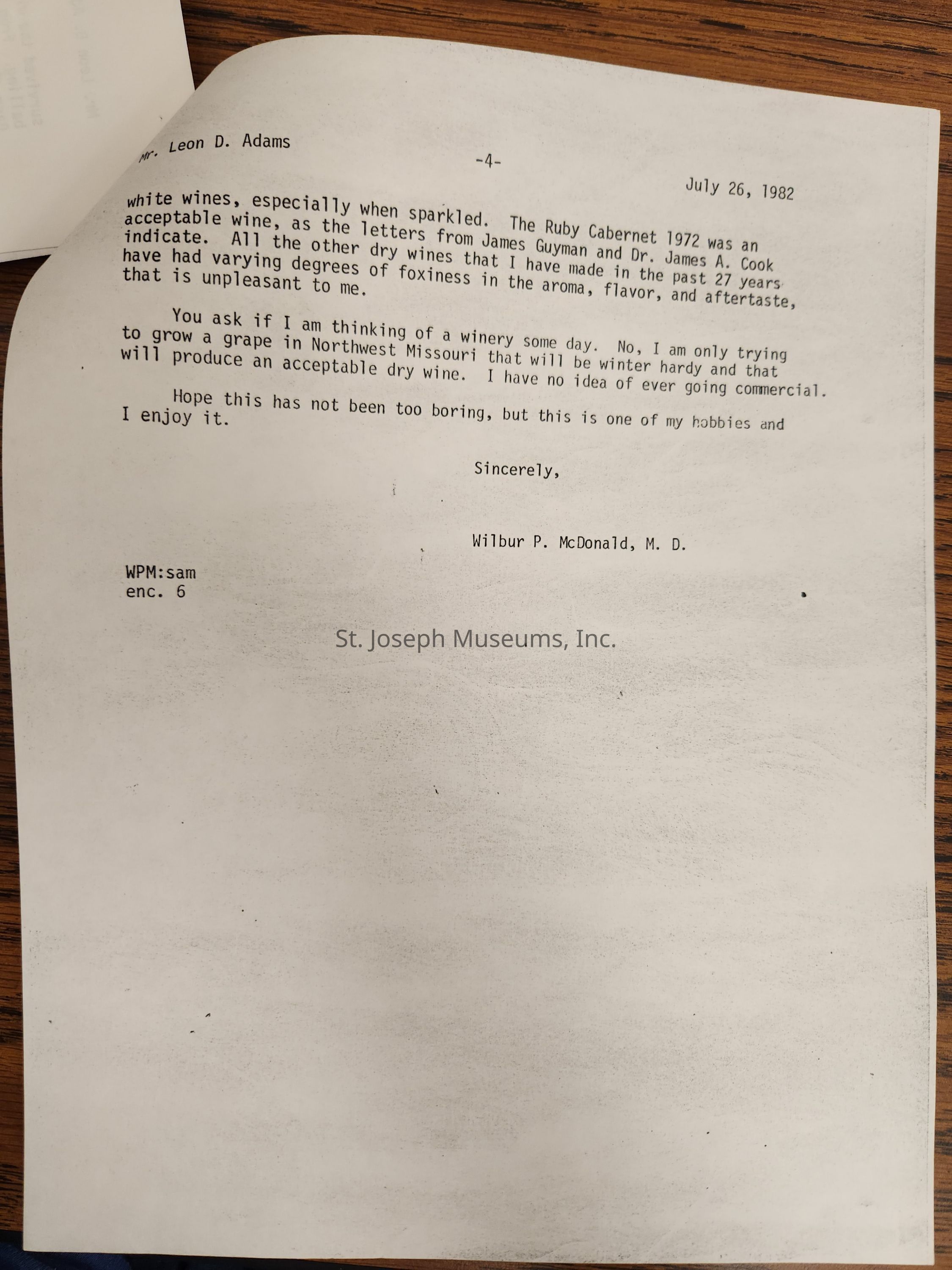
Concerning the wine production, I have been able to make an acceptable dry white, and sparkling wine, from my unknown grapes from Geneva, New York. The Seibel 5279 and Seyve-Villard 5-276 have produced acceptable white wines, . . . The Ruby Cabernet 1972 was an acceptable wine, . . . All the other dry wines that I have made in the past 27 years have had varying degrees of foxiness in the aroma, flavor, and aftertaste, that is unpleasant to me.
You ask if I am thinking of a winery some day. No, I am only trying to grow a grape in Northwest Missouri that will be winter hardy and that will produce an acceptable dry wine. I have no idea of ever going commercial.
Hope this has not bee too boring, but this is one of my hobbies and I enjoy it.
Sincerely,Lexicon
Nomenclature 4.0
Nomenclature Secondary Object Term
LetterNomenclature Primary Object Term
CorrespondenceNomenclature Sub-Class
Other DocumentsNomenclature Class
Documentary ObjectsNomenclature Category
Category 08: Communication ObjectsDimensions
Dimension Notes
8.5" x 11"