Name/Title
LetterEntry/Object ID
Q2022.21.149Scope and Content
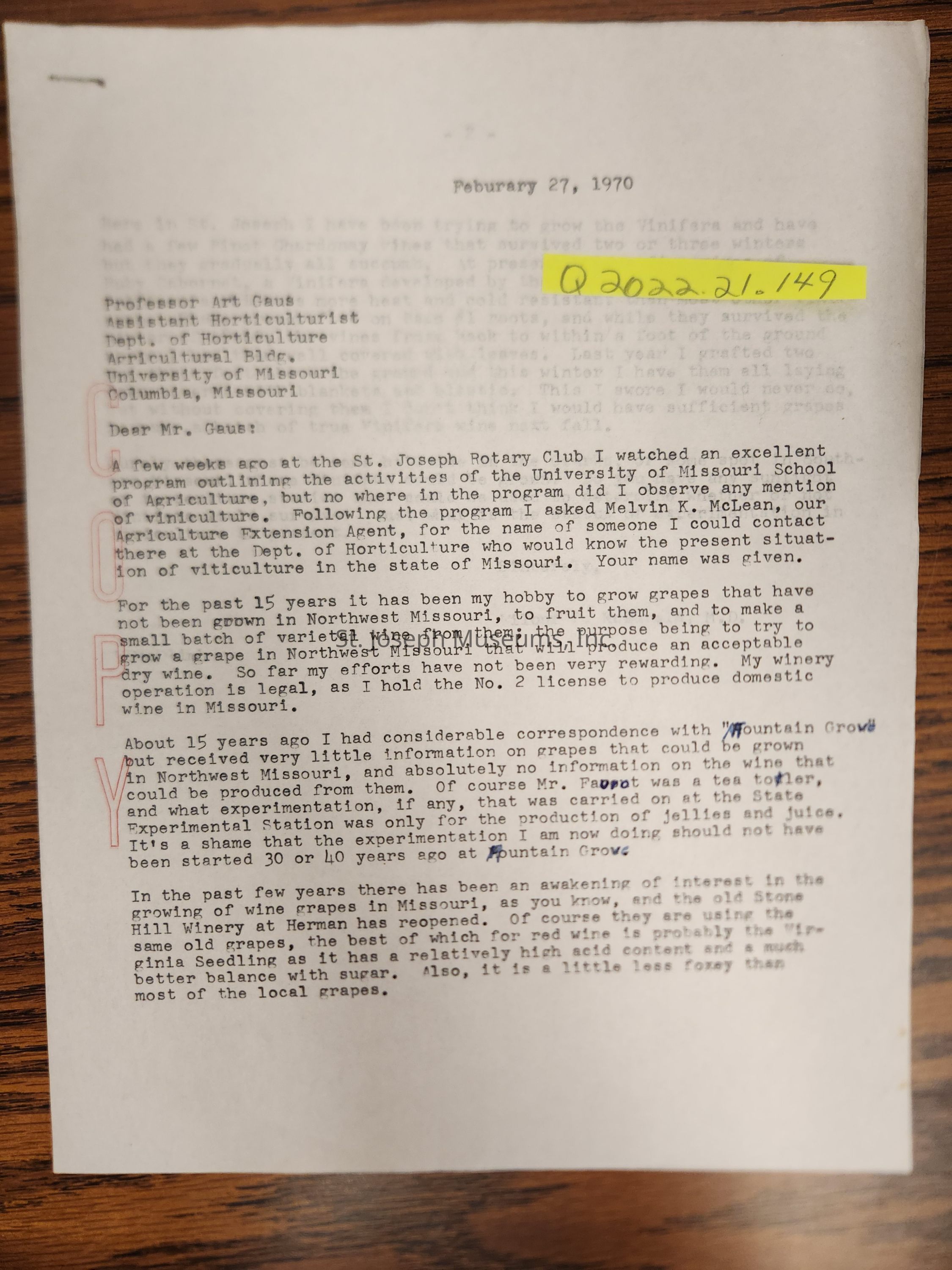
A copy of a two-page letter, on onion skin paper, from Wilbur P. McDonald, M. D., to Professor Art Gaus, Assistant Horticulturist, University of Missouri, Columbia, Missouri, dated February 27, 1970. The letters COPY in red ink are printed down the left hand side of the page.Context
Dear Mr. Gaus:
A few weeks ago . . . I watched an excellent program . . . of the University of Missouri School of Agriculture, but no where . . . did I observe any mention of viniculture. . . . , I asked Melvin K. McLean, . . . , for the name of someone I could contact there . . . who would know the present situation of viticulture in the State of Missouri. Your name was given.
For the past 15 years it has been my hobby to grow grapes that have not been grown in Northwest Missouri, to fruit them, . . to make a small batch of varietal wine from them; the purpose being to try to grow a grape in Northwest Missouri that will produce an acceptable dry wine. So far my efforts have not been very rewarding. My winery operation is legal, as I hold the No. 2 license to produce wine in Missouri.
About 15 years ago I . . . (corresponded) with "Mountain Grove" but received very little information on grapes that could be grown in Northwest Missouri, and absolutely no information on the wine that could be produced from them. . . . , what experimentation , . ., was carried on at the State Experimental Station was only for the production of jellies and juices. . . . the experimentation that I am now doing should . . have been started 30 or 40 years ago at Mountain Grove.
. . . there has been an awakening of interest in the growing of wine grapes in Missouri, . . ., the old Stone Hill Winery at Herman has reopened. Of course, they are using the same old grapes, the best of which for the red wine is probably the Virginia Seedling as it has relatively high acid content and a much better balance with sugar. Also, it is a little less foxey than most of the local grapes.
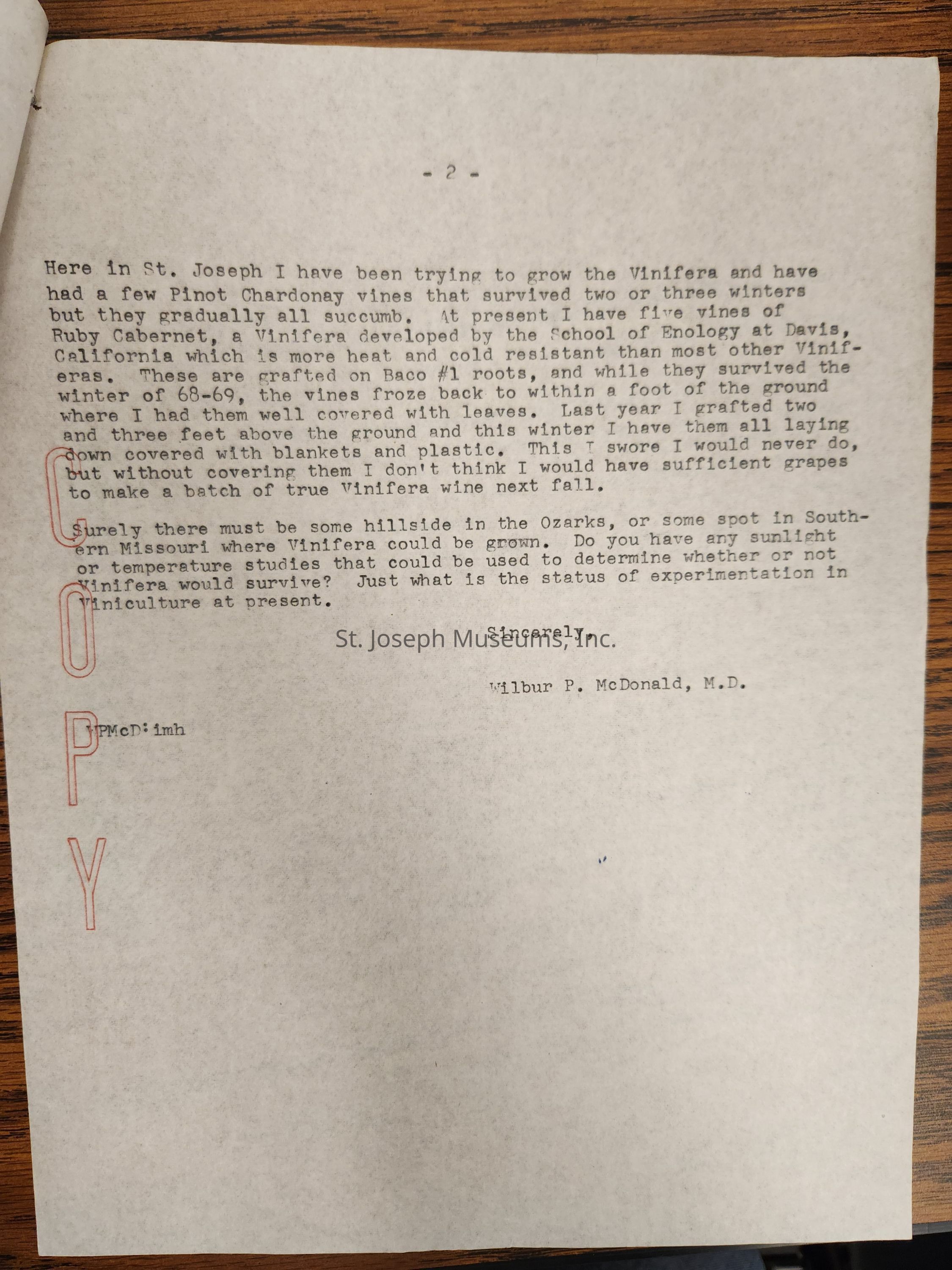
. . . I have been trying to grow the Vinifera and . . a few Pinot Chardonnay vines that survived two or three winters but gradually they all succumb. . . . I have five vines of Ruby Cabernet, a Vinifera . . . which is more heat and cold resistant than most other(s). . . These are grafted on Baco #1 roots, . . . they survived the winter of 68-69, (but) the vines froze back to within a foot of the ground where I had them covered with leaves. Last year I grafted two and three feet above the ground and this winter I have them all laying down covered with blankets and plastic. . . . , without covering them I don't think I would have sufficient grapes to make a batch of true Vinifera wine next fall.
Surely there must be some hillside in the Ozarks, or some spot in Southern Missouri where Vinifera could be grown. Do you have any sunlight or temperature studies that could be used to determine whether or not Vinifera would survive? Just what is the status of experimentation in Viniculture at present.
Sincerely,Lexicon
Nomenclature 4.0
Nomenclature Secondary Object Term
LetterNomenclature Primary Object Term
CorrespondenceNomenclature Sub-Class
Other DocumentsNomenclature Class
Documentary ObjectsNomenclature Category
Category 08: Communication ObjectsDimensions
Dimension Notes
8.5" x 11"