Name/Title
Letter from Francis LaFlesche to Harry GeorgeEntry/Object ID
Q1430.635.7CDescription
Vol II pg. 7C
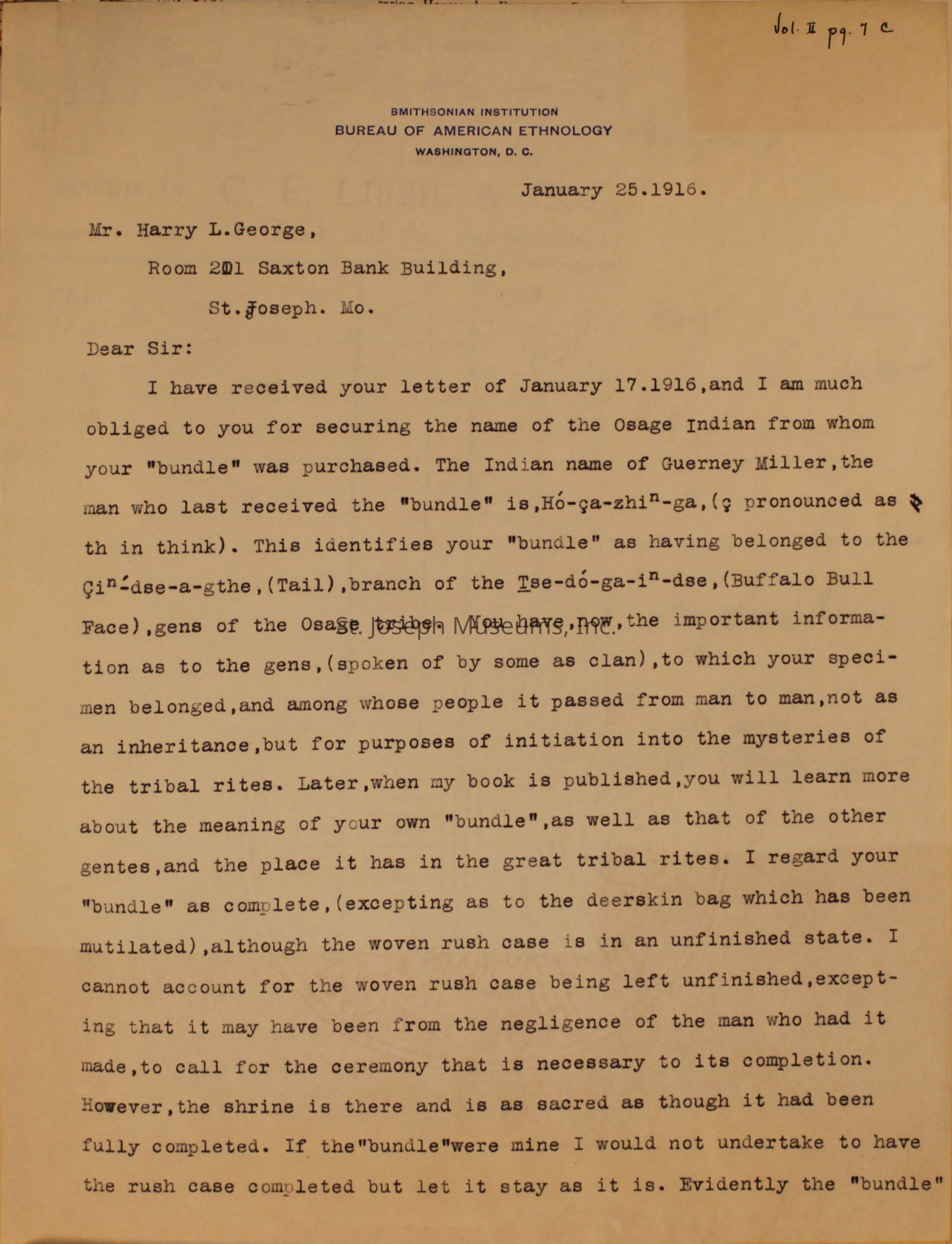
Letter from Francis LaFlesche to Harry George providing information on George's Osage and Winnebago bundles
January 25. 1916.
Mr. Harry L. George,
Room 201 Saxton Bank Building,
St. Joseph, Mo.
Dear Sir:
I have received your letter of January 17. 1916, and I am much obliged to you for securing the name of the Osage Indian from whom your “bundle” was purchased. The Indiana name of Guerney Miller, the man who last received the “bundle” is , Ho-ca-zhin-ga (c pronounced as th in think). This identifies your “bundle” as having belonged to the Cin-dse-a-gthe, (Tail), branch of the Tse-do-ga-in-dse, (Buffalo Bull Face), gens of the Osage tribe. You have, now, the important information as to the gens, (spoken of by some as a clan), to which your specimen belonged, and among whose people it passed from man to man, not as an inheritance, but for purposes of intiation into the mysteries of the tribal rites. Later, when my book is published, you will learn more about the meaning of your own “bundle”, as well as that of the other gentees, and the place it has in the great tribal rites. I regard your “bundle” as complete, (excepting as to the deerskin bag which has been mutilated), although the woven rush case is in an unfinished state. I cannot account for the woven rush case being left unfinished, excepting that it may have been from the negligence of the man who had it made, to call for the ceremony that is necessary to its completion. However, the shrine is there and is as sacred as though it had been fully completed. If the “bundle” were mine I would not undertake to have the rush case completed but let it stay as it is. Evidently the “bundle” is one of the oldest. I am sure that the “battle az” does not belong to it.
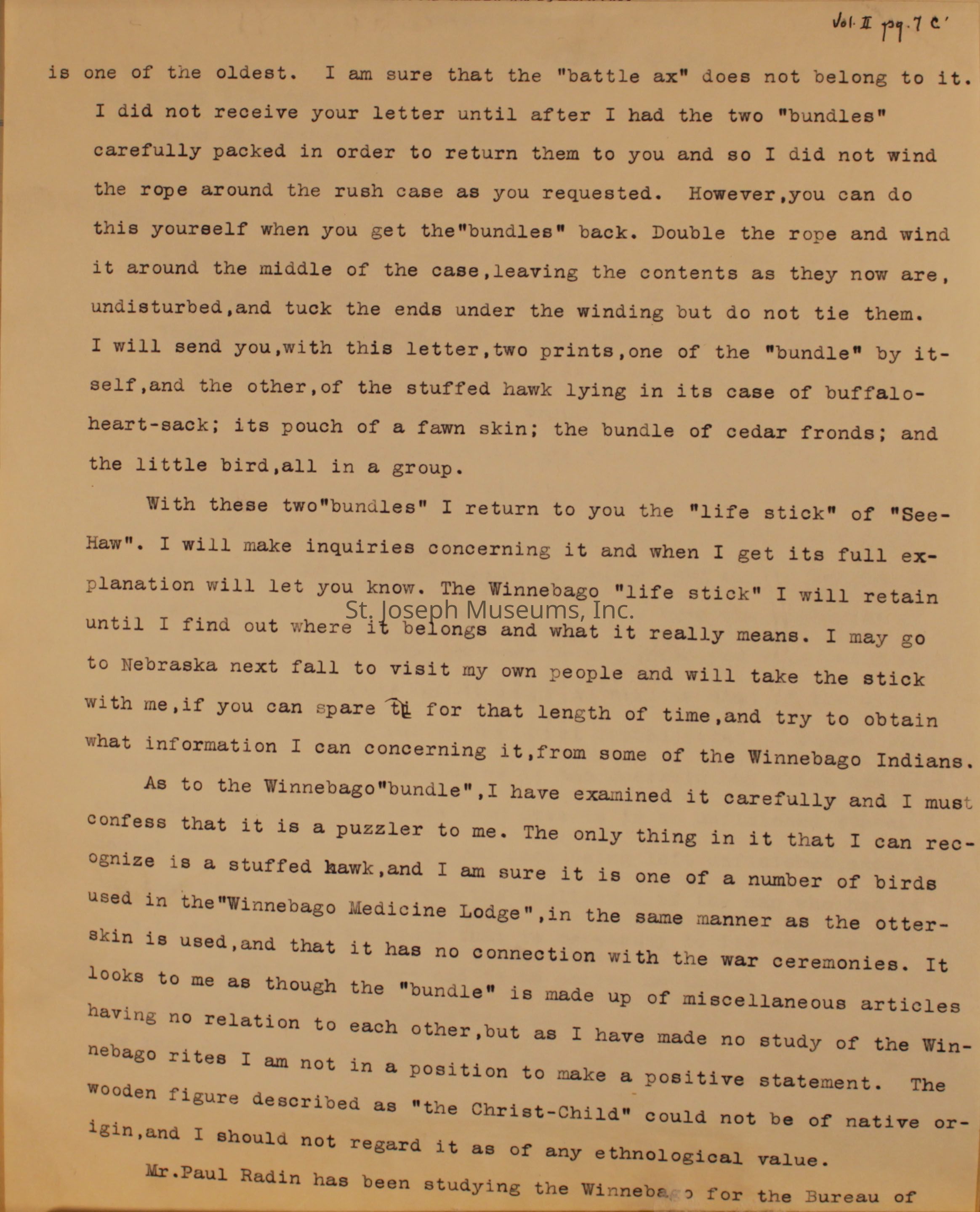
I did not receive your letter until after I had the two “bundles” carefully packed in order to return them to you and so I did not wind the rope around the rush case as you requested. However, you can do this yourself when you get the “bundles” back. Double the rope and wind it around the middle fo the case, leaving the contents as they now are, undisturbed, and tuck the ends under the winding but do not tie them. I will send you, with this letter, two prints, one of the “bundle” by itself, and the other, of the stuffed hawk lying in its case of buffalo-heart-sack; its pouch of a fawn skin; the bundle of cedar fronds; and the little bird, all in a group.
With these two “bundles” I return to you the “life stick” of “See-Haw”. I will make inquiries concerning it and when I get its full explanation will let you know. The winnebago “life stick” I will retain until I find out where it belongs and what it really means. I may go to Nebraska next fall to visit my own people and will take the stick with me, if you can spare it for that length of time, and try to obtain what information I can concerning it, from some of the Winnebago Indians.
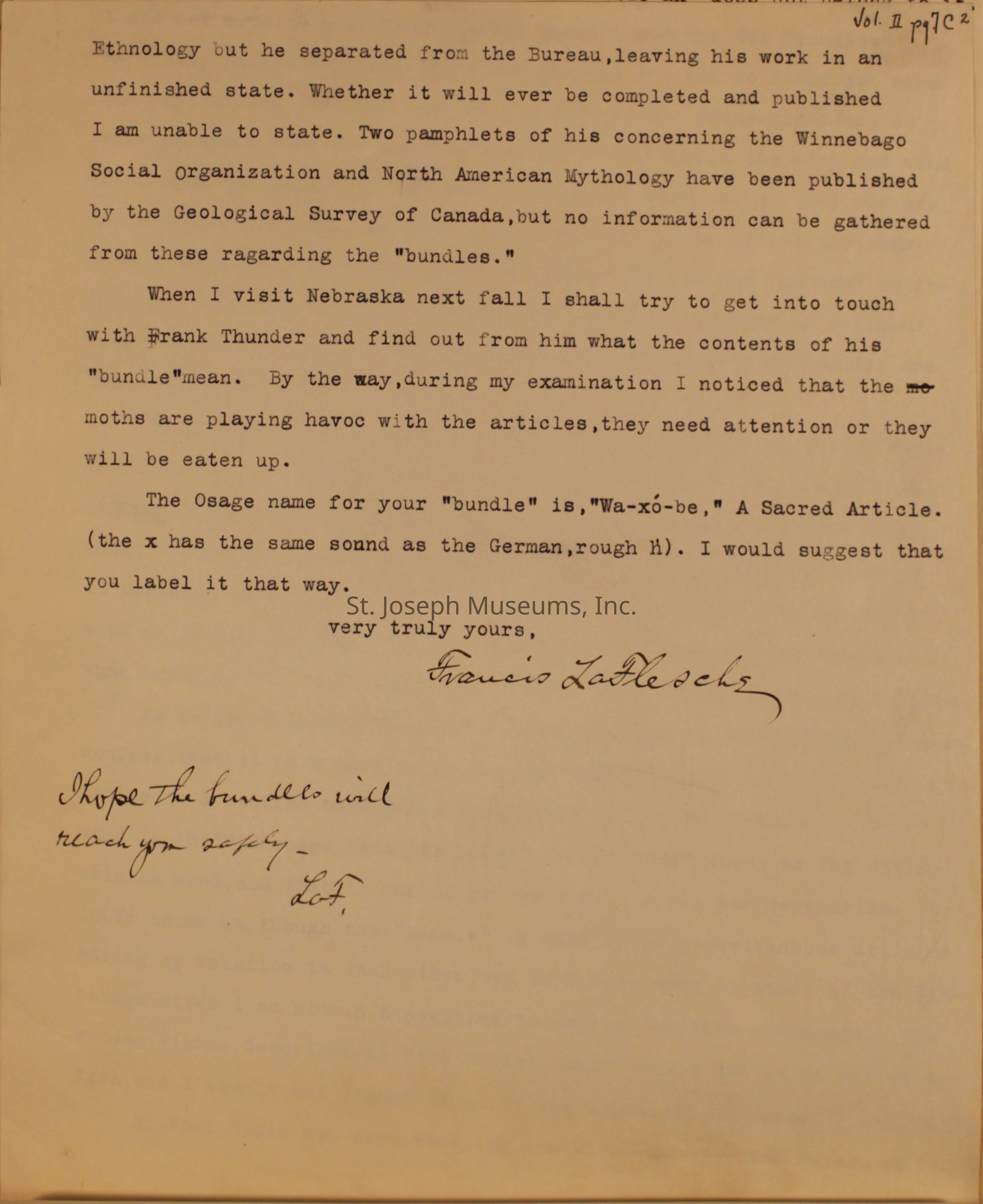
As to the Winnebago “bundle”, I have examined it carefully and I must confess that it is a puzzler to me. The only thing in it that I can recognize is a stuffed hawk, and I am sure it is one of a number of birds used in the “Winnebago Medicine Lodge”, in the same manner as the otter-skin is used, and that it has no connection with the war ceremonies. It looks to me as though the “bundle” is made up of miscellaneous articles having no relation to each other, but as I have made no study of the Winnebago rites I am not in a position to make a positive statement. The wooden figure described as “the Christ-Child” could not be of native origin, and I should not regard it as of any ethnological value. Mr. Paul Radin has been studying the Winnebago for the Bureau of Ethnology but he separated from the Bureau, leaving his work in an unfinished state. Whether it will ever be completed and published I am unable to state. Two pamphlets of his concerning the Winnebago Social Organization and North American Mythology have been published by the Geological Survey of Canada, but no information can be gathered from these regarding the “bundles.”
When I visit Nebraska next fall I shall try to get into touch with Frank Thunder and find out from him what the contests of his “bundle” mean. By the way, during my examination I noticed that the moths are playing havoc with the articles, they need attention or they will be eaten up.
The Osage name for your “bundle” is Wa-xo-be,” A Sacred Article. (the x has the same sound as the German rough h). I would suggest that you label it that way.
Very truly yours,
Francis LaFlescheSubject
LaFlesche, Francis
Smithsonian Institution
Bureau of American Ethnology
Washington, D.C.
Bundle -- Osage
Bundle -- Winnebago
Osage
Winnebago
Radin, Dr. PaulSubject Person/Organization
Harry L. George Collection