Name/Title
Mrs. Menifee's Black Opal, Short Story by Mary Alicia OwenEntry/Object ID
AM2013.3.72Scope and Content
Mrs. Menifee's Black Opal, Short Story by Mary Alicia Owen. About an elusive stone in the lives of St. Joseph residents. 13 pages. Typewritten.
For Transcript, click on the Multimedia button on top menu, then open the Word File.Context
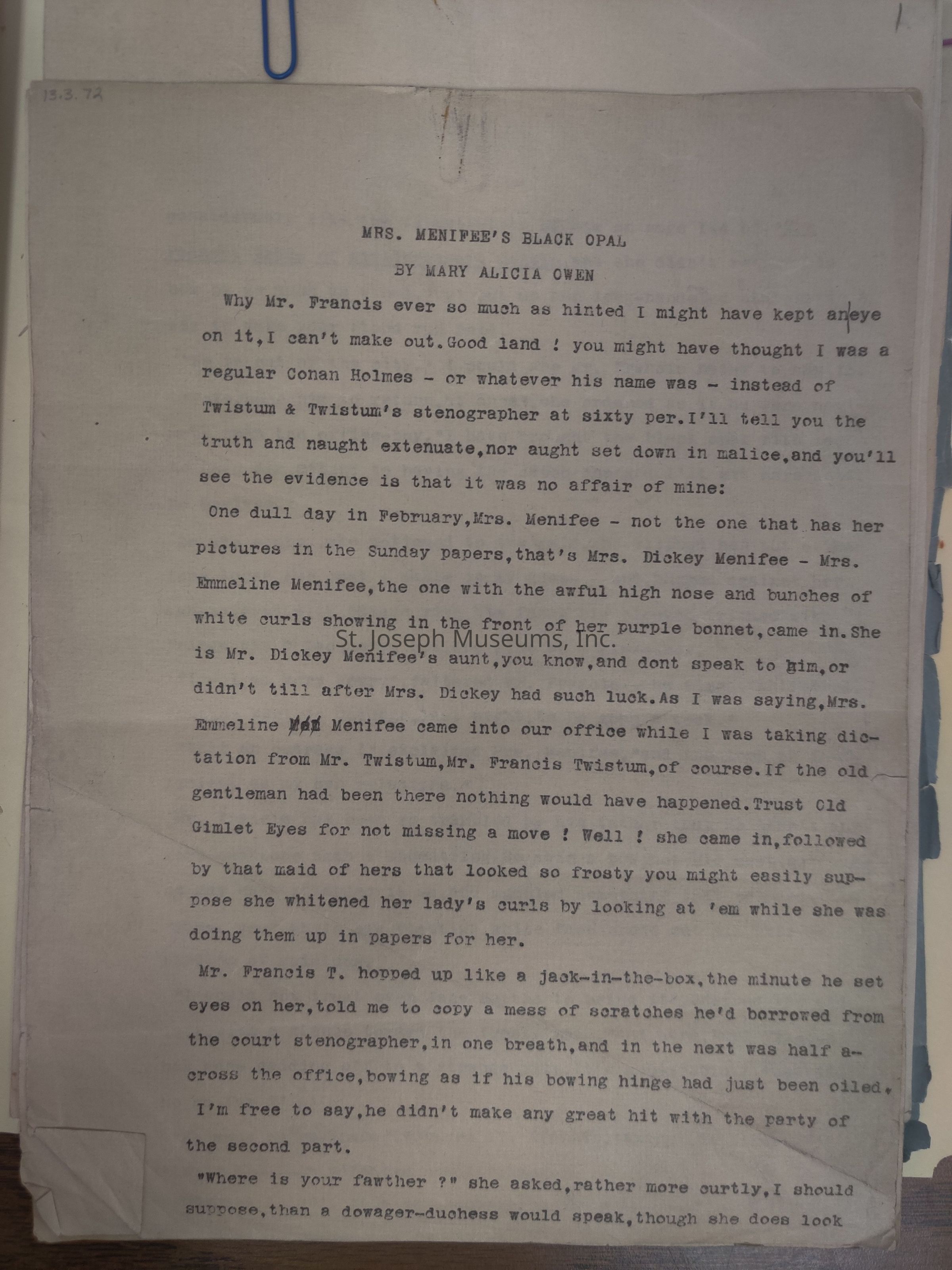
Mrs. Menifee's Black Opal
By Mary Alicia Owen
Why Mr. Francis ever so much as hinted I might have kept an eye on it, I can't make out. Good land! You might have thought I was a regular Conan Holmes- or whatever his name was- instead of Twistum and Twistum's stenographer at sixty per. I'll tell you the truth and naught extenuate, nor aught set down in malice, and you'll see the evidence is that it was no affair of mine:
One dull day in February, Mrs. Menifee - not the one that has her pictures in the Sunday paper's, that's Mrs. Dickey Meniff - Mrs. Emmeline Menifee, the one with the awful high nose and bunches of white curls showing in the front of her purple bonnet, came in. She is Mr. Dickey Manifee's aunt, you know, and don't speak to him, or didn't till after Mrs. Dicky had such luck. As I was saying, Mrs. Emmeline Menifee came into our office while I was taking dictation from Mr. Twistum, Mr. Francis Twistum, of course. If the old gentleman had been there nothing would have happened. Trust Old Gimlet Eyes for not missing a move! Well! she came in, followed by that maid of hers that looked so frosty you might easily suppose she whitened her lady's curls by looking as 'em while she was doing them up in papers for her.
Mr. Francis T. hopped up like a jack-in-the-box, the minute he set eyes on her, told me to copy a mess of scratches he'd borrowed from the court stenographer, in one breath, and in the next half across the office, bowing as if his bowing hinge had just been oiled. I'm free to say, he didn't make any great hit with the party of the second part.
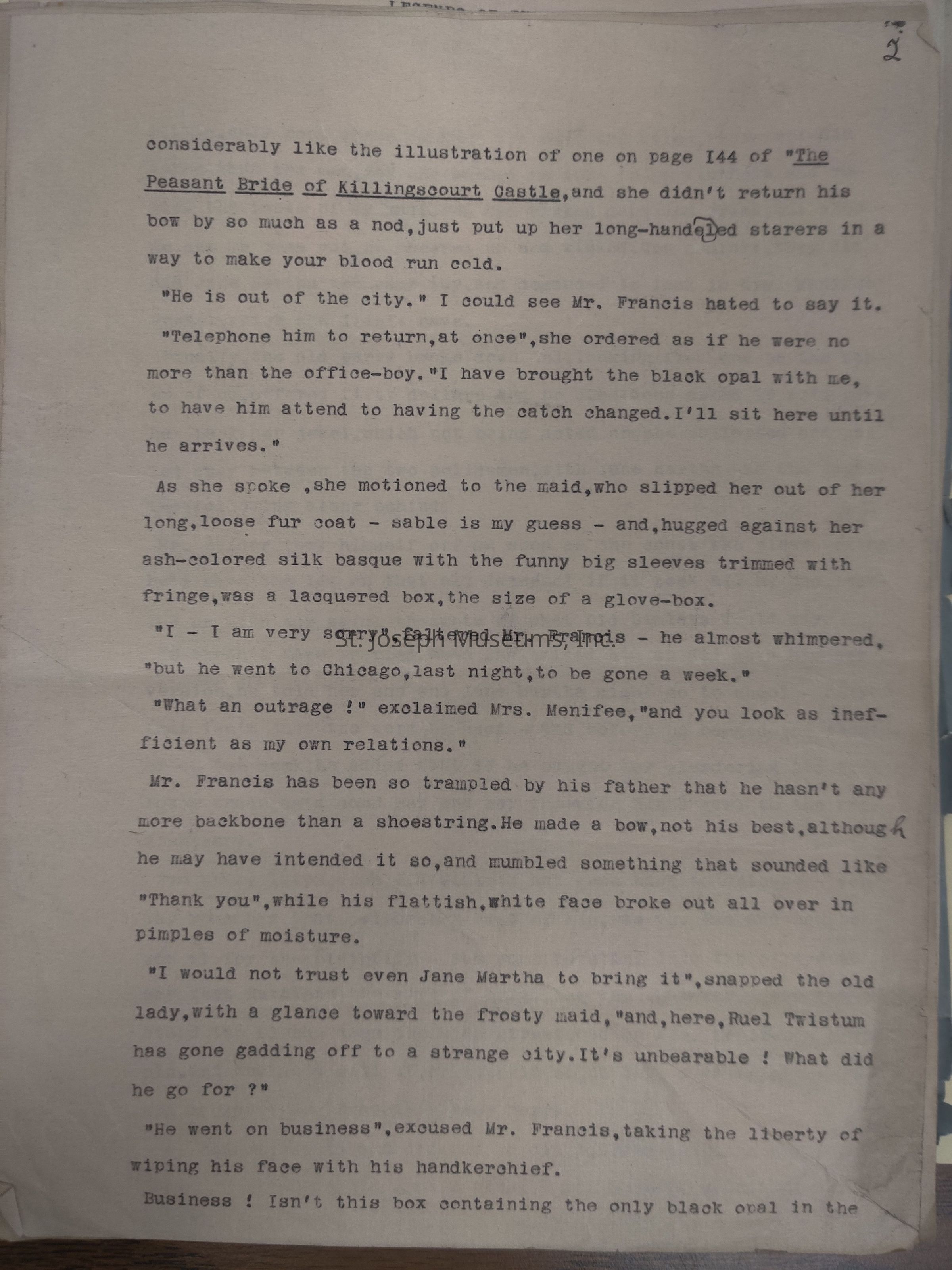
"Where is your fawther?" she asked, rather more curtly, I should suppose, than a dowager-dutchess would speak, though she does look considerably like the illustration of one on page 144 of "The Peasant Bridge of Killingscourt Castle, and she didn't return his bow by so much as a nod, just put her long handled starers in a way to make your blood run cold.
"He is out of the city," I could see Mr. Francis hated to say it.
"Telephone him to return, at one", she ordered as if he were no more than the office-boy. "I have brought the black opal with me, to have him attend to having the catch changed, I'll sit here until he arrives."
As she spoke, she motioned to the maid, who slipped her out of her long, loose fur coat-sable is my guess- and, hugged against her ash-colored silk basque with the funny big sleeves trimmed with fringe, was a lacquered box, the size of a glove box.
"I -I am very sorry", faltered Mr. Francis- he almost whimpered, "but he went to Chicago, last night, to be gone a week."
"What an outrage!" exclaimed Mrs. Menifee, "and you look as inefficient as my own relations."
Mr. Francis has been so trampled by his father that he hasn't any more backbone than a shoestring. He made a bow, not his best, although he may have intended it so, and mumbled something that sounded like "Thank you", while his flattish, white face broke out all over again in pimples of moisture.
"I would not trust even Jane Martha to bring it", snapped the old lady, with a glance toward the frosty maid, "and, here, Ruel Twistum has gone gadding off to a strange city. It's unbearable; what did he go for?"
"He went on business", excused Mr. Francis, taking the liberty of wiping his face with his handkerchief.
Business! Isn't this box containing the only black opal in the
(PAGES 3-6 MISSING)
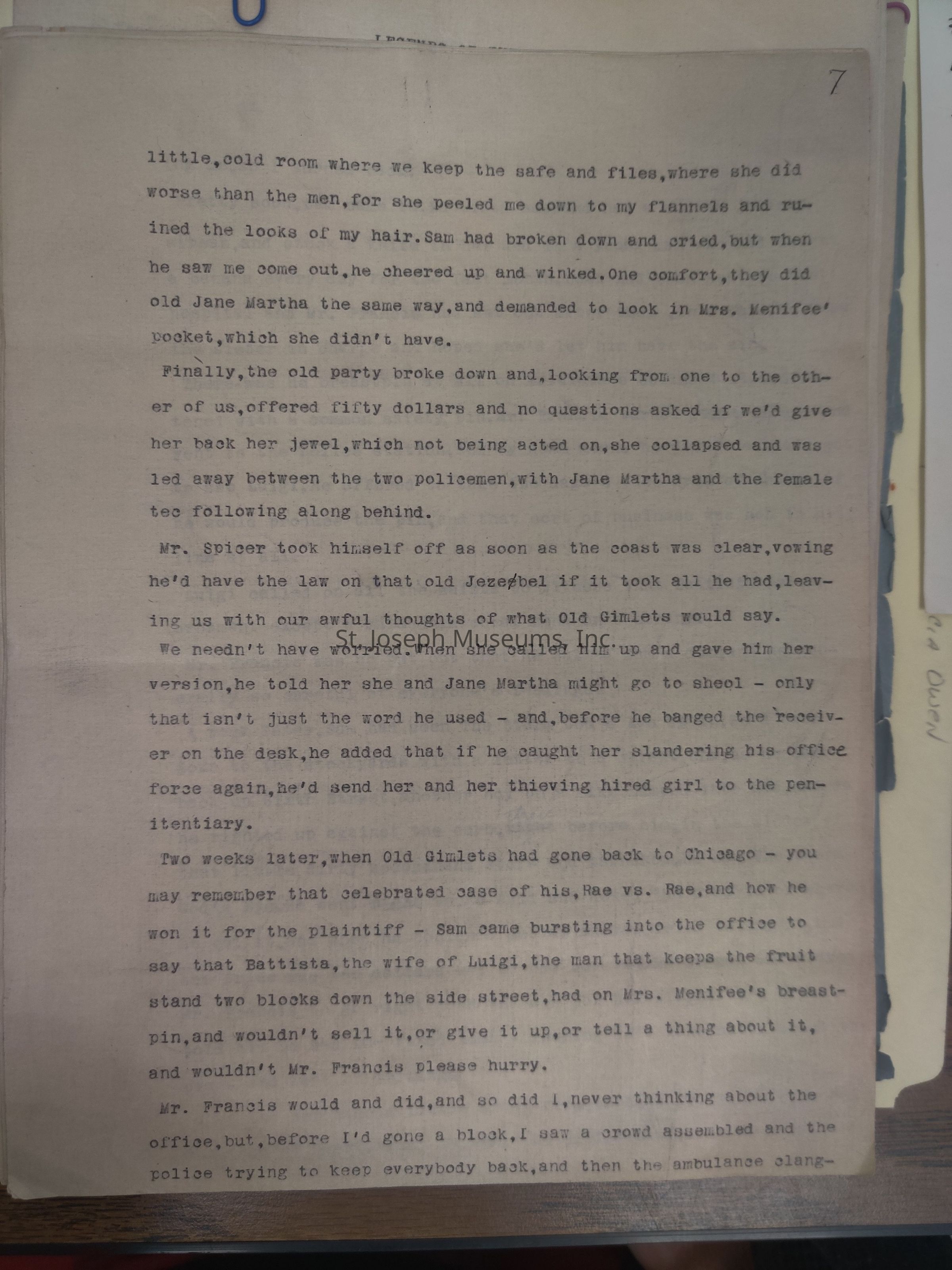
little, cold room where we keep the safe and files, where she did worse than the men, for she peeled me down to my flannels and rulined the looks of my hair. Sam had broken down and cried, but when he saw me come out, he cheered up and wink. One comfort, they did old Jane Martha the same way, and demanded to look in Mrs. Menifee's pocket, which she didn't have.
Finally, the old party broke down and, looking from one to the or of us, offered fifty dollars and no questions asked if we'd give her back her jewel, which not being acted on, she collapsed and was led away between the two policemen, with Jane Martha and the female tec following along behind.
Mr. Spicer took himself off as soon as the coast was clear, vowing he'd have the law on that old Jezebel if it took all he had, leaving us with our awful thoughts of what old Gimlets would say.
We needn't have worried. When she called him up and gave him her version, he told her she and Jane Martha might go to sheol- only that isn't just the word he used- and, before he banged the receiver on the desk, he added that if he caught her slandering his office force again, he'd send her and her thieving hired girl to the penitentiary.
Two weeks later, when Old Gimlets had gone back to Chicago- you may remember that celebrated case of his, Rae vs. Rae, and how he won it for the plaintiff - Sam came bursting into the office to say that Battista, the wife of Luigi, the man that keeps the fruit stand two blocks down the side of the street, had on Mrs. Menifee's breastpin, and wouldn't sell it, or give it up, or tell a thing about it, and wouldn't Mr. Francis please hurry.
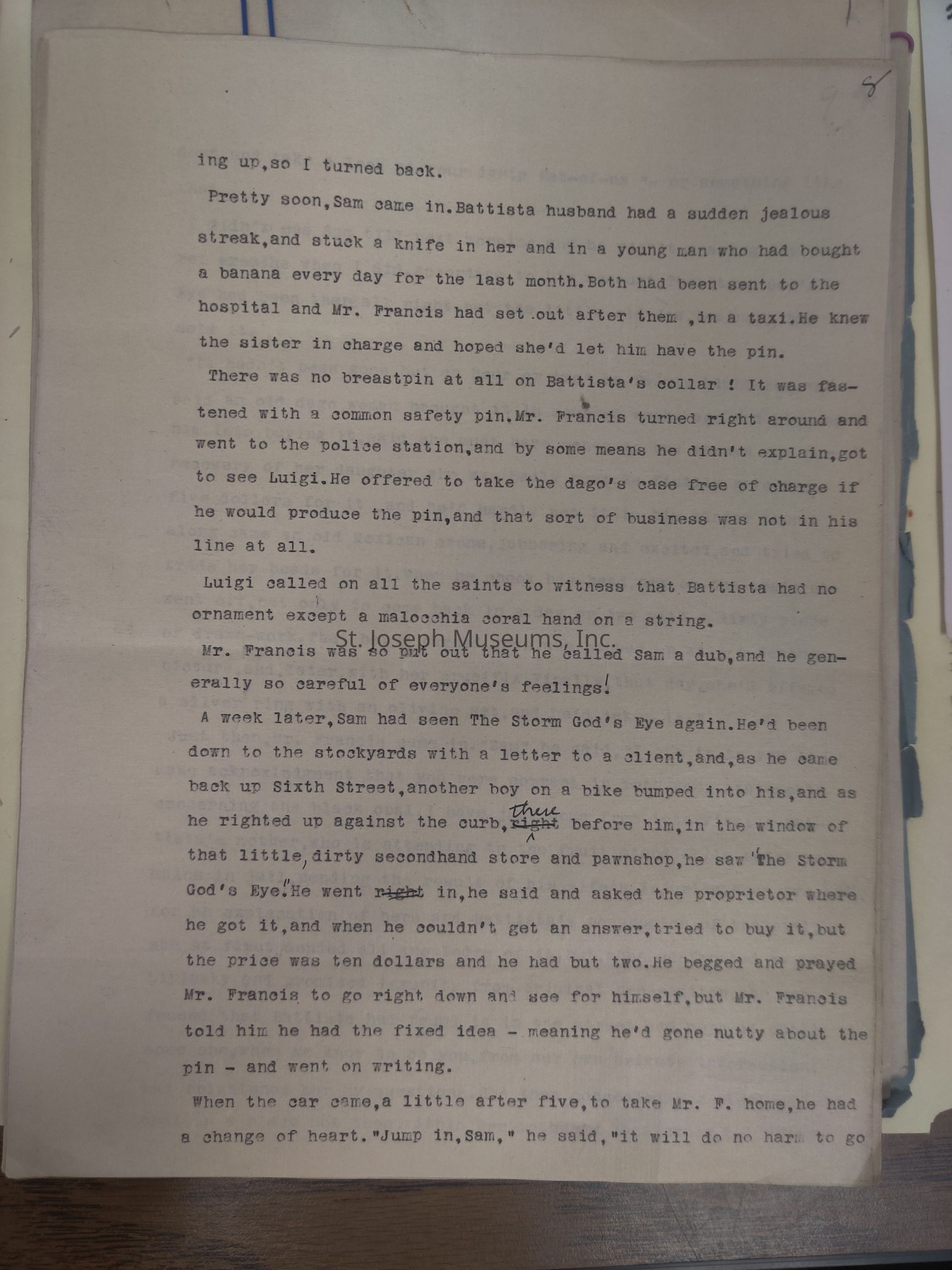
Mr. Francis would and did, and so did I, never thinking about the office, but, before I'd gone a block, I saw a crowd assembled and the police trying to keep everybody back, and then the ambulance clanging up, so I turned back.
Pretty soon, Sam came in. Battista husband had a sudden jealous streak, and stuck a knife in her and in a young man who had bought a banana every day for the last month. Both had been sent to the hospital and Mr. Francis had set out after them, in a taxi. He knew the sister in charge and hoped she'd let him have the pin.
There was no breastpin at all in Battisa's collar! It was fastened with a common safety pin. Mr. Francis turned right around and went to the police station, and by some means he didn't explain got to see Luigi. He offered to take the dago'd case free of charge if he would produce the pin, and that sort of business was not in his line at all.
Luigi called on all the saints to witness that Battista had no ornament except a malocchia coral hand on a string.
Mr. Francis was so put out that he called Sam a dub, and he generally so careful of everyone's feeling!
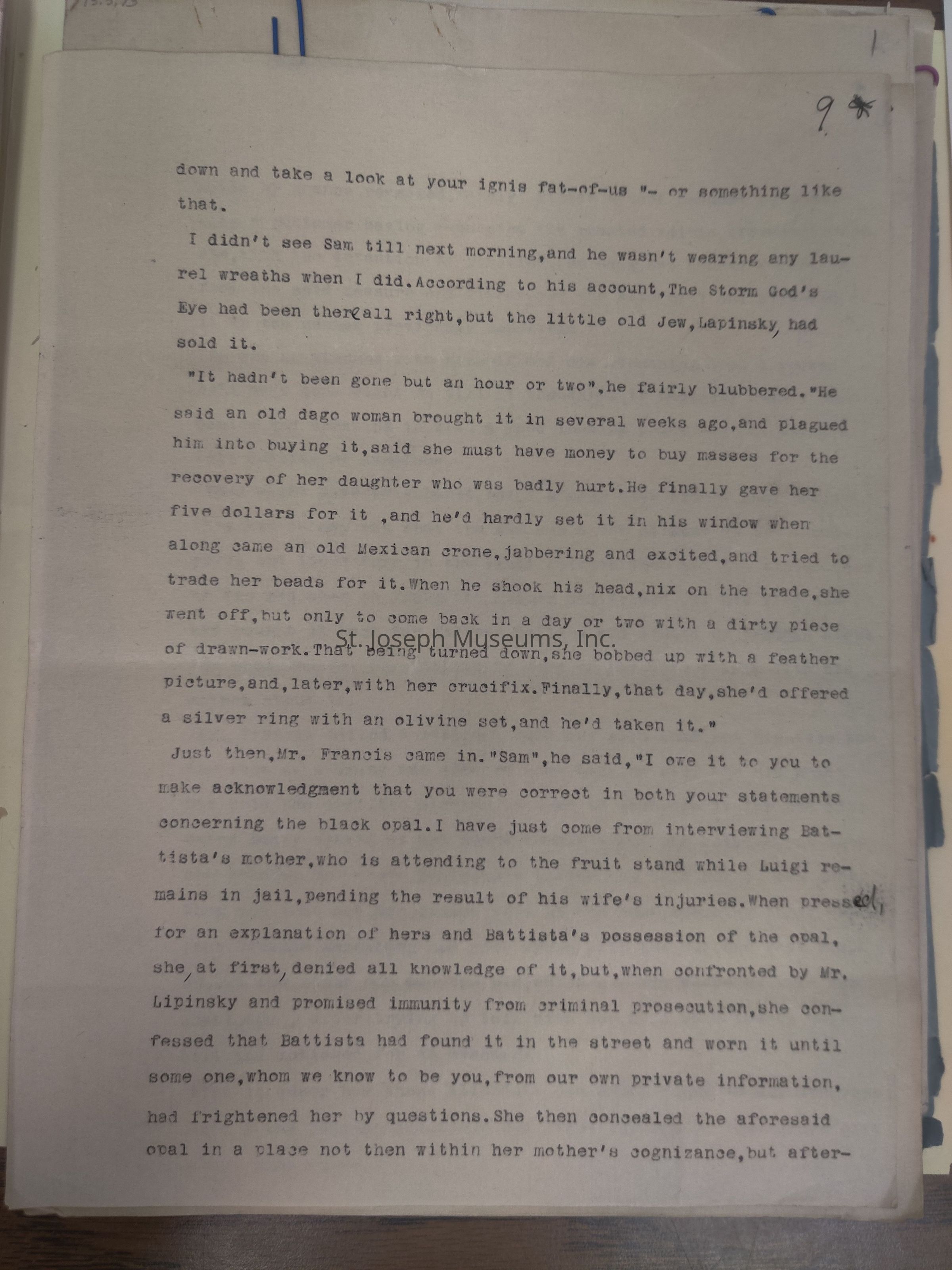
A week later, Sam had seen The Storm God's Eye again. He'd been down to the stockyards with a letter to a client, and, as he came down to the stock yards with a letter to a client, and, as he came back up Sixth Street, another boy on a bike bumped into his, and as he righted up against the curb, there before him, in the window of that little, dirty secondhand store and pawnshop, he saw "The Storm God's Eye." He went in, he said and asked the proprietor where he got it, and when couldn't get an answer, tried to buy it, but the price was ten dollars and he had but two. He begged and prayed Mr. Francis to go right down and see for himself but Mr. Francis told him he had the fixed idea - meaning he'd gone nutty about the pin - and went on writing.
When the car came, a little after five, to take Mr. F. home, he had a change of heart. "jump in, Sam," he said, "it will do no harm to go down and take a look ignis fat-of-us"- or something like that.
I didn't see Sam till next morning, and he wasn't wearing any laurel wreaths when I did. According to his account, The Storm God's Eye had been there all right, but the little old Jew, Lapinsky, had sold it.
"It hadn't been gone but an hour or two", he fairly blubbered." He said an old dago woman brought it in several weeks ago, and plagued him into buying it, said she must have money to buy massea for the recovery of her daughter who was badly hurt. He finally gave her five dollars for it, and he'd set it in his window when along caome an old Mexican crone, jabbering and excited and tried to trafe her beads for it. When he shook his head, nix on the trade, she went off, but only to come back in a day or two with a dirty piece of drawn-work. That being turned down, she bobbed up with a feather picture, and, later, with her crucifix. Finally, that day, she'd offered a silver ring with an olivine set, and he'd taken it."
Just then, Mr. Francis came in. "Sam", he said, "I owe it to you to make acknowledgement that you were correct in both your statements concerning the black opal. I have just come from interviewing Battista's mother, who is attending to the fruit stand while Luigi remains in jail, pending the results of his wife's injuries.
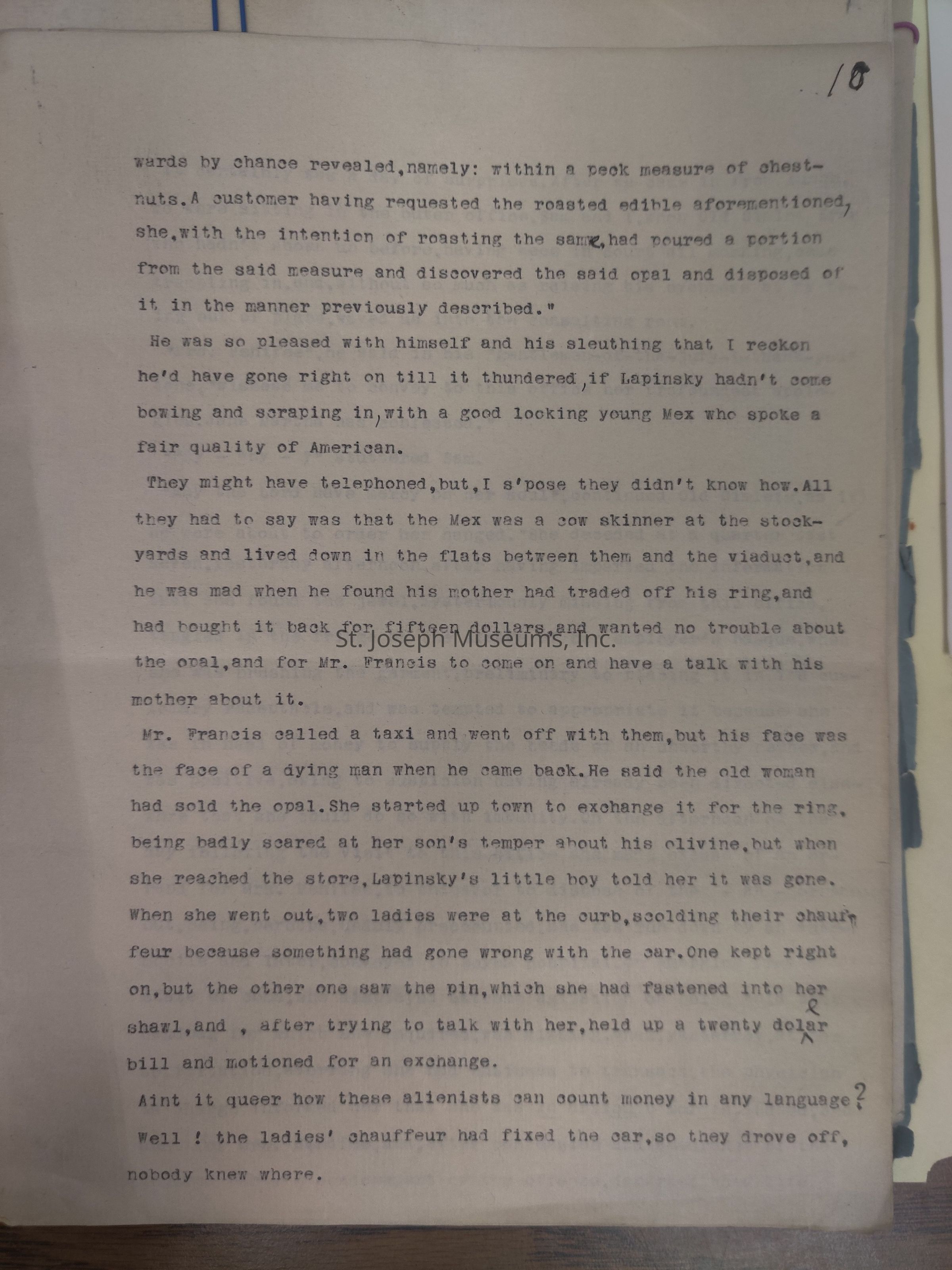
When pressed, for an explanation of hers and Battista's possession of the opal, she, at first, denied all knowledge of it, but, when confronted by Mr. Lipinsky and promised immunity from criminal prosecution, she confessed that Battista had found it in the street and worn it until some one, whom we know to be you, from our own private information, had frightened her by questions. She then concealed the aforesaid opal in a place not then within her mother's cognizance, but afterwards by chance revealed, namely: within a pick measure of chest-nuts. A customer having requested the roasted edible aforementioned, she, with the intention of roasting the same, had poured a portion from the said measure and discovered the said opal and disposed of it in the manner previously described.
He was so pleased with himself and his sleuthing that I reckon he'd have gone right on till it thundered, if Lapinsky hadn't come bowing and scraping in, with a good looking young Mex who spoke a fair quality of American.
They might have telephones, but, I s'pose they didn't know how. All they had to say was that the Mex was a cowskinner at the stock-yards and lived down in the flats between them and the viaduct, and he was mad when he found his mother had traded off his ring, and had bought it back for fifteen dollars, and wanted no troubled about the opal, and for Mr. Francis to come on an have a talk with his mother about it.
Mr. Francis called a taxi and went off with them, but his face of a dying man when he came back. He said the old woman had sold the opal. She started up town to exchange it for the ring, being badly scared at her son's temper about his oliveine, but when she reached the store, Lapinky's little boy told her it was gone. When she went out, two ladies were at the curb, scolding their chauffeur because something had gone wrong with the car. One kept right on, but the other saw the pin, which she had fastened into her shawl, and, after trying to talk with her, held up a twenty dollar bill and motioned for an exchange.
Aint it queer how these alienists can count money in any language?
Well! the ladies' chauffeur had fixed the car, so they drove off, nobody knew where.
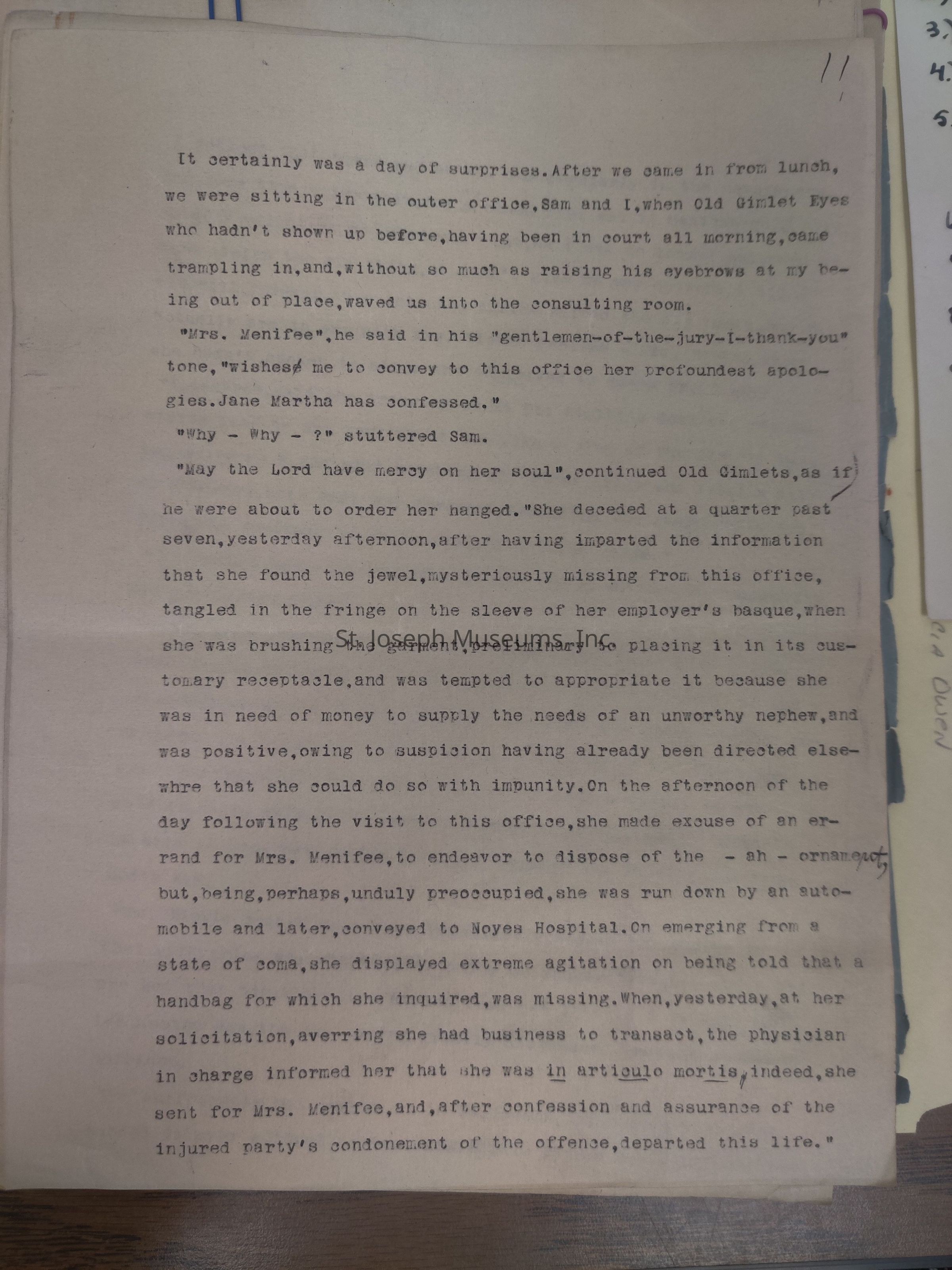
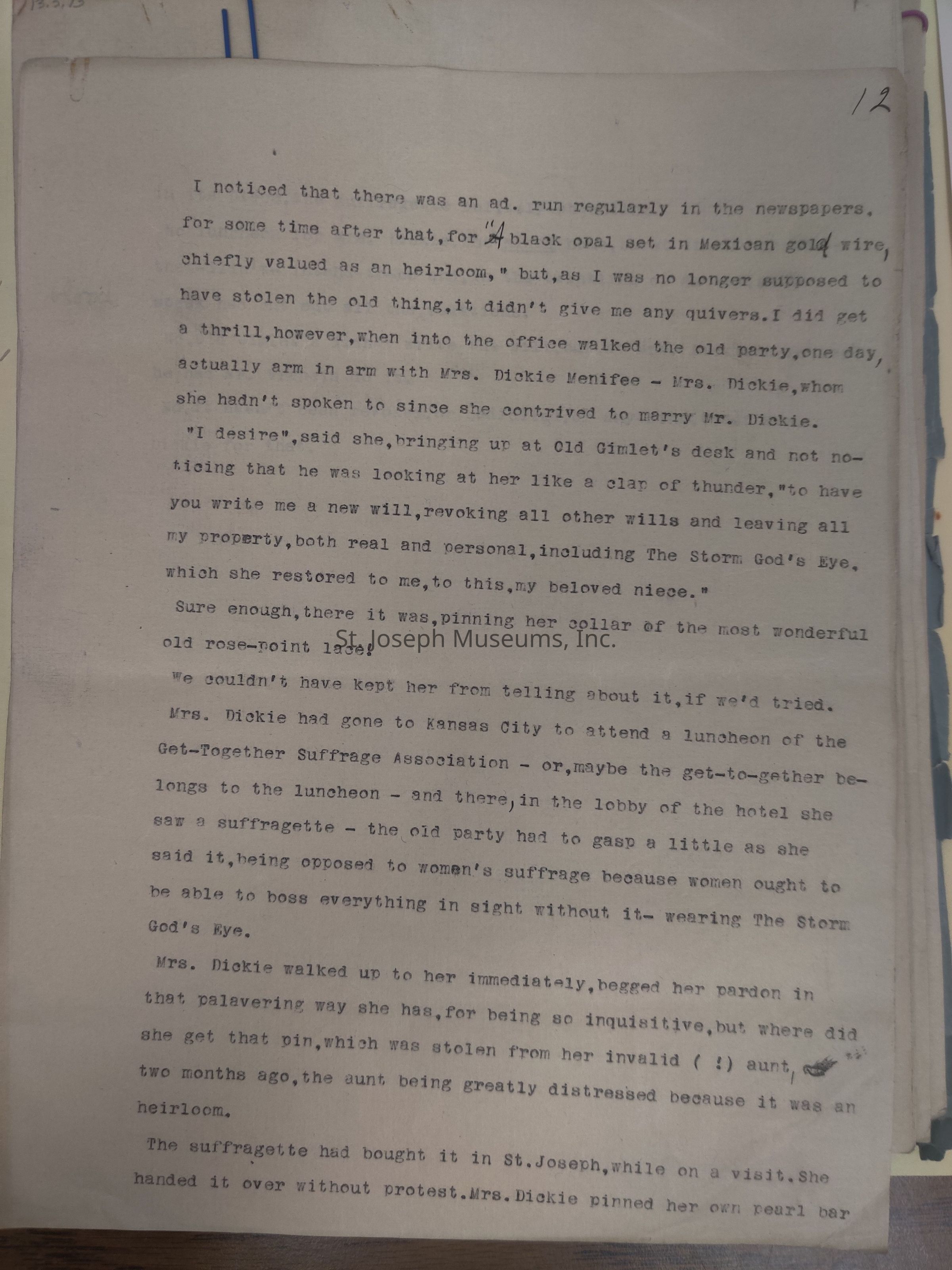
I noticed that there was an ad. run regularly in the newspapers, for some time after that, for "A black opal set in Mexican gold wired, chiefly valued as an heirloom," but, as I was no longer supposed to have stolen the old thing, it didn't give me any quivers. I did get a thrill, however, when into the office walked the old party, one day, actually arm in arm with Mrs. Dickie Menifee - Mrs. Dickie, whom she hadn't spoken to since she contrived to marry Mr. Dickie.
"I desire", said she, bringing up at Old Gimlet's desk and not noticing that he was looking at her like a clap of thunder, "to have you write me a new will, revoking all other wills and leaving all my property, both real and personal, including The Storm God's Eye, which she restored to me, to this, my beloved niece."
Sure enough, there it was, pinning her collar of the most wonderful old rose-point lace!
We couldn't have kept her from telling about it, if we'd tried.
Mrs. Dickie had gone to Kansas City to attend a luncheon of the Get-together Suffrage Association - or, maybe the get-to-gether be-longs to the luncheon - and there, in the lobby of the hotel she saw a suffragette - the old party had to gasp a little as she said it, being opposed to women's suffrage because women out to be able to boss everything in sight without it- wearing The Storm God's Eye.
Mrs. Dickie walked up to her immediately, begged her pardon in that palavering way she has, for being so inquisitive, but where did she get that pin, which was stolen from her invalid (!) aunt, two months ago, the aunt being greatly distressed because it was an heirloom.
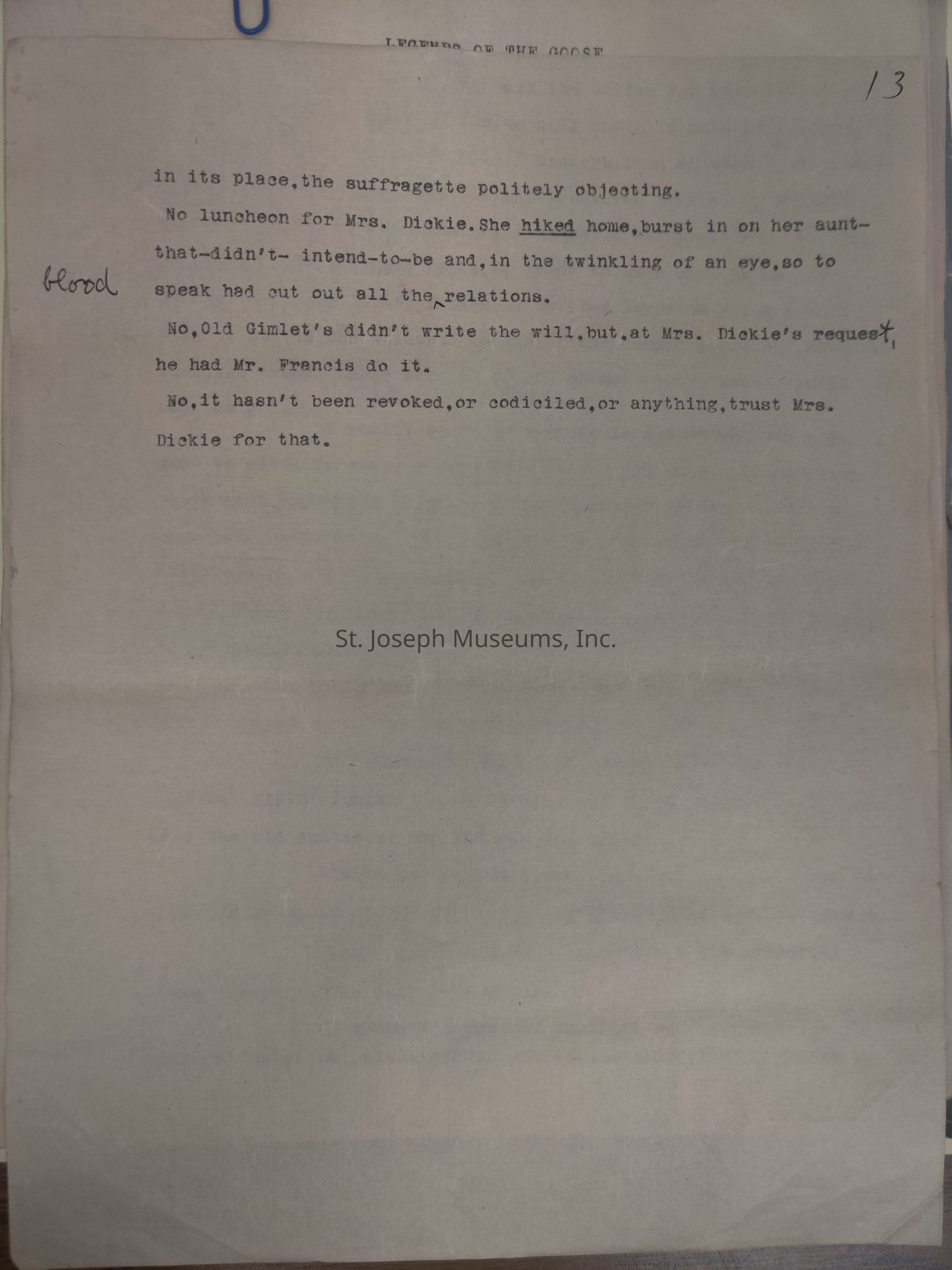
The suffragette had bought it in St. Joseph, while on a visit. She handed it over without protest. Mrs. Dickie pinned her own pearl bar in its place, the suffragette politely objecting.
No luncheon for Mrs. Dickie. She hiked home, burst in on her aunt-that-didn't-intend-to-be and in the twinkling of an eye, so to speak had cut out all the relations.
No, Old Gimlet's didn't write the will, but, at Mrs. Dickie's request, he had Mr. Francis do it.
No, it hasn't been rrevoked, or codiciled, or anything, trust Mrs. Dickie for that.Lexicon
Search Terms
Mrs. Menifee's Black Opal, St. Joseph Legends, St. Joseph History, Owen Sisters, St. Joseph AuthorsRelationships
Related Person or Organization
Person or Organization
Mary Alicia Owen