Name/Title
Ohio Buckeye (Aesculus glabra)Entry/Object ID
2021.1.17 BScope and Content
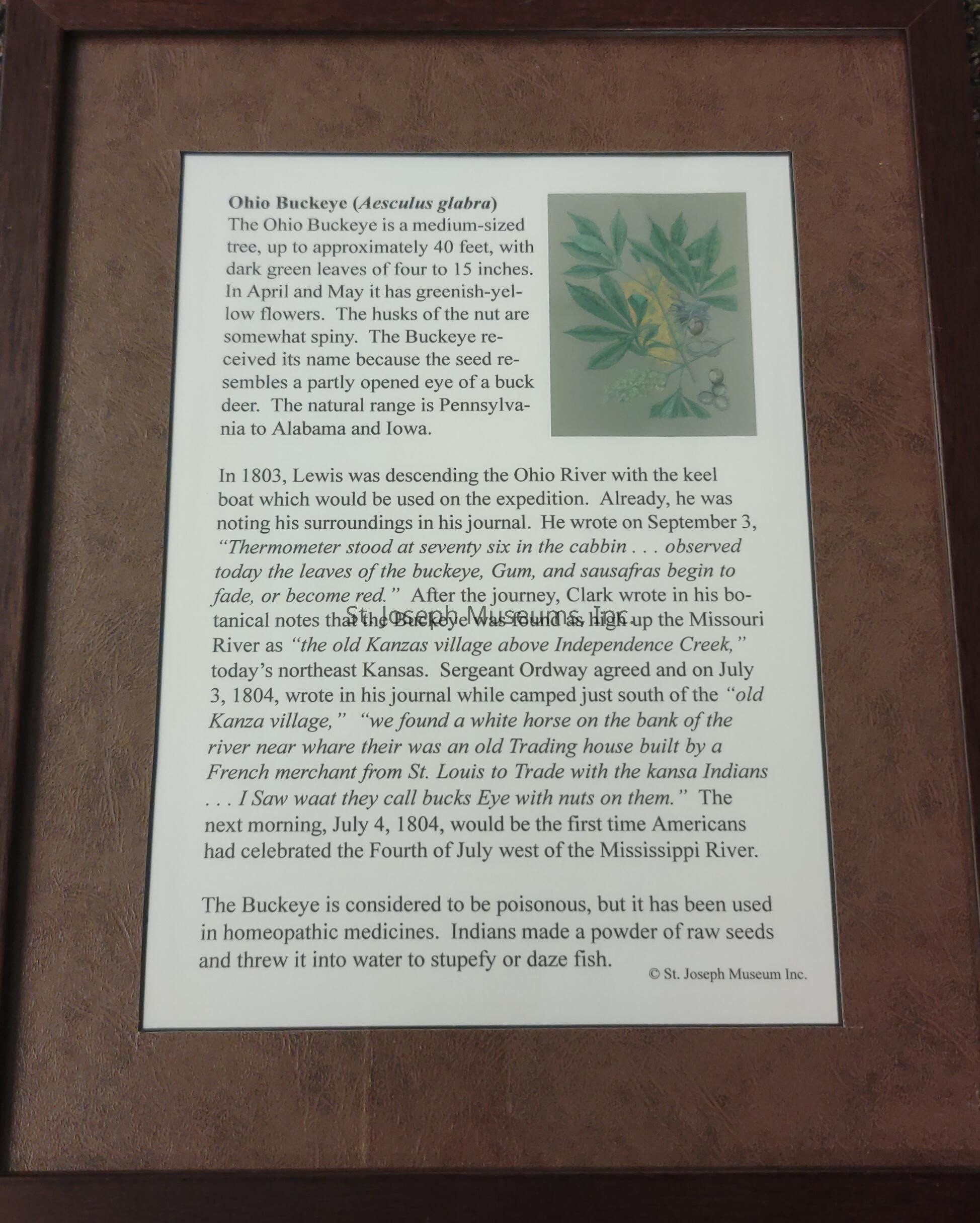
Ohio Buckeye (Aesculus glabra) Plant description, framed.
The Ohio Buckeye is a medium-sized tree, up to approximately 40 feet, with dark green leaves of four to 15 inches. In April and May it has greenish-yellow flowers. The husks of the nut are somewhat spiny. The buckeye received its name because the seed resembles a partly opened eye of a buck deer. The natural range is Pennsylvania to Alabama and Iowa.
In 1803, Lewis was descending the Ohio River with the keel boat which would be used on the expedition. Already, he was noting his surroundings in his journal. He wrote on September 3, "Thermometer stood at seventy six in the cabin... observed today the leaves of the buckeye. Gum, and sausafras begin to fade, or become red." After the journey, Cark wrote in his botanical notes that the Buckeye was found as high up the Missouri River as "the old Kansas village above Independence Creek," today's northeast Kansas. Sergeant Ordway agreed and on July 3, 1804, wrote in his journal while camped just south of the "old Kanza village," "we found a white horse on the bank of the river near whare their was an old Trading house built by a French merchant from St. Louis to Trade with the kansa Indians... I Saw waat they call bucks Eye with nuts on them." The next morning, July 4, 1804, would be the first time Americans had celebrated the Fourth of July west of the Mississippi River.
The Buckeye is considered to be poisonous, but it has been used in homeopathic medicines. Indians made a powder of raw seeds and threw it into water to stupefy or daze fish.Context
Originally designed by the St. Joseph Museum in the fall of 2004. Titled "Botanical Wonders of the Uncharted West. The Recorded Flora of the Lewis & Clark Expedition."Collection
Lewis and ClarkLexicon
LOC Thesaurus for Graphic Materials
Botanical drawings, Expeditions & surveysArchive Items Details
Title
Ohio Buckeye (Aesculus glabra)Creator
Mary L. FletcherDate(s) of Creation
2004Subjects
Plants, Watercolor paintingsParts
Count
2Parts
Watercolor of plant and descriptive label, both framed.Condition
Overall Condition
Very GoodProvenance
Notes
"Botanical Wonders of the Uncharted West" visually depicts how well Lewis followed Jefferson's instructions. In recognition of this achievement, The S. Joseph Museums, Inc. commissioned accomplished artist Mary Fletcher to create fifty (50) selected paintings of flora documented by the Corps during their Journey. These framed watercolor originals are accompanied by similarly framed labels, generated by former Head of Research Jackie Lewin, which describe the corresponding plants with appropriate quotations from the Journals. This collection makes available for study and appreciation plants that were new to Lewis and Clark, but which Native Peoples already recognized as valuable sources of food, medicine, and tools. Some of these still remain a mystery to many, but all will enjoy their beauty, their diverse uses, and their accomplished renderings.