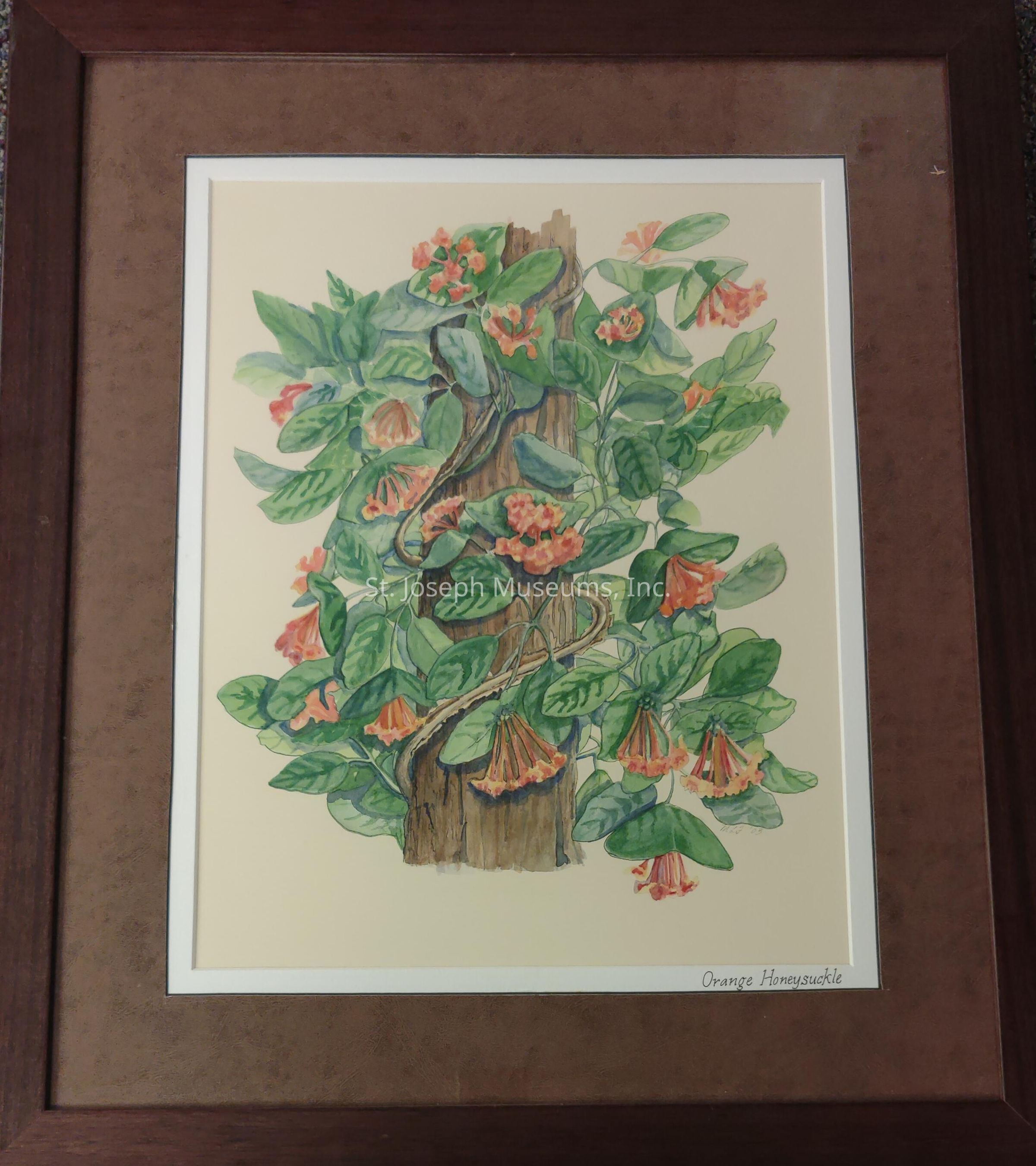
Orange Honeysuckle (Lonicera ciliosa) Watercolor, framed.
The Orange Honeysuckle vine is found on the edges of coniferous forests and climbs 15 to 20 feet up a tree. When it reaches the top it spreads out to form a cascading canopy over the tree. because of the shape of the flowers, it is also called Trumpet Honeysuckle. blossoms appear in late spring and early summer. bright red berries replace the flowers. Although very pretty, the Orange honeysuckle does not have a fragrance.
Context
Originally designed by the St. Joseph Museum in the fall of 2004. Titled "Botanical Wonders of the Uncharted West. The Recorded Flora of the Lewis & Clark Expedition."
Collection
Lewis and Clark
Lexicon
LOC Thesaurus for Graphic Materials
Botanical drawings, Expeditions & surveys
Archive Items Details
Title
Orange Honeysuckle (Lonicera ciliosa) Watercolor
Creator
Mary L. Fletcher
Date(s) of Creation
2004
Subjects
Plants, Watercolor paintings
Dimensions
Width
23 in
Length
27 in
Parts
Count
2
Parts
Watercolor of plant and descriptive label, both framed.
"Botanical Wonders of the Uncharted West" visually depicts how well Lewis followed Jefferson's instructions. In recognition of this achievement, The S. Joseph Museums, Inc. commissioned accomplished artist Mary Fletcher to create fifty (50) selected paintings of flora documented by the Corps during their Journey. These framed watercolor originals are accompanied by similarly framed labels, generated by former Head of Research Jackie Lewin, which describe the corresponding plants with appropriate quotations from the Journals. This collection makes available for study and appreciation plants that were new to Lewis and Clark, but which Native Peoples already recognized as valuable sources of food, medicine, and tools. Some of these still remain a mystery to many, but all will enjoy their beauty, their diverse uses, and their accomplished renderings.