Name/Title
Oregon White Oak (Quercus garryana)Entry/Object ID
2021.1.42 BScope and Content
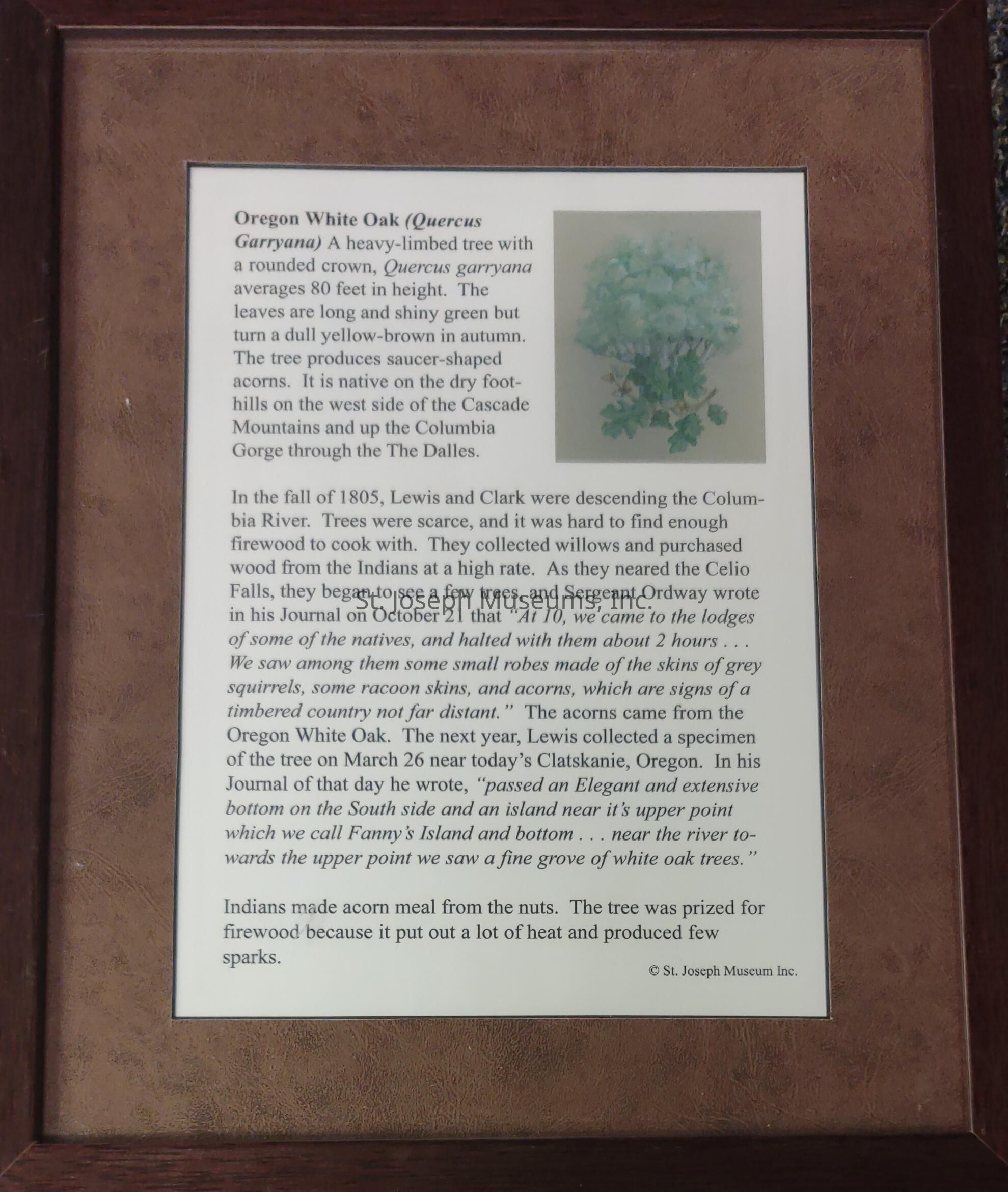
Oregon White Oak (Quercus garryana) plant description, framed.
A heavy-limbed tree with a rounded crown, Quercus garryana averages 80 feet in height. The leaves are long and shiny green but turn a dull yellow-brown in autumn. The tree produces saucer-shaped acorns. It is native on the dry foothills on the west side of the Cascade Mountains and up the Columbia Gorge through The Dalles.Context
Originally designed by the St. Joseph Museum in the fall of 2004. Titled "Botanical Wonders of the Uncharted West. The Recorded Flora of the Lewis & Clark Expedition."
In the fall of 1805, Lewis and Clark were descending the Columbia River. Trees were scarce, and it was hard to find enough firewood to cook with. They collected willows and purchased wood from the Indians at a high rate. As they neared the Celio Falls, they began to see a few trees, and Sergeant Ordway wrote in his Journal on October 21 that "At 10, we came to the lodges of some of the natives, and halted with them about 2 hours... We saw among them some small robes made of the skins of grey squirrels, some racoon skins, and acorns, which are signs of a timbered country not far distant." The acorns came from the Oregon White Oak. The next year, Lewis collected a specimen of the tree on March 26 near today's Clatskanie, Oregon. In his Journal of that day he wrote, "passed an Elegant and extensive bottom on the South side and an island near it's upper point which we call Fanny's Island and bottom... near the river towards the upper point we saw a fine grove of white oak trees."
Indians made acorn meal from the nuts. The tree was prized for firewood because it put out a lot of heat and produced few sparks.Collection
Lewis and ClarkLexicon
LOC Thesaurus for Graphic Materials
Botanical drawings, Expeditions & surveysArchive Items Details
Title
Camas (Camassia quamash)Creator
Mary L. FletcherDate(s) of Creation
2004Subjects
Plants, Watercolor paintingsParts
Count
2Parts
Watercolor of plant and descriptive label, both framed.Condition
Overall Condition
Very GoodProvenance
Notes
"Botanical Wonders of the Uncharted West" visually depicts how well Lewis followed Jefferson's instructions. In recognition of this achievement, The S. Joseph Museums, Inc. commissioned accomplished artist Mary Fletcher to create fifty (50) selected paintings of flora documented by the Corps during their Journey. These framed watercolor originals are accompanied by similarly framed labels, generated by former Head of Research Jackie Lewin, which describe the corresponding plants with appropriate quotations from the Journals. This collection makes available for study and appreciation plants that were new to Lewis and Clark, but which Native Peoples already recognized as valuable sources of food, medicine, and tools. Some of these still remain a mystery to many, but all will enjoy their beauty, their diverse uses, and their accomplished renderings.