Name/Title
Osage Plum (Prunus augustifolia)Entry/Object ID
2021.1.19 BScope and Content
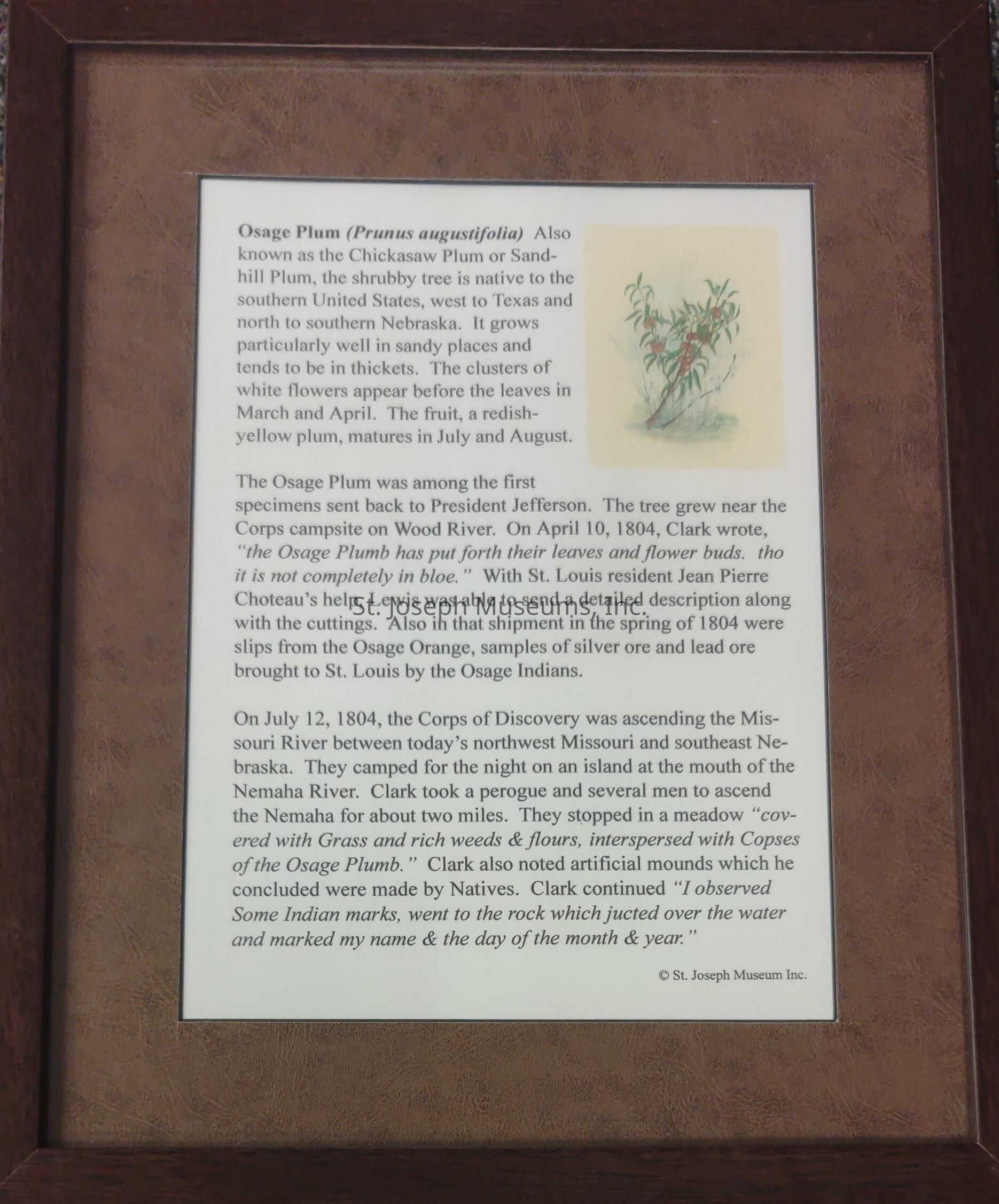
Osage Plum (Prunus augustifolia) plant description, framed.
Also known as the Chickasaw Plum or Sandhill Plum, the shrubby tree is native to the southern United States, west to Texas and north to southern Nebraska. It grows particularly well in sandy places and tends to be in thickets. The clusters of white flowers appear before the leaves in March and April. The fruit, a reddish-yellow plum, matures in July and August.
The Osage Plum was among the first specimens sent back to President Jefferson. The tree grew near the Corps campsite on Wood River. On April 10, 1804, Clark wrote, "the Osage Plumb has put forth their leaves and flower buds tho it is not completely in blow." With St. Louis resident Jean Pierre Choteau's help, Lewis was able to send a detailed description along with the cuttings. Also in that shipment in the spring of 1804 were slips from te Osage Orange, samples of silver ore and lead ore brough to St. Louis by the Osage Indians.
On July 12, 1804, the Corps of Discovery was ascending the Missouri River between today's northwest Missouri and southeast Nebraska. They camped for the night on an island at the mouth of the Nemaha River. Clark took a perogue and several men to ascend the Nemaha for about two miles. They stopped in a meadow "covered with Grass and rich weeds & flours, interspersed with Copses of the Osage Plumb." Clark also noted artificial mounds which he concluded were made by Natives. Clark continued "I observed Some Indian marks went to the rock which jucted over the water and marked my name & the day of the month & year."Context
Originally designed by the St. Joseph Museum in the fall of 2004. Titled "Botanical Wonders of the Uncharted West. The Recorded Flora of the Lewis & Clark Expedition."Collection
Lewis and ClarkLexicon
LOC Thesaurus for Graphic Materials
Botanical drawings, Expeditions & surveysArchive Items Details
Title
Osage Plum (Prunus augustifolia)Creator
Mary L. FletcherDate(s) of Creation
2004Subjects
Plants, Watercolor paintingsParts
Count
2Parts
Watercolor of plant and descriptive label, both framed.Condition
Overall Condition
Very GoodProvenance
Notes
"Botanical Wonders of the Uncharted West" visually depicts how well Lewis followed Jefferson's instructions. In recognition of this achievement, The S. Joseph Museums, Inc. commissioned accomplished artist Mary Fletcher to create fifty (50) selected paintings of flora documented by the Corps during their Journey. These framed watercolor originals are accompanied by similarly framed labels, generated by former Head of Research Jackie Lewin, which describe the corresponding plants with appropriate quotations from the Journals. This collection makes available for study and appreciation plants that were new to Lewis and Clark, but which Native Peoples already recognized as valuable sources of food, medicine, and tools. Some of these still remain a mystery to many, but all will enjoy their beauty, their diverse uses, and their accomplished renderings.