Name/Title
Pacific Yew (Taxus brevifolia)Entry/Object ID
2021.1.64 BScope and Content
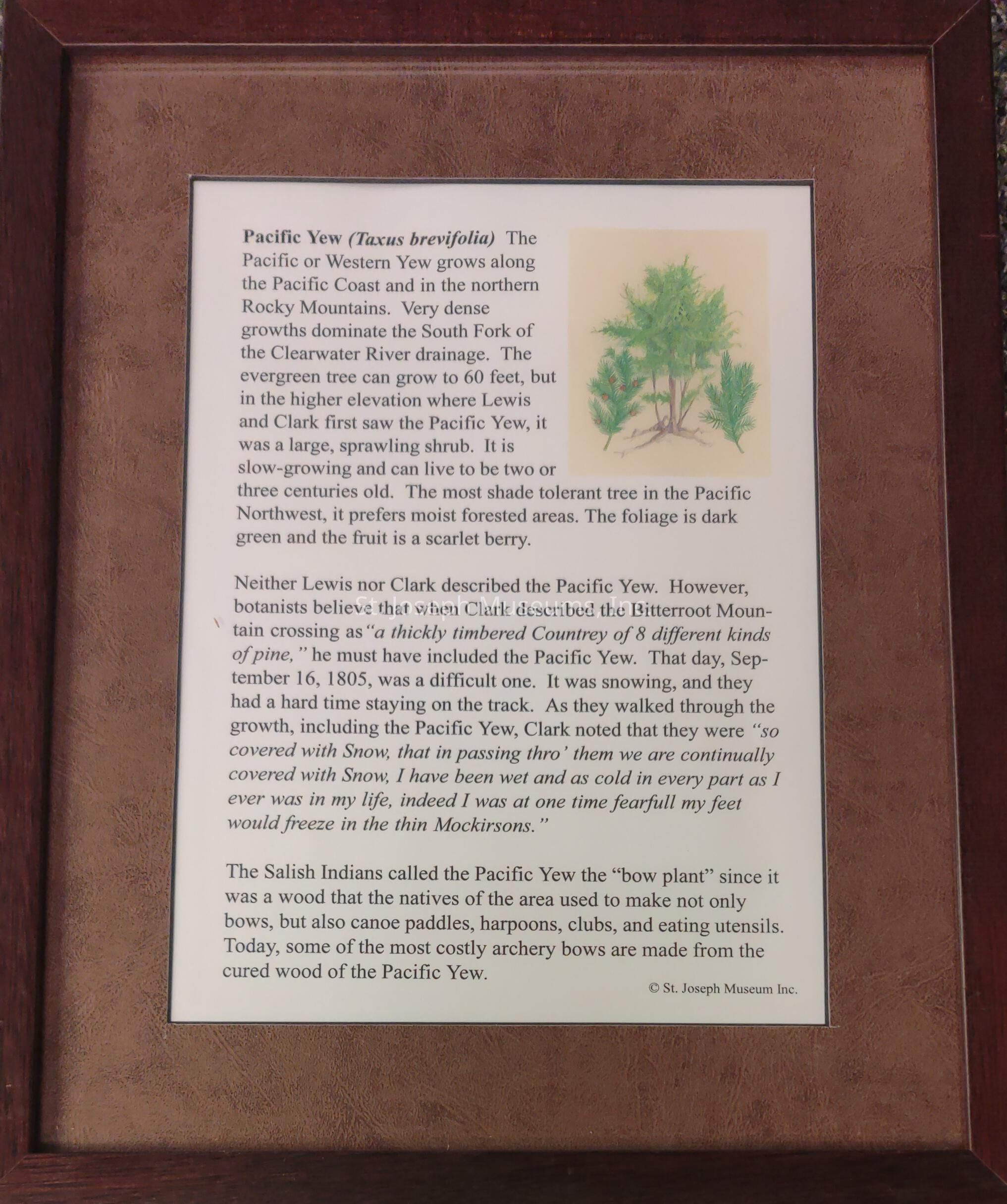
Pacific Yew (Taxus brevifolia) plant description, framed.
The Pacific or Western Yew grows along the Pacific Coast and in the northern Rocky Mountains. Very dense growths dominate the South Fork of the Clearwater River drainage. The evergreen tree can grow to 60 feet, but in the higher elevations where Lewis and Clark first saw the Pacific Yet, it was a large, sprawling shrub. It is slow-growing and can live to be two or three centuries old. The most shade tolerant tree in the Pacific Northwest, it prefers moist forested areas. The foliage is dark green and the fruit is a scarlet berry.
Neither Lewis nor Clark described the Pacific Yew. However, botanists believe that when Clark described the Bitterroot Mountain crossing as "a thickly timbered Countrey of 8 different kinds of pine," he must have included the Pacific Yew. That day, September 16, 1805, was a difficult one. It was snowing, and they had a hard time staying on the track. As they walked through the growth, including the Pacific Yew, Clark noted that they were "so covered with Snow, that in passing thro' them we are continually covered with Snow, I have been wet and as cold in every part as I ever was in my life, indeed I was at one time fearfull my feet would freeze in the thin Mockirsons."
The Salish Indians called the Pacific Yew the "bow plant" since it was a wood that the natives of the area used to make not only bows, but also canoe paddles, harpoons, clubs, and eating utensils. Today, some of the most costly archery bows are made from cured wood of the Pacific Yew.Context
Originally designed by the St. Joseph Museum in the fall of 2004. Titled "Botanical Wonders of the Uncharted West. The Recorded Flora of the Lewis & Clark Expedition."Collection
Lewis and ClarkLexicon
LOC Thesaurus for Graphic Materials
Botanical drawings, Expeditions & surveysArchive Items Details
Title
Pacific Yew (Taxus brevifolia)Creator
Mary L. FletcherDate(s) of Creation
2004Subjects
Plants, Watercolor paintingsParts
Count
2Parts
Watercolor of plant and descriptive label, both framed.Condition
Overall Condition
Very GoodProvenance
Notes
"Botanical Wonders of the Uncharted West" visually depicts how well Lewis followed Jefferson's instructions. In recognition of this achievement, The S. Joseph Museums, Inc. commissioned accomplished artist Mary Fletcher to create fifty (50) selected paintings of flora documented by the Corps during their Journey. These framed watercolor originals are accompanied by similarly framed labels, generated by former Head of Research Jackie Lewin, which describe the corresponding plants with appropriate quotations from the Journals. This collection makes available for study and appreciation plants that were new to Lewis and Clark, but which Native Peoples already recognized as valuable sources of food, medicine, and tools. Some of these still remain a mystery to many, but all will enjoy their beauty, their diverse uses, and their accomplished renderings.