Name/Title
Paw Paw (Asimina triloba)Entry/Object ID
2021.1.63 BScope and Content
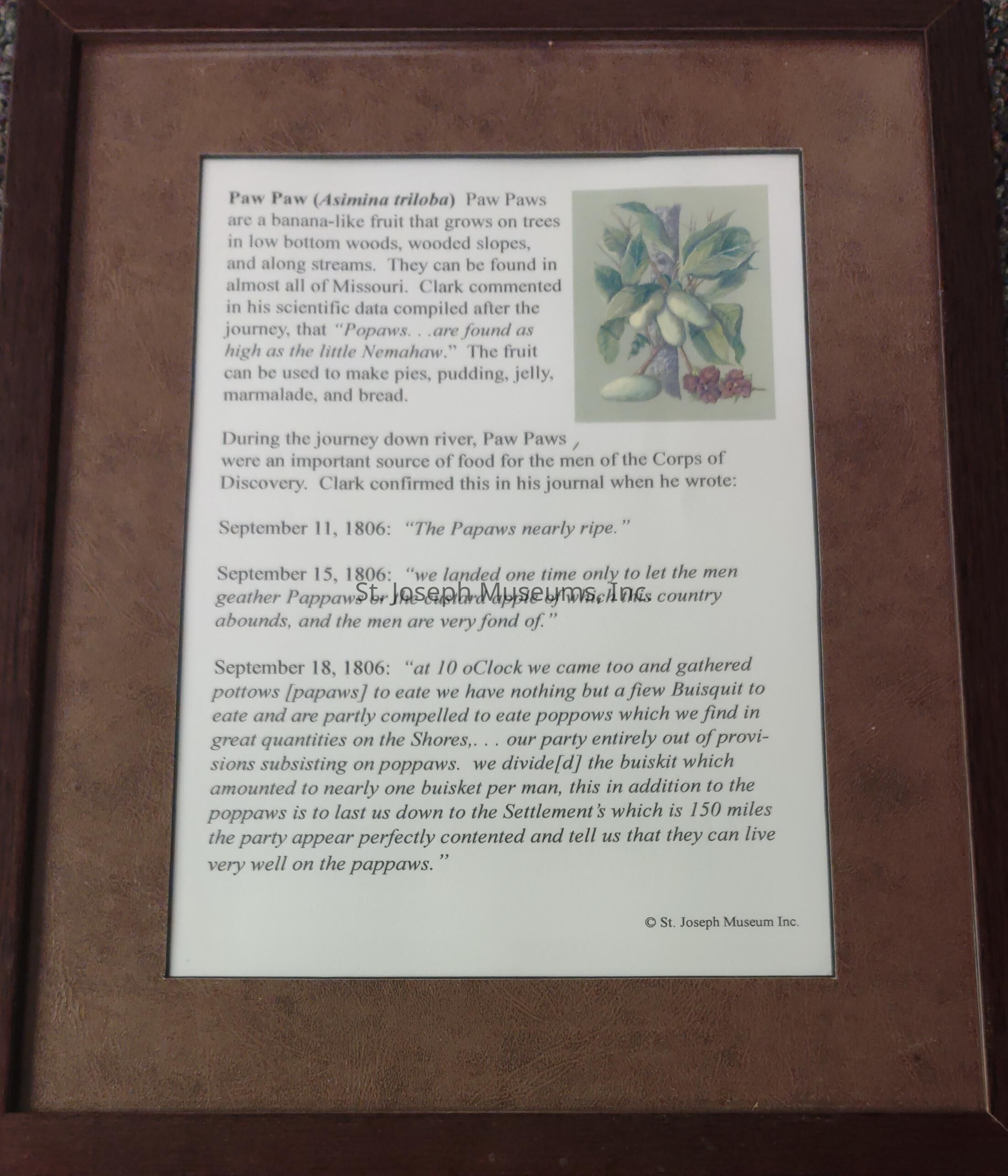
Paw Paw (Asimina triloba) plant description, framed.
Paw Paws are a banana-like fruit that grows on trees in low bottom woods, wooded slopes, and along streams. They can be found in almost all of Missouri. Clark commented in his scientific data compiled after the journey, that "Popaws...are found as high as the little Nemahaw." The fruit can be used to make pies, pudding, jelly, marmalade, and bread.
During the journey down river, Paw Paws were an important source of food for the men of the Corps of Discovery. Clark confirmed this is his journal when he wrote:
September 11, 1806: "The Pawpaws nearly ripe."
September 15, 1806: "we landed one time only to let the men geather Pappaws or the custard apple of which this country abounds, and the men are very fond of."
September 18, 1806: "at 10 oClock we came too and gathered pottows [ papaws] to eate we have nothing but a fiew Buisquit to eate and are partly compelled to eate poppows which we find in great qualities on the Shores,...our party entirely out of provisions subsisting on pappaws. we divide[d] the buiskit which amounted to nearly one buisket per man, this in addition to the pappaws is to last us down to the Settlement's which is 150 miles the party appear perfectly contented and tell us that they can live very well on the pappaws."Context
Originally designed by the St. Joseph Museum in the fall of 2004. Titled "Botanical Wonders of the Uncharted West. The Recorded Flora of the Lewis & Clark Expedition."Collection
Lewis and ClarkLexicon
LOC Thesaurus for Graphic Materials
Botanical drawings, Expeditions & surveysArchive Items Details
Title
Paw Paw (Asimina triloba)Creator
Mary L. FletcherDate(s) of Creation
2004Subjects
Plants, Watercolor paintingsParts
Count
2Parts
Watercolor of plant and descriptive label, both framed.Condition
Overall Condition
Very GoodProvenance
Notes
"Botanical Wonders of the Uncharted West" visually depicts how well Lewis followed Jefferson's instructions. In recognition of this achievement, The S. Joseph Museums, Inc. commissioned accomplished artist Mary Fletcher to create fifty (50) selected paintings of flora documented by the Corps during their Journey. These framed watercolor originals are accompanied by similarly framed labels, generated by former Head of Research Jackie Lewin, which describe the corresponding plants with appropriate quotations from the Journals. This collection makes available for study and appreciation plants that were new to Lewis and Clark, but which Native Peoples already recognized as valuable sources of food, medicine, and tools. Some of these still remain a mystery to many, but all will enjoy their beauty, their diverse uses, and their accomplished renderings.