Point, Projectile

Object/Artifact

-

St. Joseph Museums

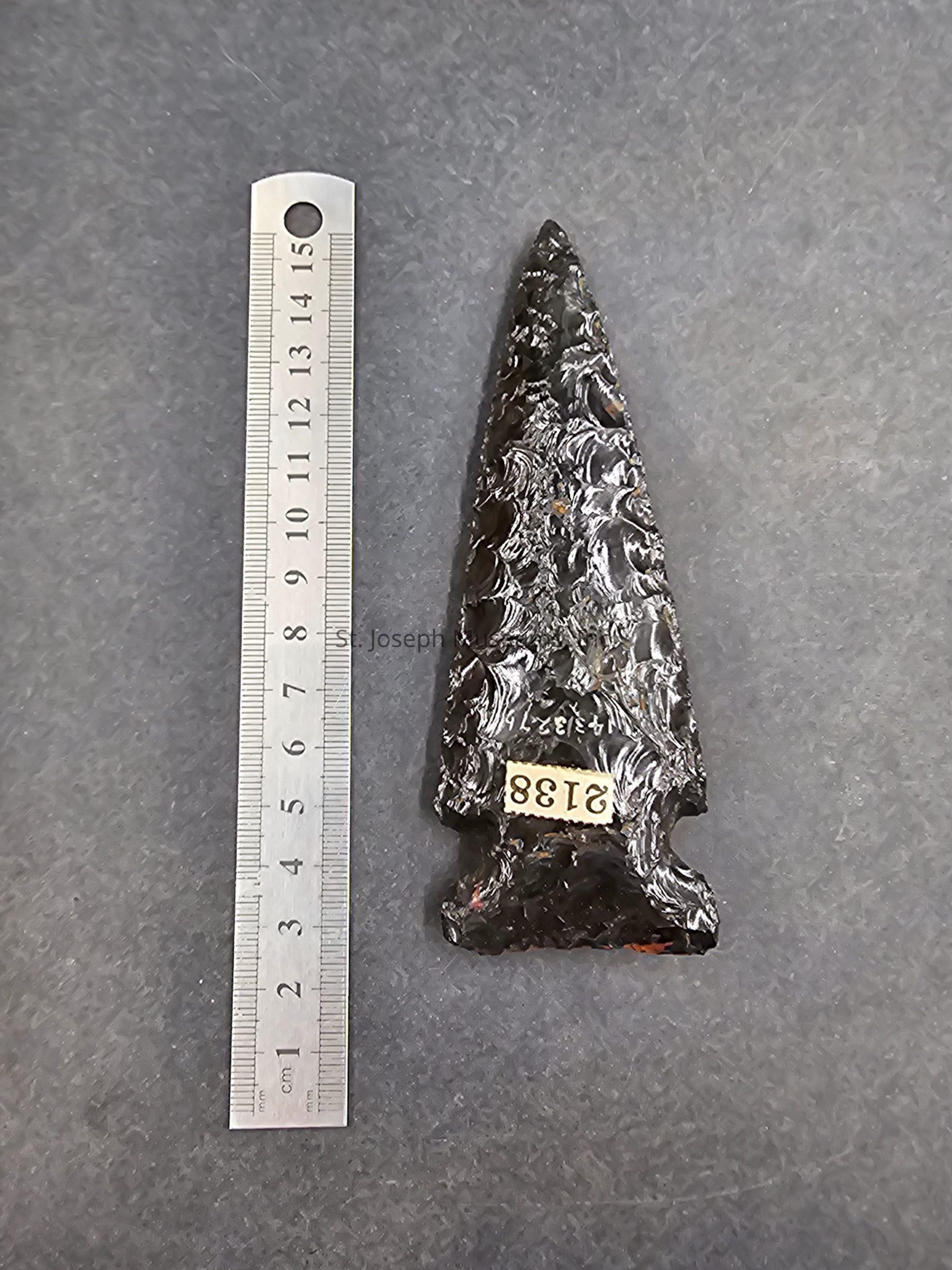
The image depicts a black, intricately carved obsidian spearhead lying on a flat gray surface, with a silver measuring tool placed adjacent to it for scale. The spearhead, marked with a label displaying the number "2138," exhibits a glossy finish and a beautifully serrated edge, revealing the craftsmanship involved. The ruler, marked in centimeters, shows an approximate length of 14 cm, providing a clear understanding of the spearhead's size.

The image depicts a black, intricately carved obsidian spearhead lying on a flat gray surface, with a silver measuring tool placed adjacent to it for scale. The spearhead, marked with a label displaying the number "2138," exhibits a glossy finish and a beautifully serrated edge, revealing the craftsmanship involved. The ruler, marked in centimeters, shows an approximate length of 14 cm, providing a clear understanding of the spearhead's size.

Name/Title

Point, Projectile

Entry/Object ID

143/3276

Description

BLACK WITH REDDISH BROWN STREAKS/ TYPE: ROUND NOTCH

Collection

ARCHAEOLOGY

Made/Created

Place

Continent

North America

Ethnography

Culture/Tribe

Needs to be Identified

Lexicon

Nomenclature 4.0

Nomenclature Primary Object Term

Point, Projectile

Nomenclature Sub-Class

Edged Weapons

Nomenclature Class

Armaments

Nomenclature Category

Category 05: Tools & Equipment for Science & Technology

Parts

Count

1

Material

OBSIDIAN

Condition

Overall Condition

Good

Interpretative Labels

Label Type

Cultural/Historical Context

Label

The modern country of Mexico has a deeply rich and diverse history. Home to some of the largest civilizations in the world, Mexico is home to thousands of years of history and culture. The first civilization, the Olmecs, lived in Mexico from 1200 BCE to 600 BCE. The Zapotecs ruled the area around Oaxaca in southern Mexico from around 500 BCE to around 900 CE. Around the year 200 BCE, an unknown group of people built a massive city called Teotihuacan, near modern-day Mexico City. This city was one of the ancient world’s largest cities, with around 200,000 people living within its borders. While no writing system has been discovered at this site and the cultural beginnings are unknown, this city and its massive pyramids still stand today. The Mayan civilization flourished between 250 and 900 CE, though the earliest Mayan settlements date all the way back to 1800 CE. While Mayan settlements can be found in several countries in Central America, some of their most famous sites are in Mexico, like Chichen Itza, which was added to the New Seven Wonders of the World list in 2007. The Toltecs settled in central Mexico around the 10th century CE. While this civilization’s power only lasted about 200 years, their influence was extensive. The Aztecs, the last of the pre-Columbian native civilizations in Mexico, claimed that they were descendants of the Toltecs and placed great honor on the remains of their civilization. The Aztec civilization was established in 1325 but rose to prominence in 1427, when the Aztecs partnered with other area tribes to conquer surrounding cultures, until their empire stretched across Mexico coast to coast and they were the dominant civilization in Mexico. At the height of their power, the Aztecs controlled over 5 million people. The Aztecs are famous for their capital city, Tenochtitlan, being built in the middle of a lake and for their practice of human sacrifice (though they were not the only civilization in Mexico to do this). The Aztec empire fell when Hernán Cortés brought a contingent of Spanish soldiers to the continent. Through massacre and disease, the Spanish killed almost 50% of the Aztec population and within two years, the Aztec empire fell. Cortés razed Tenochtitlan and built Mexico City on its ruins. Like Native American tribes in United States, many of these cultures, namely the Maya and Zapotec, still live in the modern world.
Research Notes

Person

Tori Zieger

Notes

Obsidian is a natural glass that is formed when lava cools rapidly. Obsidian usually is a shiny black color, but it is possible that the lava has inclusions, like iron or gas bubbles, that could modify the color. Obsidian is incredibly strong and incredibly sharp, making it an ideal material to make weapons out of. The Aztecs made a special weapon called a macuahuitl, which is multiple obsidian pieces that project from the side of a wooden paddle. Arrows and spears were tipped with obsidian and used for hunting and for warfare. The reflective nature of obsidian also allowed the Aztec people to use obsidian in mirrors. There have been sculptures and carvings discovered by archaeologists either made out of obsidian or with obsidian features. Obsidian was also a popular material to make jewelry out of. The variation in obsidian deposits made it a highly sought after trade good. The more common varieties were traded as weapons; some of the more unique varieties were treated like precious gems. This is an example of a finely wrought obsidian knife. If you look closely, brown streaks are visible in the jet black obsidian. The brown color is caused by iron inclusions.