Name/Title
PrintEntry/Object ID
2018.3.195 ADescription
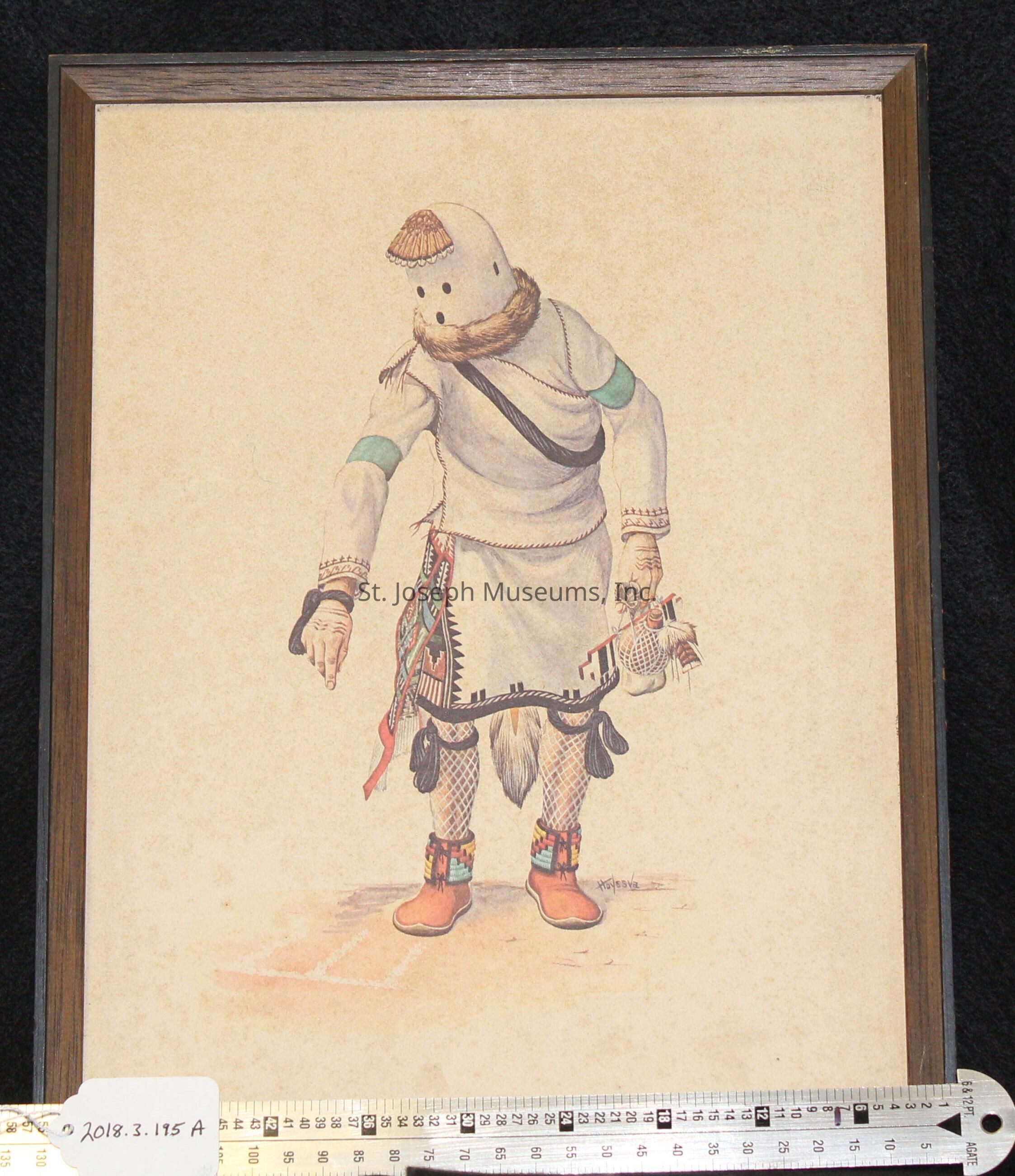
Prints/Framed images of Kachinas with pamphlets attached to back/A-image of a man dressed in white with a white mask, fur collar, and feathers on the top, sprinkling white seeds in the shape of an E on the ground/signed "Hoyesva"/label on back "John's Paint and Art Center 432 North Santa Cruz Ave. Los Gatos, Calif. 354-7008 John R. Garcia"/pamphlet "Eototo the Kachina Chief…about Eototo White case mask without ears, Douglas fir ruff. He wears a white shirt and kilt, sash, and a hank of blue yarn over one shoulder, white knitted leggings, red moccasins, carries a gourd of sacred water and a small wand. Considered by the Hopis to be the Chief of all Kachinas, Eototo is thought to control the seasons and is the leading figure in the Bean Dance. …about Motorola With silicon device technology becoming more and more sophisticated, Motorola's recent announcement of the industry's first low-storage, high-voltage PNP silicon transistors marks still another milestone in the advancement of the semiconductor art. This breakthrough in transistor process technology now extends the design simplification of complementary transistor circuits to magnetic memory circuits…for the combined requirements of high-speed (for thin-film and core memories) and high-voltage (for increasing the number of series-driven magnetic elements). Look to Motorola for continued leadership in silicon transistors! …about Kachinas During the first half of the Hopi year there are held one-day ceremonies, called ordinary or regular Kachina dances, in which the Kachinas dance in the village plazas. In these ceremonies a group of twenty to thirty Kachinas, all identically masked and dressed, may take part or it may be a "Mixed Kachina Dance" where each mask and costume is different. Any ceremony is a social occasion for the village, for friends and relatives to come from the neighboring towns to see the "dance" and partake of the feasts that are always prepared. During the second half of the year from July when the Niman Kachina (Home Dance Ceremony) takes place, until the following December, no ceremonies are held in which masked impersonators take part. There are a number of ceremonies like the famous Snake Dance, but the participants do not wear masks. The Niman Kachina is called the Home Dance because it is the last appearance of the Kachinas before they return to their homes on the San Francisco Peaks near Flagstaff, Arizona. …about the Artist Hoyesva…the original Indian name given the artist by his Hopi tribe, was born and raised in Oraibi, Arizona. Hoyesva, which means "arrow maker" in the Hopi language, is recognized in the art field for the extreme care which he gives to minute details-a quality that is quite obvious in your Kachinas."/12"x9.5"0.5"Collection
NATIVE AMERICANLexicon
Nomenclature 4.0
Nomenclature Primary Object Term
PrintNomenclature Sub-Class
Graphic DocumentsNomenclature Class
Documentary ObjectsNomenclature Category
Category 08: Communication ObjectsDimensions
Height
12 inWidth
9-1/2 inDepth
1/2 in