Name/Title
Rocky Mountain Maple (Acer glabrum)Entry/Object ID
2021.1.38 BScope and Content
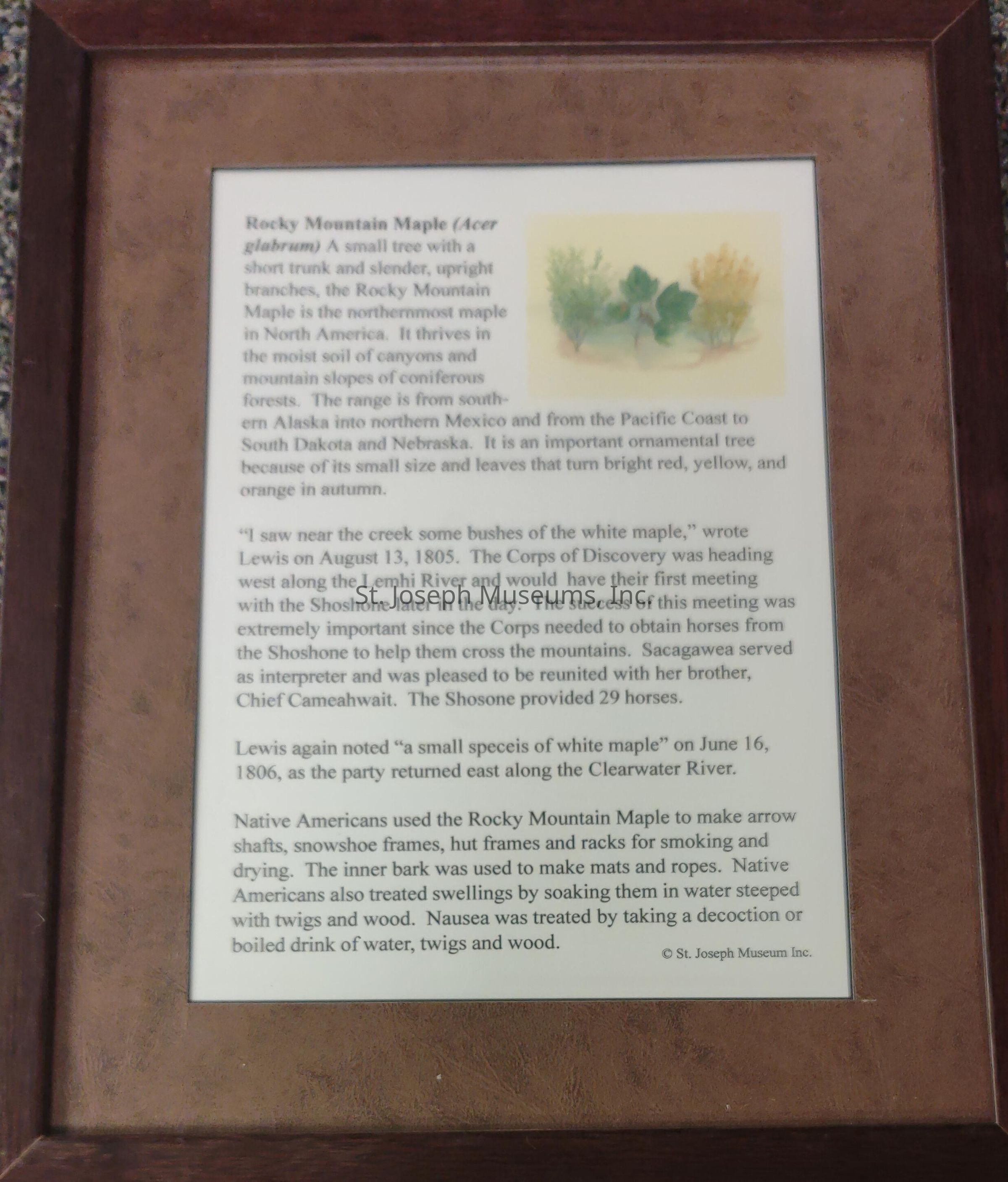
Rocky Mountain Maple (Acer glabrum) plant description, framed.
A small tree with a short trunk and slender, upright branches, the Rocky Mountain Maple is the northernmost maple in North America. It thrives in the moist soil of canyons and mountain slopes of coniferous forests. The range is from southern Alaska into northern Mexico and from the Pacific Coast to South Dakota and Nebraska. It is an important ornamental tree because of its small size and leaves that turn bright red, yellow, and orange in autumn.
"I saw near the creek some bushes of the white maple," wrote Lewis on August 13, 1805. The Corps of Discovery was heading west along the Lemhi River and would have their first meeting with the Shoshone later in the day. The success of this meeting was extremely important since the Corps needed to obtain horses from the Shoshone to help them cross the mountains. Sacagawea served as interpreter and was pleased to be reunited with her brother, Chief Cameahwait. The Shosone provided 29 horses.
Lewis again noted "a small speceis of white maple" on June 16, 1806, as the party returned east along the Clearwater River.
Native Americans used the Rocky Mountain Maple to make arrow shafts, snowshoe frames, hut frames and racks for smoking and drying. The inner bark was used to make mats and ropes. Native Americans also treated swellings by soaking them in water steeped with twigs and wood. Nausea was treated by taking a decoction or boiled drink of water, twigs and wood.Context
Originally designed by the St. Joseph Museum in the fall of 2004. Titled "Botanical Wonders of the Uncharted West. The Recorded Flora of the Lewis & Clark Expedition."Collection
Lewis and ClarkLexicon
LOC Thesaurus for Graphic Materials
Botanical drawings, Expeditions & surveysArchive Items Details
Title
Rocky Mountain Maple (Acer glabrum)Creator
Mary L. FletcherDate(s) of Creation
2004Subjects
Plants, Watercolor paintingsParts
Count
2Parts
Watercolor of plant and descriptive label, both framed.Condition
Overall Condition
Very GoodProvenance
Notes
"Botanical Wonders of the Uncharted West" visually depicts how well Lewis followed Jefferson's instructions. In recognition of this achievement, The S. Joseph Museums, Inc. commissioned accomplished artist Mary Fletcher to create fifty (50) selected paintings of flora documented by the Corps during their Journey. These framed watercolor originals are accompanied by similarly framed labels, generated by former Head of Research Jackie Lewin, which describe the corresponding plants with appropriate quotations from the Journals. This collection makes available for study and appreciation plants that were new to Lewis and Clark, but which Native Peoples already recognized as valuable sources of food, medicine, and tools. Some of these still remain a mystery to many, but all will enjoy their beauty, their diverse uses, and their accomplished renderings.