Sioux of the Rosebud, The
Name/Title
Sioux of the Rosebud, TheEntry/Object ID
L2019.13.124Description
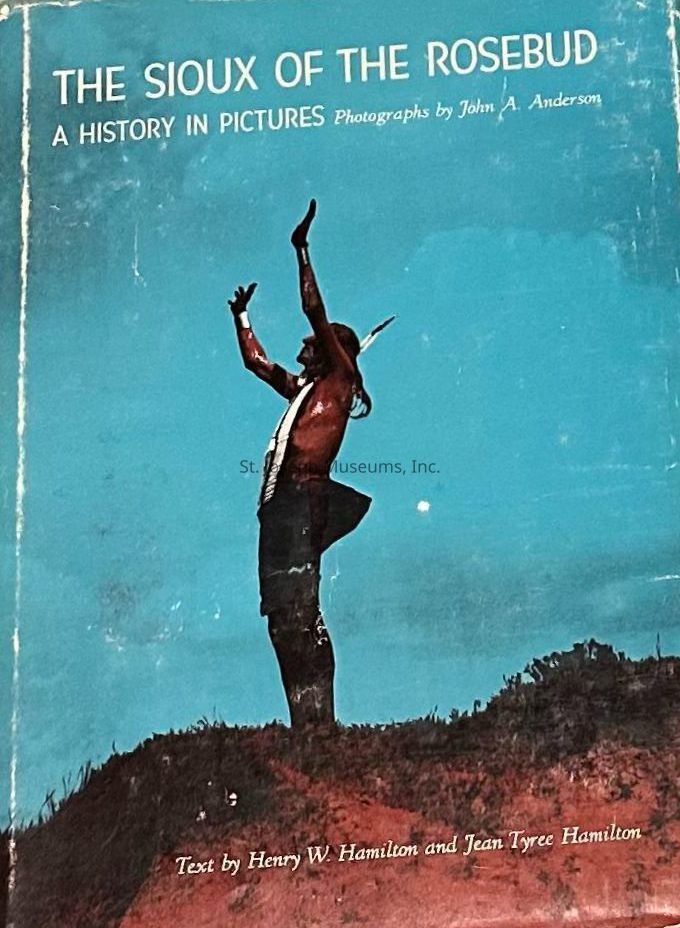
Sioux of the Rosebud, The. A History in Pictures, 1891-1948. John A. Anderson was the official photographer to the Crook Treaty Commission. Anderson lived on the Rosebud Reservation in South Dakota. Henry and Jean Hamilton compiled the photographs of Anderson and provided captions and narrative for those photographs regarding the history of the Brulé Sioux. Hugh Lewis research notation: Page 47 & 163: Possible Roubideaux girl photographed on Plate 45. "Indians and a white girl at Fort Niobrara, 1889..." Roubideaux girl also possibly shown in Plate 110. "A Sioux gathering, 1889. This picture was taken at the Rosebud Agency, facing east. The hill in the background is on the far side of Rosebud Creek. Several of the dancers carry Sun Dance scars on their chests. The girl fourth from left in the foreground resembles the girl in Plate 25." Page 59: Text seems to suggest a Roubideaux house. Plate 34 "...In the right middle distance, inside the near corner of the stockade, is the big L-shaped warehouse, and on the right of the warehouse is the home of the Indian agent." Page 77: Louis Roubideaux. Plate 44 "White Bear speaks to his people, May, 1888. White Bear is advising his people to accept the Great White Father's offer to take the land in severalty. The official interpreter for the United states, Louis Roubideaus, a mixed blood, stands by his side. He is probably translating White Bear's presentation for a government official, not shown in the photograph." Page 78: Roubideaux cabin. Plate 45 "In this photograph, which faces north, the log house on the left (the one with people sitting on the roof), is the Louis Roubideaux home..." Page 79: Roubideaux cabin. Plate 46 "The Crook Treaty hitch lot, 1889..." Page 80: Roubideaux cabin. Plate 47 "The council held to persuade the Indians to sell Tripp and Gregory counties, 1892." Page 89: Louis Roubideaux. Plate 55 "Arrival of commissioner Browning at Cut Meat, 1894. 1, J. George Wright, Indian agent; 2, Mrs. Charles B. Corning; 3 Indian Commissioner D. M. Browning; 4, Louis Roubideaux, interpreter; 5, Charles R. Corning, United States attorney; 6, Mrs. H. W. Caton, wife of the Cut Meat farmer; 7, Chief Hollow Horn Bear; 8, Good Shield, captain of the Indian police; 9, Bear Looks Back; 10, John Brown, chief of police." Page 112: Roubideaux cabin. Plate 76 "Indian women jerking (drying) beef (copyright 1893). This is a comparatively affluent household, with a log house of at least two rooms built at different times and five visible windows, as well as two sweat lodges and a tipi. Extra tipi poles and framework are stacked near the house. In the wagon is a water barrel." Page 135: Anderson home located next door to the Roubideaux cabin. Plate 92 "...The Anderson home is on the left. Valentine McKenzie, the interpreter, is fourth from the left with his back to the camera. The individual at the far left, foreground, writing on a sheet of paper, is unknown. He is perhaps Cody's representative. Part of the outline of Soldier's Hill is visible in the background." Page 142: Louis Roubideaux. Plate 97 "A flag-raising ceremony at Rosebud. The building on the right is the Rosebud day school. This is an early picture. None of the consultants were able to identify the rather distinctive building to the left, and they were able to identify only one person in the picture, The second man on the left, without a hat, is Louis Roubideaux, the interpreter. The white man with the beard on the far right may be Dr. J. Thomas S. Williamson, beloved physician and teacher of the Sioux." Page 164: Picture taken directly in front of Roubideaux cabin. The edge of the cabin roof can be viewed on the bottom right corner of the picture. Plate 111 "Squaw Dance at Rosebud, 1889." Page 165: Photograph taken in front of the Roubideaux cabin, possibly from the roof. Louis Roubideaux is pictured in the middle left of the photograph. Plate 112 "Squaw Dance, June 2, 1889 (copyright 1893). Another scene of the Squaw Dance at White Thunder's Camp at the agency. Many of the dancers wear sage crowns. Note that umbrellas are very popular among the women." Page 167: Roubideaux cabin pictured on the left hand side. Possible the man with hat sitting facing away from the camera, on the far left front, is Louis Roubideaux. Plate 114 "Preparing for the Omaha Dance, or Grass Dance, June 2, 1889." Page 168: Roubideaux cabin pictured on the left hand side. Possible the man with hat sitting facing away from the camera, on the far left front, is Louis Roubideaux. Plate 115 "Omaha Dance, or Grass Dance, June 2. 1889..." Page 169: Photograph taken in front of the Roubideaux cabin. Plate 116 "Omaha Dance, the start (copyright 1893). The flag has forty-four stars." Page 170: Photograph taken in front of the Roubideaux cabin. Plate 117 "Omaha Dance (copyright 1893). Page 171: The roof to the Roubideaux cabin can be seen in the background of the photograph. Plate 118 "Omaha Dance (copyright 1893)." Page 172: Photograph taken in front of the Roubideaux cabin. Plate 119 "Scalp Dance, or War Dance, (copyright 1893)..." Page 173: Photograph taken in front of the Roubideaux cabin. The shadow of the cabin can be seen at the bottom of the photograph. Plate 120 "War Dance (copyright 1893)." Page 186: Louis Roubideaux. Plate 129 "Group of Rosebud Sioux chiefs. Left to right: Bear Head, High Bear, Two Strike, Scoop (Stands and Looks Back), Stranger Horse, He Dog, Swift Bear, and Louis Roubideaux, interpreter. Dr. Hardin remarks in his diary, "Rouideau [sic] would be interpreter for God or the Great Father at Judgment." Bear Head had an 1809 Madison Peace Medal which had been given to his grandfather Iron Man and handed down to his father, Hail Thunder." Page 192: Louis Roubideaux interpreter, back middle of photograph. Plate 133 "Reading the Declaration of Independence, July 4, 1897 (copyright 1897)..." Page 193: Photograph taken in front on Roubideaux cabin. Plate 134 "Gathering for the Fourth of July parade, 1897..." Page 194: Louis Roubideaux photographed to the right of the horse-drawn buggy, riding a horse and wearing a hat. Plate 135 "Parade at Fourth of July celebration at fairgrounds, 1897..." Page 197: Photograph taken in front of the Roubideaux cabin. Plate 140 "A mock attack of mounted Indians on the agency stockade at Rosebud, 1897. For a number of years this continued to be an annual affair held at daybreak on the fourth of July. Note the clouds of dust raised by the attackers." Page 198 &199: Photograph taken in front of the Roubideaux cabin. Plate 141 "Another view of the mock attack on the agency stockade at Rosebud, 1897..." Page 201: Photograph taken in front of the Roubideaux cabin by hill? Plate 143 "Drummers and dancers, about 1900..." Page 202: Photograph taken in front of the Roubideaux cabin. Possible Katie Roubideaux pictured with the children stand in the front far left. Possible Louis Roubideaux pictured sitting on the ground facing away from the camera. Plate 144 Dancers stop to have their pictures taken, about 1900. This is a later photograph of the scene in Plate 143. The same hills are visible in the background. More people, including children in costume, have arrived, and more drummers have joined the group around the drum." Page 224: Katie Roubideaux. Plate 164 " Katie Roubideaux, the daughter of Louis Roubideaux, at the age of eight 1898. Today she is Mrs. Blue Thunder, of Rosebud. Katie is wearing a beaded dress, leggings, and moccasins. She stand on a saddle blanket which is laying on a buffalo robe. Behind her is a tipi." Page 259: Louis Roubideaux pictured in the second row, on the far left. Plate 187 "Men of the Brulé Sioux, Rosebud Agency, 1894. Anderson called this large group of identified men "Chiefs of the Brulé Sioux," although not all of them are chiefs-- or even Indians." Inserted in book: Newspaper clipping titled "Indian calendar 'Count' explained" written by Kathryn Wright. Newspaper clipping titled "As Ghosts Rebelled, the Indians Slew Sitting Bull". Article and map of Belle Fourche, S.D. northern Gateway to the Black Hills. "Belle Fourche, a town of 4000, is the hub of a vast agricultural empire and focal point of a rapidly developing industrial region." 319/Hardcover/Light blue/Jacket depicting an Indian standing with hands raised to the sky/Maps/PhotographsCollection
Robidoux Collection by Hugh LewisLexicon
Nomenclature 4.0
Nomenclature Primary Object Term
BookNomenclature Sub-Class
Other DocumentsNomenclature Class
Documentary ObjectsNomenclature Category
Category 08: Communication ObjectsSearch Terms
Robidoux Family, Robidoux, Louis, Sioux, Rosebud Reservation, Native American, Crook Treaty Commission, Fort NiobraraEthnography
Culture/Tribe
Oceti Sakowin
Native American