SKIRT

Object/Artifact

-

St. Joseph Museums

Name/Title

SKIRT

Entry/Object ID

1975.1.38

Description

WRAP AROUND STYLE/RED/BLUE/WHITE/BLUE LINING/RED IS ACCORDIAN PLEATED/BLUE & WHITE HAS EMB. DES. & BUTTERFLIES

Collection

ETHNOGRAPHIC/CHINA

Made/Created

Place

Continent

Asia

Ethnography

Cultural Region

Country

China

Culture/Tribe

Chinese
Asian

Lexicon

Nomenclature 4.0

Nomenclature Primary Object Term

Skirt

Nomenclature Sub-Class

Main Garments

Nomenclature Class

Clothing

Nomenclature Category

Category 03: Personal Objects

Parts

Count

1

Material

Silk

Condition

Overall Condition

Good

Interpretative Labels

Label Type

Cultural/Historical Context

Label

Ancient China is divided into distinct dynasties, each ruled over by a specific family. The guiding principle for the government of ancient China was called the Mandate of Heaven. The Mandate of Heaven was a philosophy that established whether rulers had the right to rule China. The rulers of ancient China were given vast amounts of power, but they had a moral obligation to use it for the good of their people. If a ruler did not do this, then the country would experience natural disasters. These natural disasters would be a sign to the peasants that the ruler lost the blessing of the gods to rule, and thus it was allowed to overthrow the existing government and install a new dynasty. Each dynasty saw specific achievements and major events. The Zhou dynasty (1046 BCE-256 BCE), for example, saw the formalization of their writing system and the rise of such important philosophers like Confucious, Lao-Tzu, and Sun-Tzu. The Qin Dynasty (221 BCE-206 BCE) began construction on the Great Wall of China. Shi Huangdi, the first emperor of the Qin dynasty, built for himself an enormous tomb which he filled with over 8,000 terracotta warriors to serve him in the afterlife. The Han Dynasty (206 BCE-220 CE) saw the invention of paper, established Confucianism as the exclusive philosophy of the government (a practice that has continued through to modern times), opened the Silk Road which opened trade routes to the rest of Asia and into Europe. The Sui Dynasty (589-618 CE) built the Grand Canal, enlarged the Great Wall, standardized coins across the country, built the army to its largest size, and encouraged the development of literature. The famous story Legend of Hua Mulan is thought to have been written during this time. The Tang Dynasty (618-907 CE) is considered the Golden Age of China, where the country saw an elongated period of peace, during which art, culture, and innovation could flourish. During this time, China also saw its first and only female monarch - Wu Zetian. The Song Dynasty (960 - 1279 CE) saw massive strides in artistic forms, characterized by large landscape paintings. Paper money was used for the first time, movable type was invented to make books and literature widely available and easier to print, traditional Chinese pottery was refined and the quintessential blue and white “China” was made popular, and public schooling was made available to all during this time. The Song Dynasty ended when the Mongols, led by Kublai Khan conquered the area, who established the Yuan Dynasty. There were only two more imperial dynasties that followed, and in 1911 the Republic of China was established.
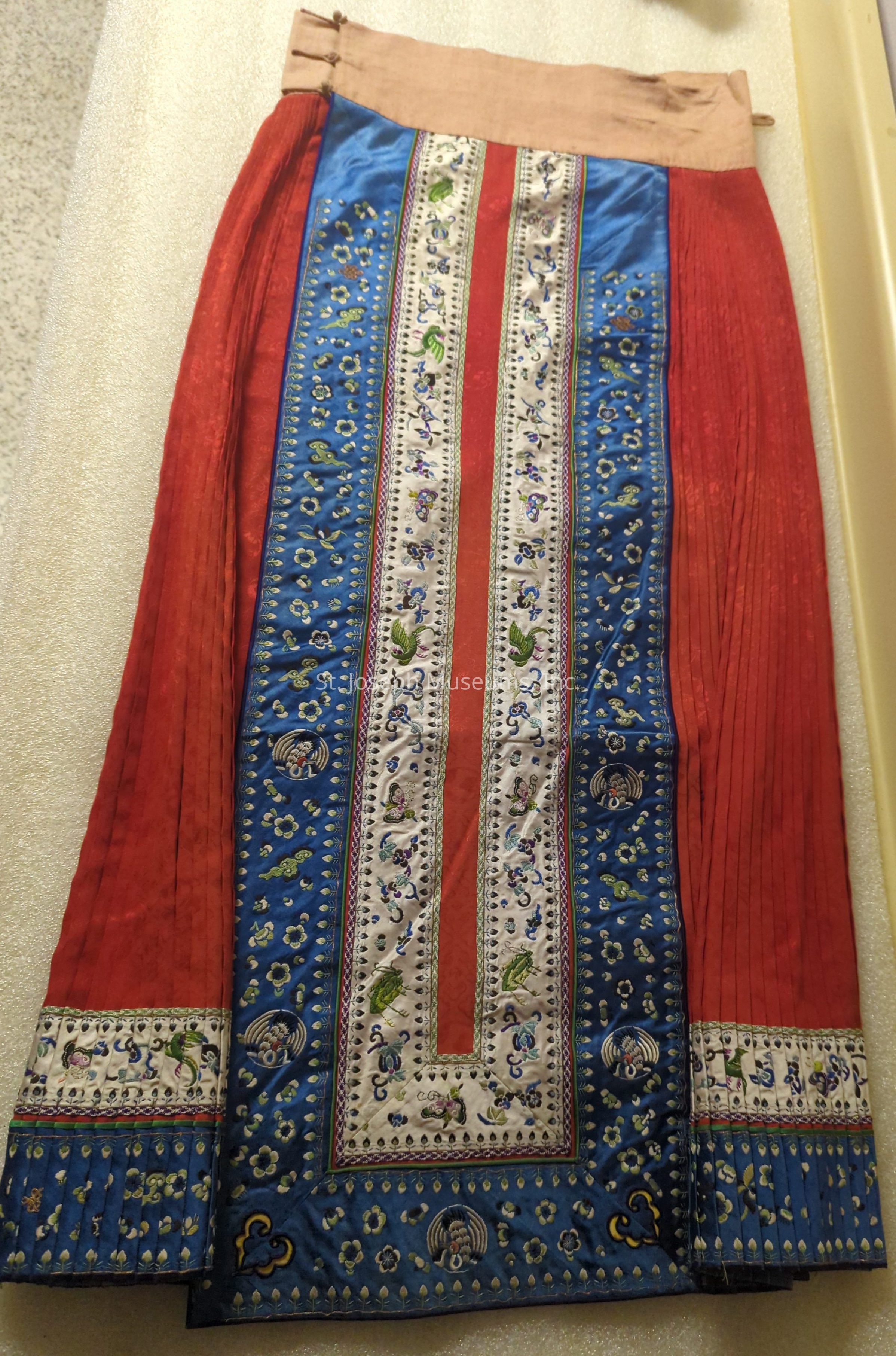
Research Notes

Person

Tori Zieger

Notes

This skirt was made to match the short jacket that is also on display here. This is a common outfit worn by the Han Chinese during the late 1800s and early 1900s (during other periods of time as well, but this particular garment dates to that time period). During this time, the Han Chinese were the indigenous culture in China while the Manchu were the governing powers. The Manchu conquered and took control of China in 1644, established the Qing Dynasty, and would remain in power until World War I. This particular style of skirt is called mamianqun (simplified Chinese: 马面裙; traditional Chinese: 馬面裙) and is one half of hanfu, the traditional clothing of the Han Chinese (the other half being the jacket seen here). These were the favored skirt styles for hundreds of years until they fell out of favor in the 1920s and 1930s. Recently, however, the hanfu movement has been revitalized and the skirt style is more common now. This skirt style would have been exclusive to the Han women and would never have been worn by the Manchu women during the Qing dynasty. Clothing in China is highly symbolic. Not only do the colors and imagery have significance, but the shape and style of the clothing as well. This particular skirt style became popular because it was representative of the Zen idea of avoiding structure in garments and emphasizing decoration. While red was seen as a lucky color and would be used in celebration ceremonies, red also had meaning in every day life. Chinese culture was often polygamous, meaning that men could have more than one wife. The primary wife was the only one allowed to wear the color red (this was an actual law). Secondary wives had to wear green. This style skirt is overlapping and closes with two sets of loops and buttons at the waist. This double closure allowed for more movement, specifically it made horseback riding easier. This style of skirt was also essential for women who had bound feet. The practice of binding feet originated in China as early as the 10th century CE and continued through the early 20th century. In this practice, women’s feet were broken early in childhood with the purpose of preventing the growth of the feet. Traditionally, small feet were seen as a beauty symbol; the smaller the feet, the more desirable the woman. The “highest achievement” would be to have feet no more than 3 inches long, though it was respectable to have 4 inch feet. If a girl were to have 5 inch feet or larger, the prospect of her finding a husband was very slim. Foot binding is extremely painful and made walking very difficult. Women would have to adapt their walking style. This particular walking style would mean they would have to shuffle a little to walk - the double opening on this skirt made that type of walking a little easier. Under this skirt, a Han woman would have worn functional trousers called ku. The traditional mamianqun are characterized by the pleated sides seen here. The mamianqun would be worn as everyday clothing, but is also seen in formal attire. Brides would wear an (often red) mamianqun, for ceremonies like birthdays and family sacrificial rites, as well as formal court attire. The color and embroidery images of garments were highly symbolic in China. On this skirt cranes, butterflies, grasshoppers, flowers, and another bird that is likely a swallow can be seen. In Chinese culture, cranes represent nobility and wishes for longevity. Butterflies represent love and happiness. Grasshoppers represent happiness and joy. Swallows are symbols of good luck and positive change. Flowers can represent different things depending on the type of flower. These flowers are likely cherry blossoms, which represent women’s beauty, or jasmine, which symbolize eternal love. Linked altogether, the symbols on this skirt likely wish the owner happiness and longevity in marriage.