Name/Title
Pamphlet "The Truth About Navajo Rugs"Entry/Object ID
Q1430.635.56DDescription
Vol II pg. 56D
Pamphlet entitled "The Truth About Navajo Rugs," with information regarding the creation of and symbolism behind the making of the rugs. Includes photographs.
undated.
The Truth About Navajo Rugs
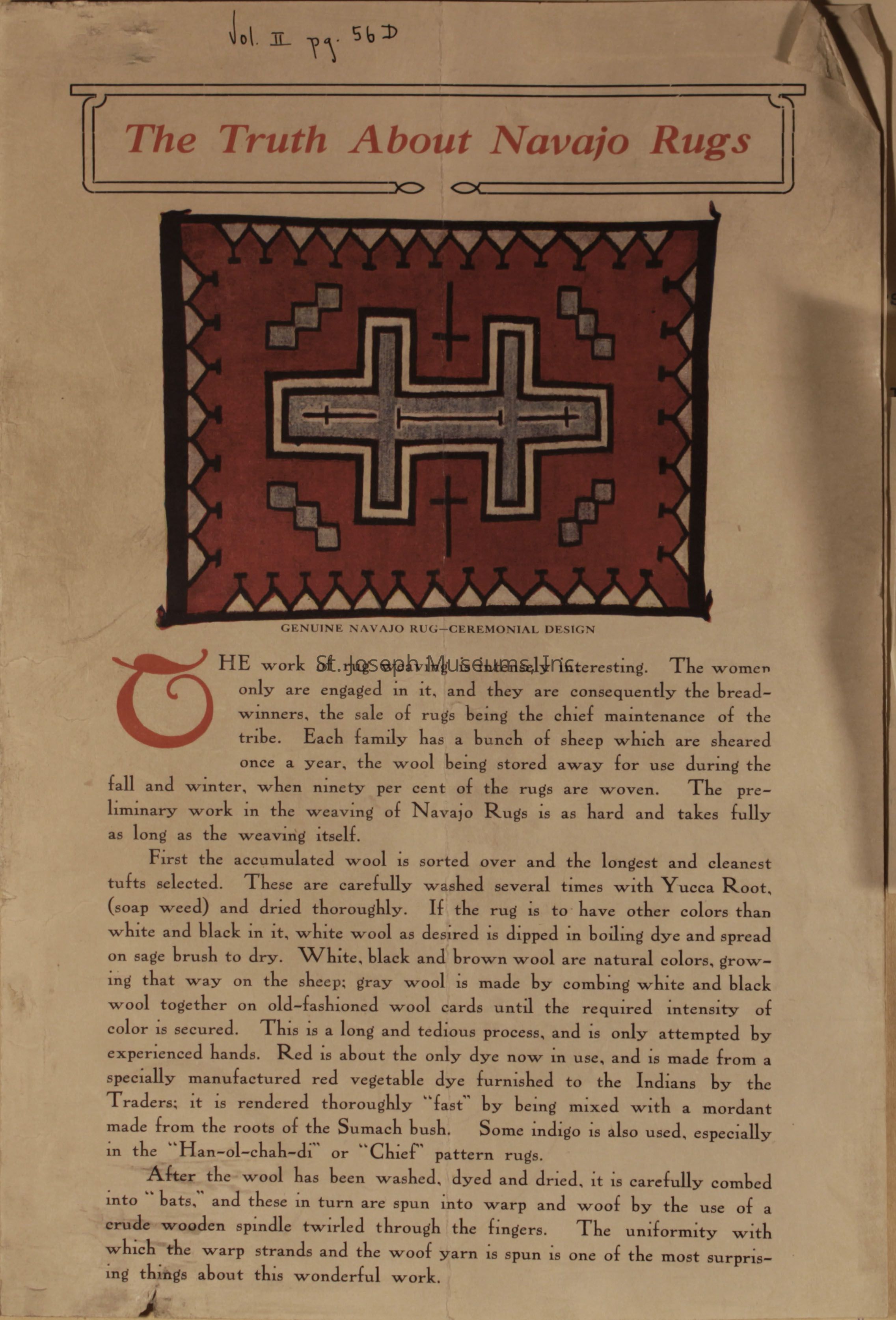
[image caption] Genuine Navajo Rug - Ceremonial Design
The work of rug weaving is intensely interesting. The women only are engaged in int, and they are consequently the breadwinners, the sale of rugs being the chief maintenance of the tribe. Each family has a bunch of sheep which are sheared once a year, the wool being stored away for use during the fall and winter, when ninety per cent of the rugs are woven. The preliminary work in the weaving of Navajo Rugs is as hard and takes fully as long as the weaving itself.
First the accumulated wool is sorted over and the longest and cleanest tufts selected. These are carefully washed several times with Yucca Root, (soap week) and dried thoroughly. If the rug is to have other colors than white and black in it, white wool as desired is dipped in boiling dye and spread on sage brush to dry. White, black and brown wool are natural colors, growing that way on the sheep; gray wool is made by combing white and black wool together on old-fashioned wool cards until the required intensity of color is secured. This is a long and tedious process, and is only attempted by experienced hands. Red is about the only dye now in use, and is made from a specially manufactured red vegetable dye furnished to the Indians by the traders; it is rendered thoroughly “fast” by being mixed with a mordant made from the roots of the Sumach bush. Some indigo is also used, especially in the “Han-ol-chah-di” or “Chief” pattern rugs.
After the wool has been washed, dyed and dried, it is carefully combed into “bats,” and these in turn are spun into warp and woof by the use of a crude wooden spindle twirled through the fingers. The uniformity with which the warp stranda sn the woof yarn is spun is one of the most surprising things about this wonderful work.
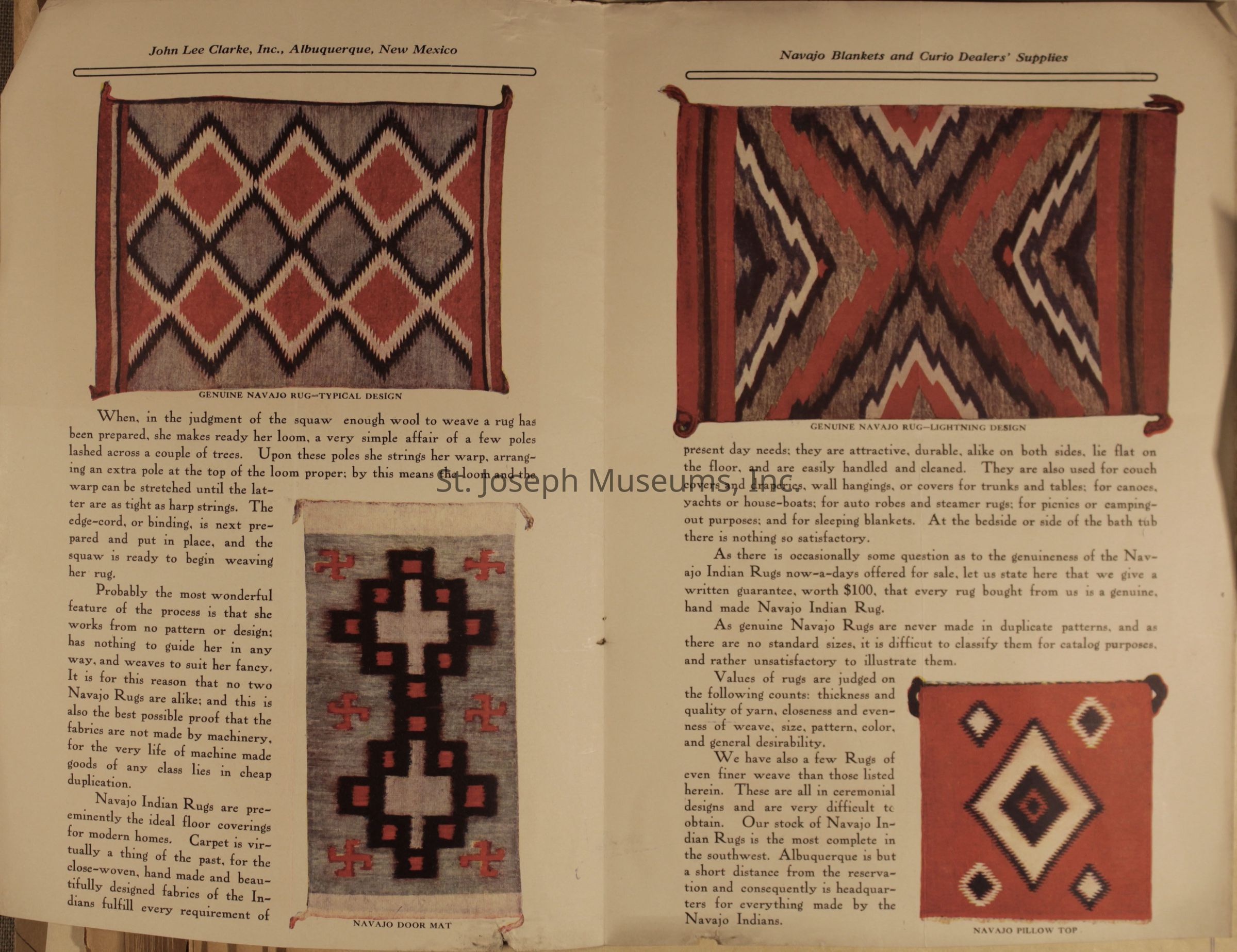
[image caption] genuine Navjo rug - typical design
When, in the judgment of the squaw enough wool to weave a rug has been prepared, she makes ready her loom, a very simple affair of a few poles lashed across a couple of trees. Upon these poles she strings her warp, arranging an extra pole at the top of the loom proper; by this means the loom and the warp can be stretched until the latter are as tight as harp strings. The edge-cord, or binding, is next prepared and put in place, and the squaw is ready to begin weaving her rug.
Probably the most wonderful feature of the process is that she workers from no pattern or design; has nothing to guide her in any way, and weaves to suit her fancy. It is for this reason that no two Navajo Rugs are alike; and this is also the best possible proof that the fabrics are not made by machinery, for the very life of machine made goods of any class lies in cheap duplication.
[image caption] Navajo door mat
Navajo Indian rugs are pre-eminently the ideal floor coverings for modern homes. Carpet is virtually a thing of the past, for the close-woven, hand-made and beautifully designed fasbrics of the Indians fulfill every requirement of present day needs; they are attractive, durable, alike on both sides, lie flat on the floor, and are easily handled and cleaned. They are also used for couch covers and draperies, wall hangings, or covers for trunks and tables; for canoes, yachts or house-boats; for auto robes and steamer rugs; for picnics or camping-out purposes; and for sleeping blankets. At the bedside or side of the bath rub there is nothing so satisfactory.
[image caption] Genuine Navajo rug – lightning design
As there is occasionally some question as to the genuineness of the Navajo Indian Rugs now-a-days offered for sale, let us state here that we give a written guarantee, worth $100, that every rug bought from us is a genuine, hand made Navajo Indian Rug.
As genuine Navajo Rugs are never made in duplicate patterns, and as there are no standard sizes, it is difficut to classify them for catalog purposes, and rather unsatisfactory to illustrate them.
Values of rugs are judged on the following counts: thickness and quality of yarn, closeness and evenness of weave, size, pattern, color, and general desirability.
We have also a rfew Rugs of even finer weave than those listed herein. These are all in ceremonial designs and are very difficult to obtain. Our stock of Navajo Indian Rugs is the most complete in the southwest. Albuquerque is but a short distance from the reservation and consequently is headquarters for everything made by the Navajo Indians.
[image caption] Navajo pillow topSubject
Navajo
RugsSubject Person/Organization
Harry L. George Collection