Name/Title
Western Spring Beauty (Claytonia lanceolata)Entry/Object ID
2021.1.36 BScope and Content
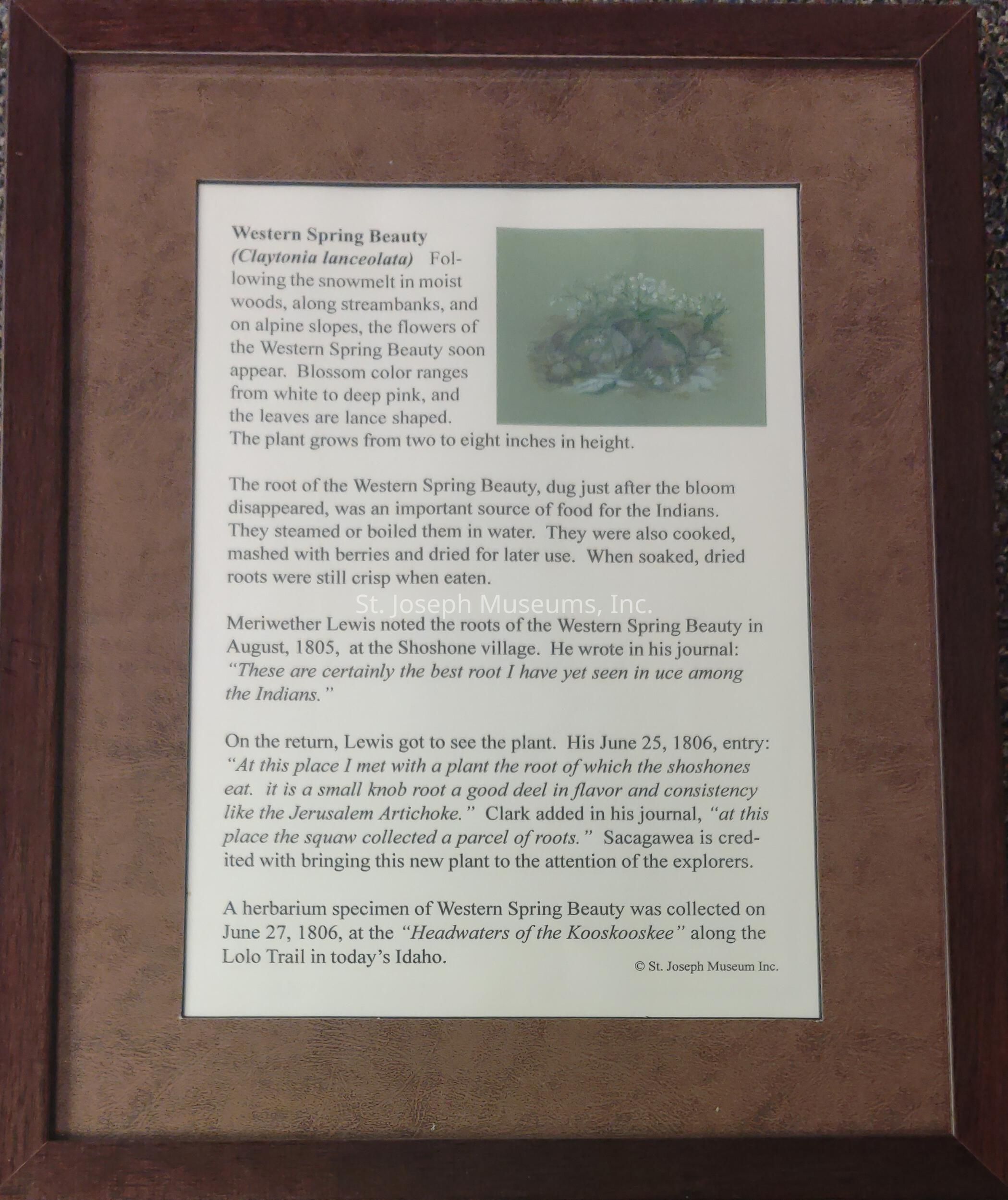
Western Spring Beauty (Claytonia lanceolata) plant description, framed.
Following the snowmelt in moist woods, along streambanks, and on alpine slopes, the flowers of the Western Spring Beauty soon appear. Blossom color ranges from white to deep pink, and the leaves are lance shaped. The plant grows from two to eight inches in height.
The root of the Western Spring Beauty, dug just after the bloom disappeared, was an important source of food for the Indians. They steamed or boiled them in water. They were also cooked, mashed with berries and dried for later use. When soaked, dried roots were still crisp when eaten.
Meriwether Lewis noted the roots of the Western Spring Beauty in August, 1805, at the Shoshone village. He wrote in his journal; "These are certainly the best root I have yet seen in uce among the Indians."
O the return Lewis got to see the plant. His June 25, 1806, entry; "At this place I met with a plant the root of which the shoshones eat. it is a small knob root a good deel in flavor and consistency like the Jerusalem Artichoke." Clark added in his journal, "at this place the squaw collected a parcel of roots." Sacagawea is credited with bringing this new plant to the attention of the explorers.
A herbarium specimen of Western Spring Beauty was collected on June 27, 1806, at the "Headwaters of the Kooskooskee" along the Lolo Trail in today's Idaho.Context
Originally designed by the St. Joseph Museum in the fall of 2004. Titled "Botanical Wonders of the Uncharted West. The Recorded Flora of the Lewis & Clark Expedition."Collection
Lewis and ClarkLexicon
LOC Thesaurus for Graphic Materials
Botanical drawings, Expeditions & surveysArchive Items Details
Title
Western Spring Beauty (Claytonia lanceolata)Creator
Mary L. FletcherDate(s) of Creation
2004Subjects
Plants, Watercolor paintingsParts
Count
2Parts
Watercolor of plant and descriptive label, both framed.Condition
Overall Condition
Very GoodProvenance
Notes
"Botanical Wonders of the Uncharted West" visually depicts how well Lewis followed Jefferson's instructions. In recognition of this achievement, The S. Joseph Museums, Inc. commissioned accomplished artist Mary Fletcher to create fifty (50) selected paintings of flora documented by the Corps during their Journey. These framed watercolor originals are accompanied by similarly framed labels, generated by former Head of Research Jackie Lewin, which describe the corresponding plants with appropriate quotations from the Journals. This collection makes available for study and appreciation plants that were new to Lewis and Clark, but which Native Peoples already recognized as valuable sources of food, medicine, and tools. Some of these still remain a mystery to many, but all will enjoy their beauty, their diverse uses, and their accomplished renderings.