Name/Title
Sauce TureenEntry/Object ID
L2014.1.56Description
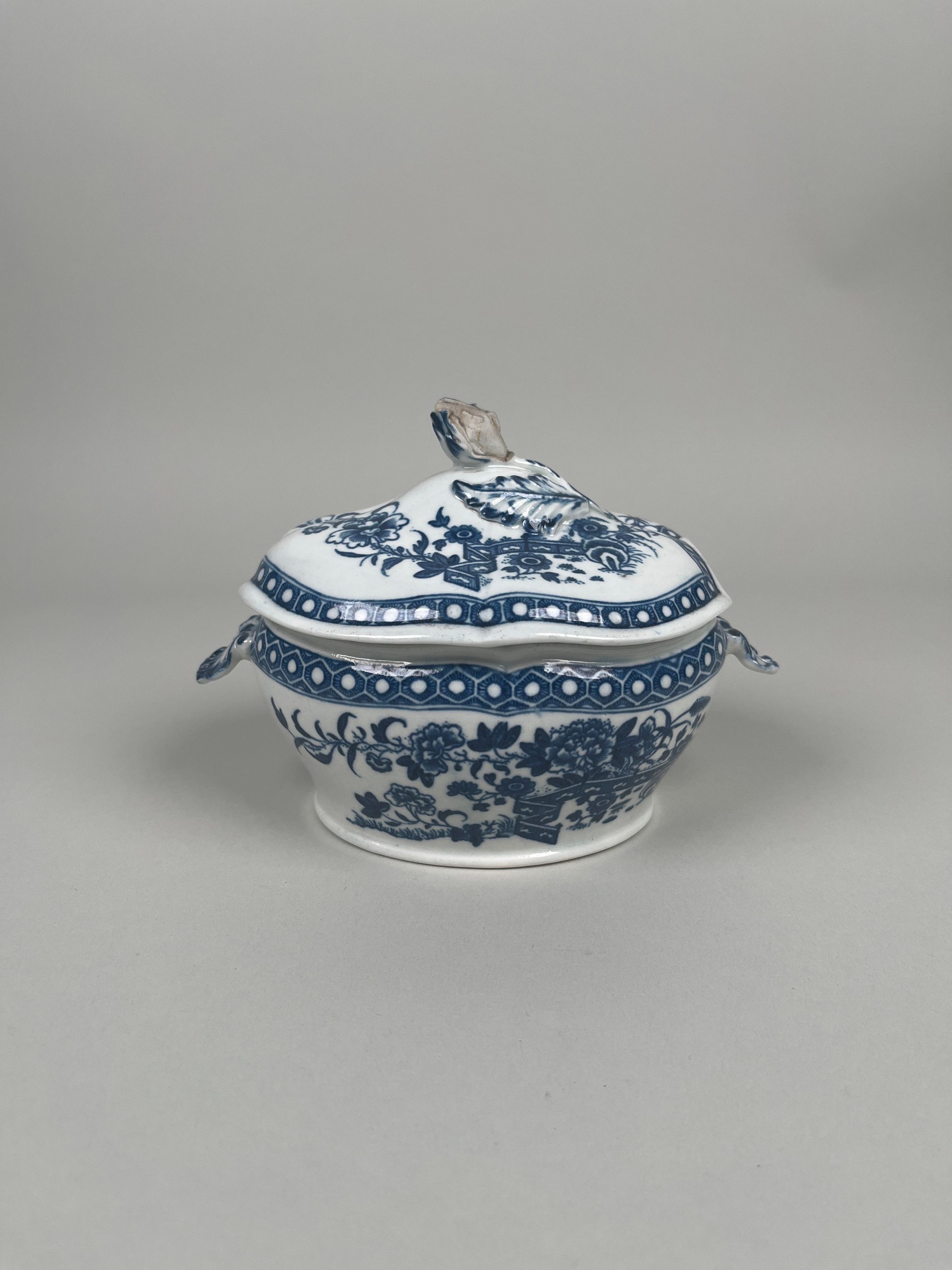
Small tureen having an oval, lobed body standing on a pedestal foot, shell-shaped handles, and a lobed domed cover with a fruit-shaped knob, transfer-printed in underglaze blue with a hexagonal cell border at the rim of the body and cover and a landscape vignette with two masses of land separated by water with oversized flowering plants, a zigzag fence, and two birds on the body of the tureen and cover. There is a notch in the cover for a ladle. On the underside is a printed crescent mark.
This piece is transfer-printed in what is known as the “Fence pattern,” after the zigzag fence that is part of the design. The most popular blue and white pattern made at Worcester, it was developed between 1765 and 1768 and is based on designs found on contemporary Chinese export porcelain. It continued in production until at least 1790, and possibly as late as 1795. The hexagonal cell border was also inspired by brocade patterns found on contemporary Chinese export porcelain. The pattern was copied by the English porcelain factories of Caughley, Coalport, Lowestoft, and Derby. (Sandon, Dictionary of Worcester Porcelain (1993), 154).
Tureens of this size and shape were developed by the Sèvres porcelain factory, where it was known as a sucrier de Monsieur le Premier (first gentleman’s sugar bowl). They were designed to be part of a dessert service.Collection
CeramicsMade/Created
Manufacturer
Worcester Porcelain FactoryDate made
circa 1765 - circa 1790Time Period
18th CenturyPlace
City
WorcesterCountry
EnglandRegion
Great Britain, British Isles, Western EuropeContinent
EuropeMaterial
Soft paste porcelain