Name/Title
TeapotEntry/Object ID
A1982.14.141Description
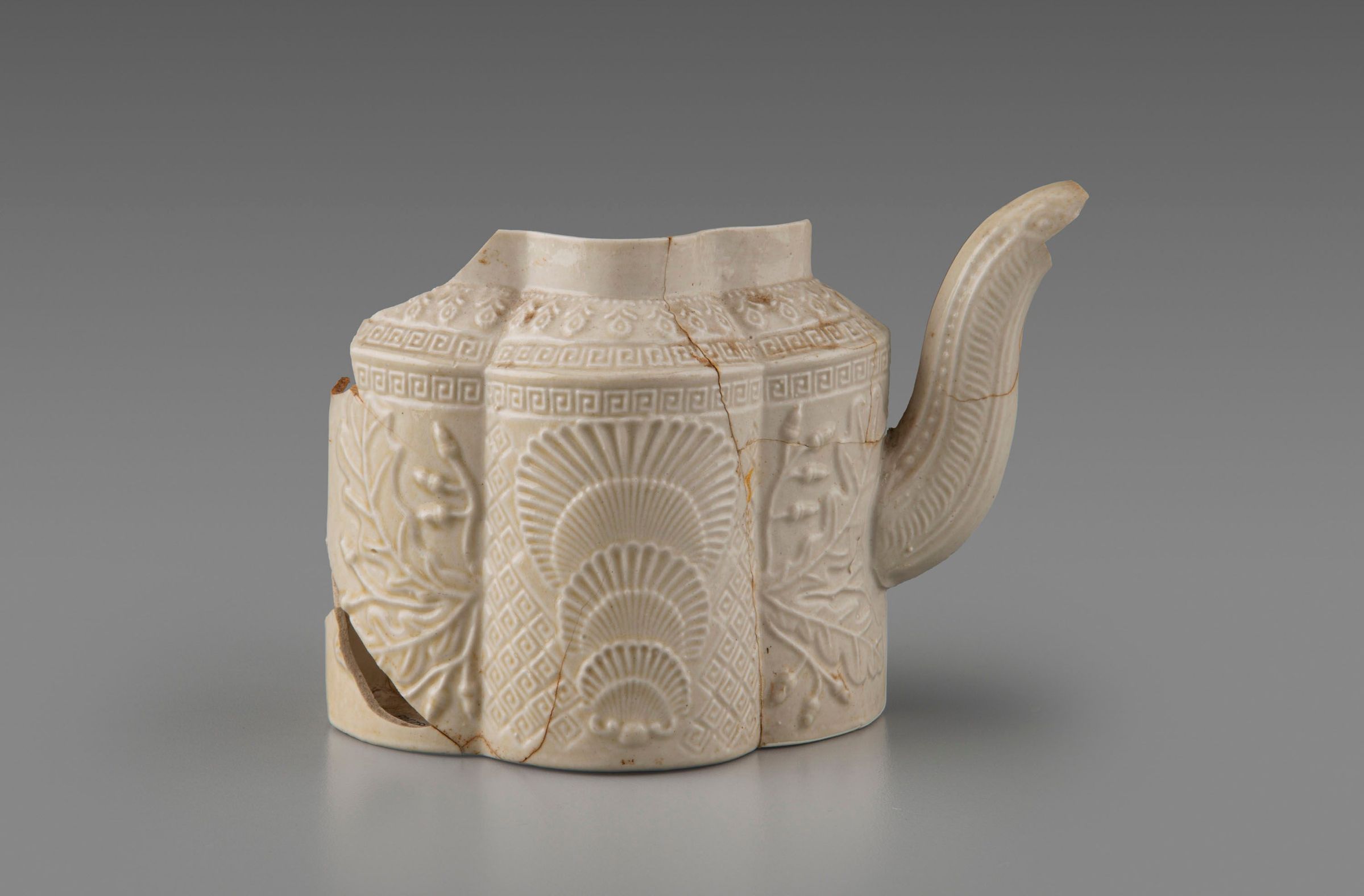
Slip-cast teapot having a straight-side, quatrefoil body with steep shoulders; a short vertical neck; and a molded s-curved spout; the body molded with three pectin shells on the side lobes, oak leaves and acorns on the front and back lobes, and a meander and vine border at the edge of the shoulders.
The pot would have probably had a simple rolled loop handle and a domed, quatrefoil cover.
Pectin shells (a type of large scallop) were among the most popular motifs used on Staffordshire white salt-glazed stoneware in the 1740s and 1750s. According to English ceramics specialist Peter Walton, the decoration of molded pectin shells and oak leaves had been associated with the Staffordshire modeler Ralph Wood (1715-1772).
Similar teapots, probably made from the same mold, are in the collection of Historic Deerfield (HD61.076), the Mint Museum (Gallagher, British Ceramics (2015), 136), and the Victoria and Albert Museum (2176&A-1901).Context
The teapot is an excellent example of English salt-glazed stoneware. Though much plainer in color than the other ceramic objects it may have shared table space with, rich surface decoration enabled by the development of slip casting and press-molding technology rendered the clear-glazed stoneware just as decorative. The shell and faunal motifs on this teapot reflect some of the aesthetic trends of the Rococo, which frequently features natural motifs and heavily decorated surfaces. The shape of the spout resembles an S-curve, serving both a functional and aesthetic purpose. Painter William Hogarth's 1753 book The Analysis of Beauty posited that the S-curve was the most beautiful line and excites the attention of the viewer, and that these undulating lines were the basis of beauty in nature.Collection
CeramicsMade/Created
Date made
circa 1745 - circa 1755Place
County
StaffordshireCountry
EnglandRegion
Great Britain, British Isles, Western EuropeContinent
EuropeNotes
Historic Deerfield notes that the design of pecten shells, acorns, and oak leaves has been associated with pieces by Ralph Wood.Material
Salt-glazed StonewareRelationships
Related Places
Place
Location
StentonCity
PhiladelphiaState/Province
PennsylvaniaCountry
United States of AmericaContinent
North AmericaRelated Events
Event
1982 Archeological Excavation