Chemise
Name/Title
ChemiseEntry/Object ID
2022.10.1Description
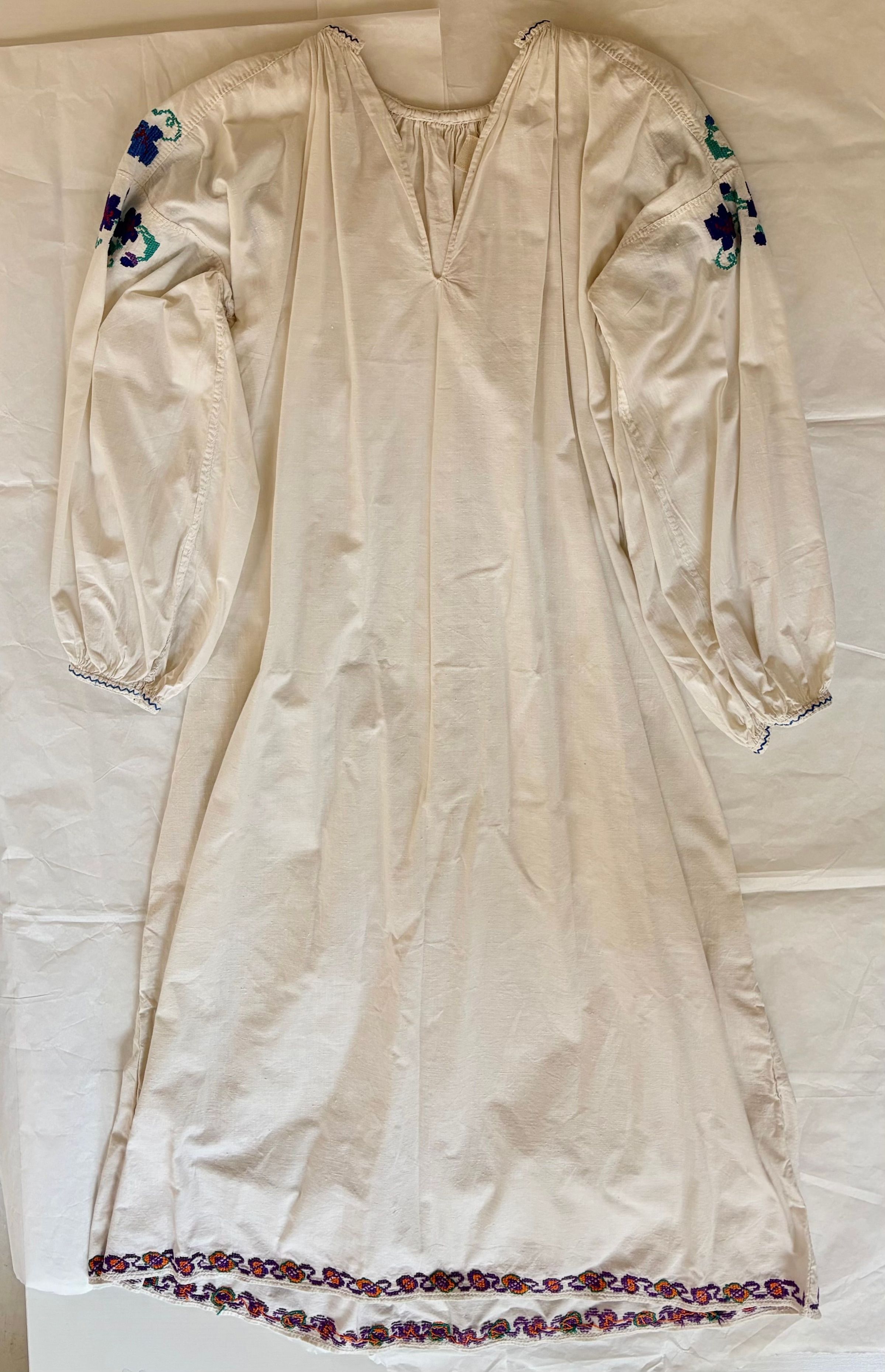
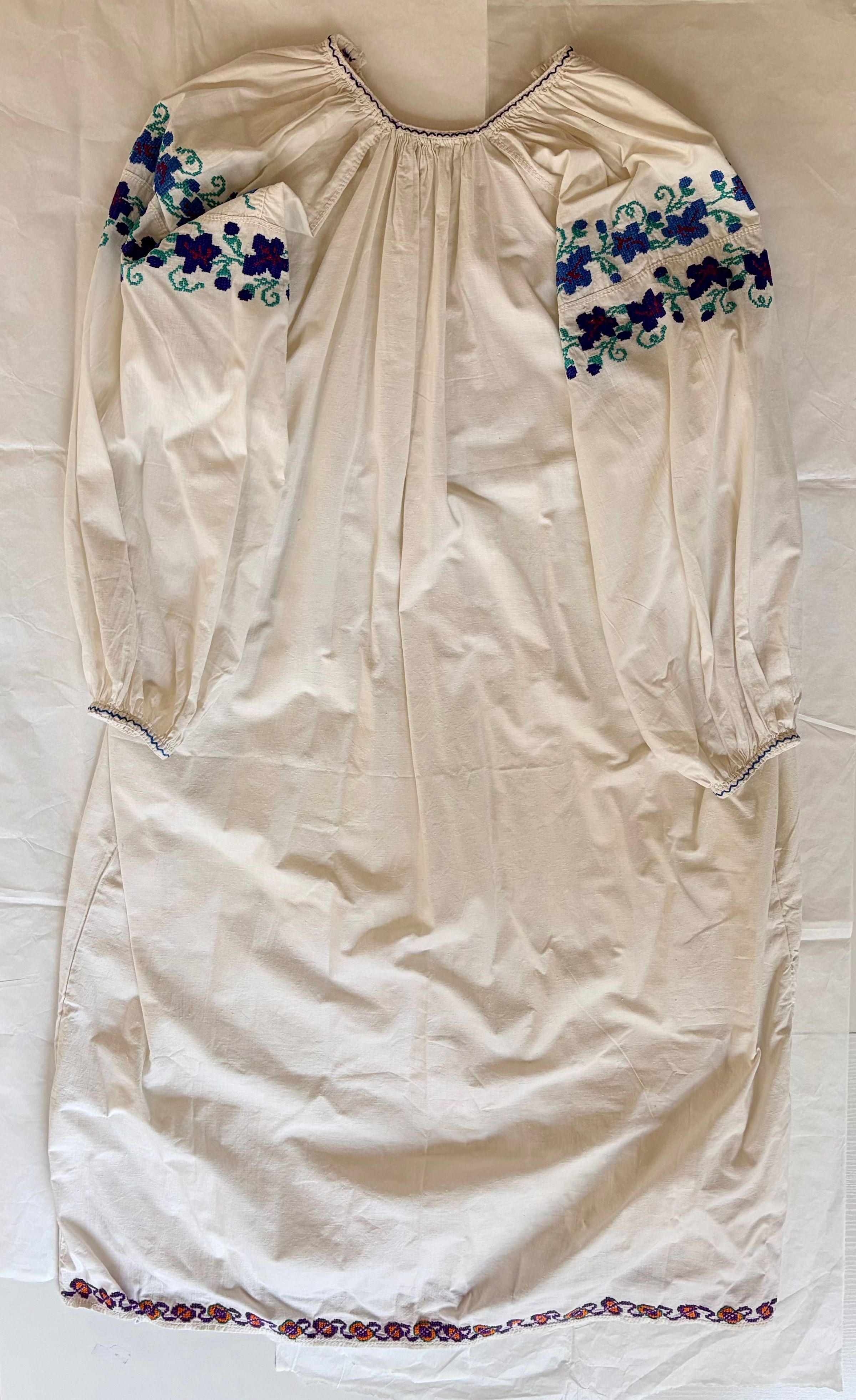
White chemise embroidered with cross-stitch patterns of blue and purple flowers with green vines. At the cuffs, jagged lines of blue embroidery. Along the bottom hem, a meandering motif of purple with green and orange accents.Use
Vyshyvanka worn by Ukrainian women as a base layer in folk dress.Context
The vyshyvanka represents the rich history of Ukrainian national folk dress and embroidery techniques. Originating back to the Middle Ages during the rule of Kyivan Rus’ (9th–13th centuries), vyshyvanky worn as part of daily dress, decorated with simple geometric motifs inspired by Byzantine and Eastern Slavic motifs. From the 15th to 17th centuries, the vyshyvanka's symbolic meanings began to evolve. By the 18th–19th centuries, under the rule of the Polish-Lithuanian Commonwealth and later the Austrian and Russian empires, the vyshyvanka became a powerful symbol of Ukrainian cultural preservation and national identity. Today, with the Russian annexation of Crimea and the ongoing war throughout Ukrainian lands, vyshyvanky remain a talisman for national pride and strength, with National Vyshyvanka Day celebrated each year. These chemises are traditionally worn by women for festive occasions and are made from a mix of standard and fine linen, although recent versions appear to be made from blends with cotton. Linen and other plant fibers were chosen for their alleged protective qualities, and were believed to be especially effective when worn against the skin. Additionally, certain colors were chosen for their spiritually protective qualities. As for the colors seen on this chemise, blue symbolized calm, depth of thought, inner harmony and wisdom. It also represents the sky and water, as well as the union of the masculine and the feminine. In ancient times, blue ornamentation was predominantly used to protect men from danger and children from illness. Purple symbolized spirituality and mysticism. In practice, purple threads were also frequently used to create clothing for pregnant women and children. Green carried meanings of fertility, life and nature. Green is additionally linked to youth, awakening, tranquillity and growth. Motifs also held symbolic weight, according to Ukrainian embroidery traditions. Of 250 recognized motifs, most fall into the categories of geometric, zoomorphic, and floral or botanical patterns. Here, we see a floral pattern along the sleeves and meandering geometric motifs at the cuffs, neck, and bottom hem. These curvilinear designs are reminiscent of “hesyky” (S-figures), or "keys". The shape resembles a half swastika or half of the figure-eight, and was seen as “the road to perfection”. The S-figure is a wavy line, symbolic of “heavy” earthly waters that gives life to fields and crops and provides protection to the wearer of such a motif. These designs are also similar to a motif called the “bezkonechnyk” (infinite line) or meander. Scholars have shown that this symbol was popular on the territory of Ukraine more than 20,000 years ago. In ancient Ukrainian traditions, its soft curves are also associated with the harmonious flow of water and of life. It forms an infinite pattern that winds its way like the thread of fate, but always comes back to the source. Meander patterns usually decorate men’s shirts, symbolizing and bestowing strength and vitality.Category
Clothing