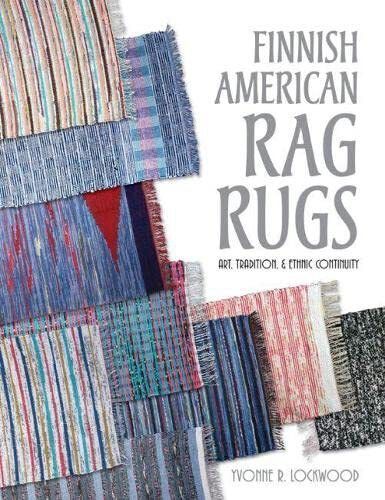
Finnish American rag rugs : art, tradition & ethnic continuity
Entry/Object ID
TT850.L63
Description
Finnish American Rag Rugs is about rag rug culture and the role of rag weaving in Finnish America. In a larger sense, it is also a study of how a craft can persist over centuries, reinforcing the culture, attitudes, behaviors, beliefs, and values of an immigrant group that retains a strong sense of its ethnic identity. Finnish American Rag Rugs provides a history of Finnish immigration to and settlement in Michigan's Upper Peninsula alongside an examination of the tradition of rag weaving in the United States and the Nordic region. Although many other immigrants have a tradition of making rag rugs, Finnish Americans are one of the few groups to have maintained the culture of rag weaving since their immigration. In the process of studying this one activity of one ethnic group, the author uncovers new information about both the history of a ubiquitous form of fiber art and the beliefs and values of an understudied ethnic group. Illustrated with more than 200 color photos, Finnish American Rag Rugs is both informative and beautiful.
Lexicon
Search Terms
finnish americans, hand weaving--michigan, rag rugs, weaving--finland, weaving--united states--history
Legacy Lexicon
Category
Book
Book Details
Author
Yvonne R. Lockwood
Publisher
Michigan State University
Place Published
City
East Lansing, MI
Date Published
2010
Call No.
TT850.L63
ISBN
870138642, 9780870138645
LCCN
2009006393
Notes
Length: 249
General Notes
Note Type
Contents
Note
Time for weaving, a poem by Johanna Pohjala -- The history of rag weaving -- Finnish -- American presence -- Weavers -- A good rug requires a good loom -- The weaving process -- Aesthetics -- Influences on tradition -- The life cycle of a rag rug -- Learning from masters -- Concluding thoughts -- Weavers and loom makers -- Location of weavers and loom makers -- Rag rug apprenticeships, 1987-2005 -- Warping the loom -- Portrait of a loom, by Mary Nikkari Bindewald -- Designs from 1920 to the 1940s.