Hmong handwoven panel
Name/Title
Hmong handwoven panelEntry/Object ID
2024.9.40Description
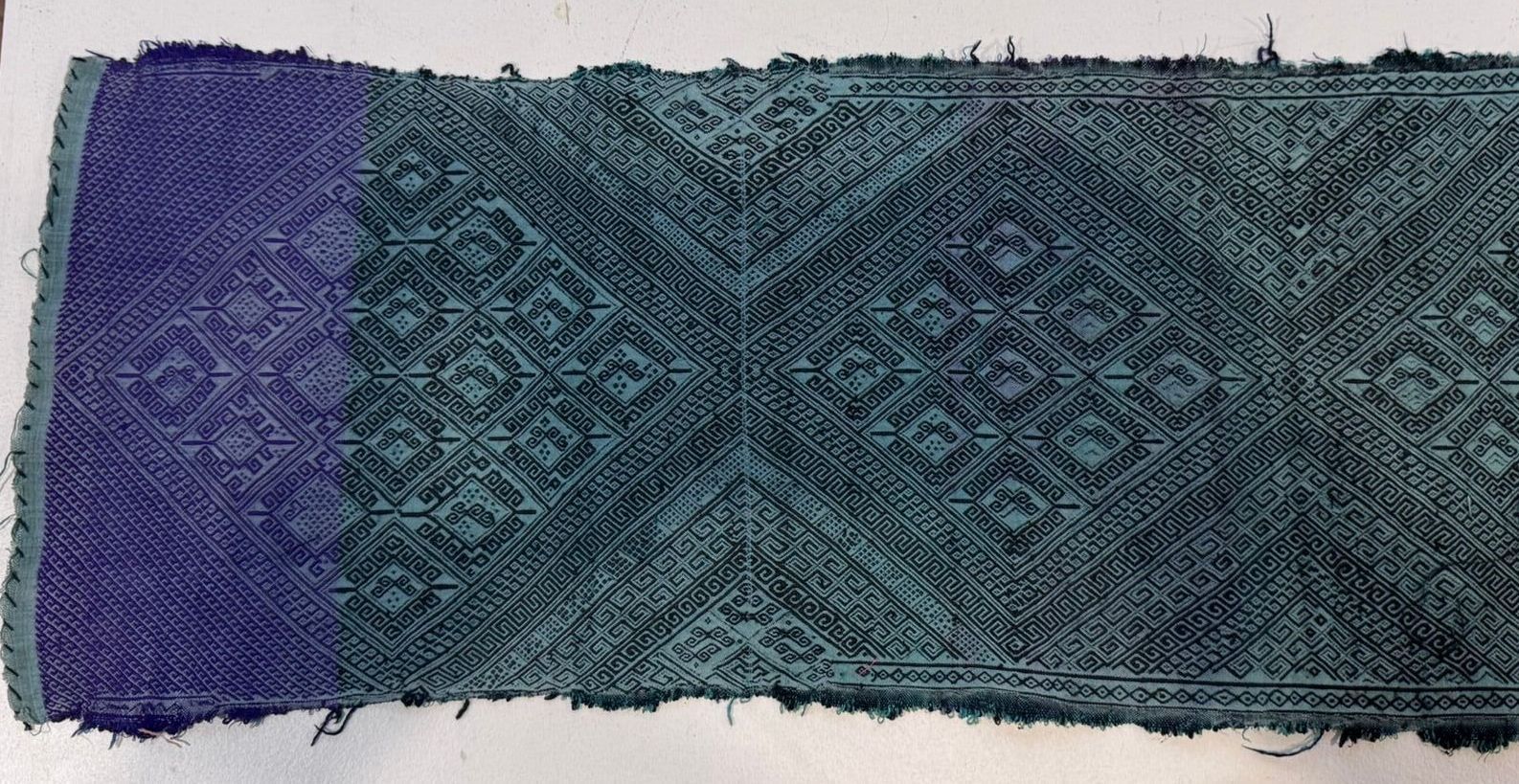
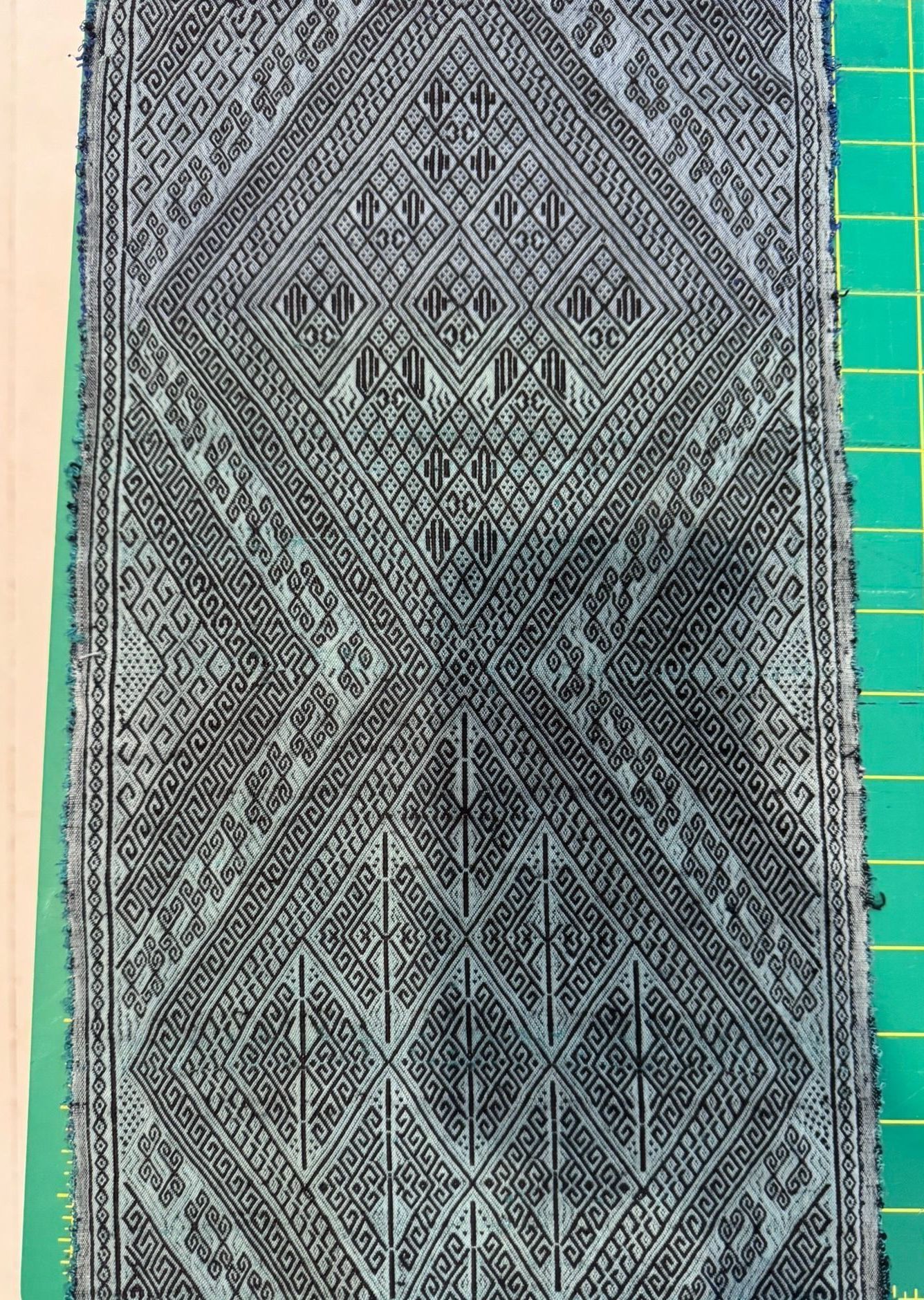
Hmong handwoven panel with diamond pattern and various motifs. Weaving is predominantly grayish-teal and black. Top of panel has a small section woven in a bright purple color. Top and bottom edges are finished with whip stitch. There are several recognizable motifs commonly used in Miao textiles, including the butterfly and spiral shapes. The butterfly relates to a legend which narrates that the Miao people are born from butterflies whose eggs were laid on the sweet gum tree. The butterfly signifies the creation of the Miao people, and represents rebirth, the continuation of Miao ethnic identity, and ancestors. The spiral shapes found in Miao textiles are associated with large bodies of water, and relate to memories of their migratory past.Textile Type
WeavingUse
Potentially used as a head wrap.Context
This is a weft float pattern weaving from women of the Miao Hmong ethnic group. Threads are typically made of hemp, which is harvested once the hemp has flowered. Women then dry the hemp in the sun for the week, turning it every two or three days to ensure that it dries properly. Once the thread is dried, it can be cut by hand, then tied together, gradually winding the resulting thread around their wrists, eventually producing a rough yellowish spool. This work is typically done during evening gatherings, though Hmong women spend every spare minute they have adding to this spool. A large flat stone and a wide wooden board are used as a millstone to soften the fibre, with the stone being rolled over the fibre until it becomes supple. The thread is then white- washed, boiled in wax and hung over a large, horizontal, cross-shaped winding-reel, or tus khqub lig. The Hmong use two types of looms, a batik loom, modeled on those used by Laotians (this is the most common type), and a traditional non- batik, single-warp loom. The loom is fastened to the woman’s hip. The weaver works sitting down, and in the case of the less common loom the other end is fastened to a pillar.Category
Weaving
Acquisition
Accession
2024.9Acquisition Method
PurchaseMade/Created
Time Period
20th CenturyPlace
Country
ChinaContinent
AsiaWoven Textile Details
Textile Shape
PanelEthnography
Cultural Region
Country
ChinaContinent
AsiaCulture/Tribe
Hmong, Miao People