Note
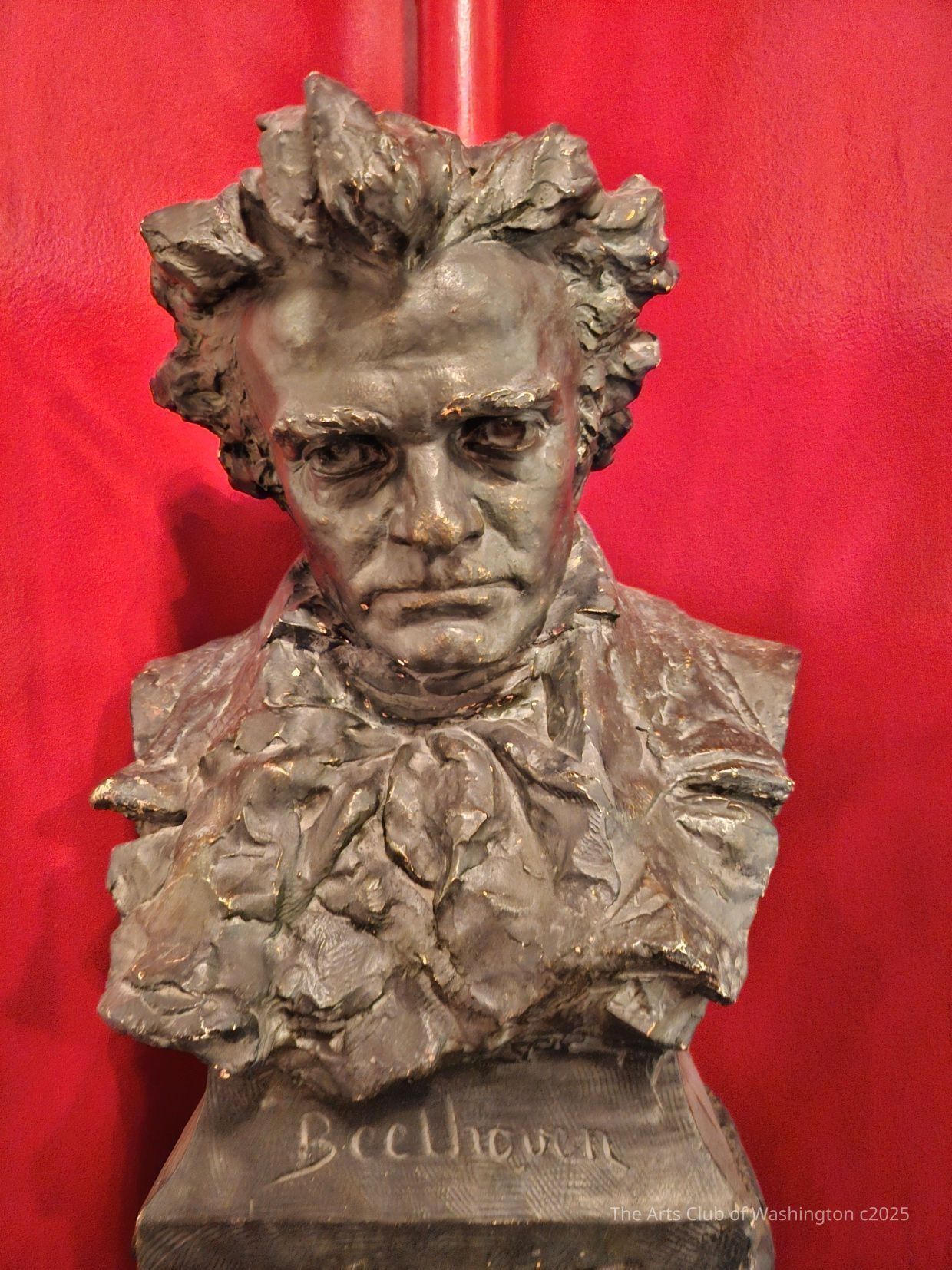
Ludwig van Beethoven was a German composer and pianist. Beethoven remains one of the most admired composers in the history of Western music; his works rank among the most performed of the classical music repertoire and span the transition from the Classical period to the Romantic era in classical music.
The plaster bust was sculpted by Romanian artist George Julian Zolnay (1863-1949). Born in Bucharest, Zolnay studied and graduated from the National School of Fine Arts of Bucharest. He then went to Paris to study under William-Adolphe Bouguereau and Alexandre Falguière, and then to the Imperial Academy of Fine Arts of Vienna where he studied under Edmund von Hellmer and Carl Kundmann and received a Grand Prix for his work.
Zolnay came to the United States in 1893 to attend the World's Columbian Exposition, at the behest of the U.S. consul-general to Vienna. He intended to return home, but chose New York City for his new home in 1894, eventually becoming an American citizen. In 1913, Zolnay moved his studios to Washington, D.C. Zolnay was a founder of the Arts Club of Washington in 1916, and served as its second president. Beside his sculptural activity, and holding sculpture classes at the Zolnay Atelier, he also delivered lectures on Romania, illustrated with traditional Romanian music and by lantern slides, at the Smithsonian Institution.