Urn, Coffee

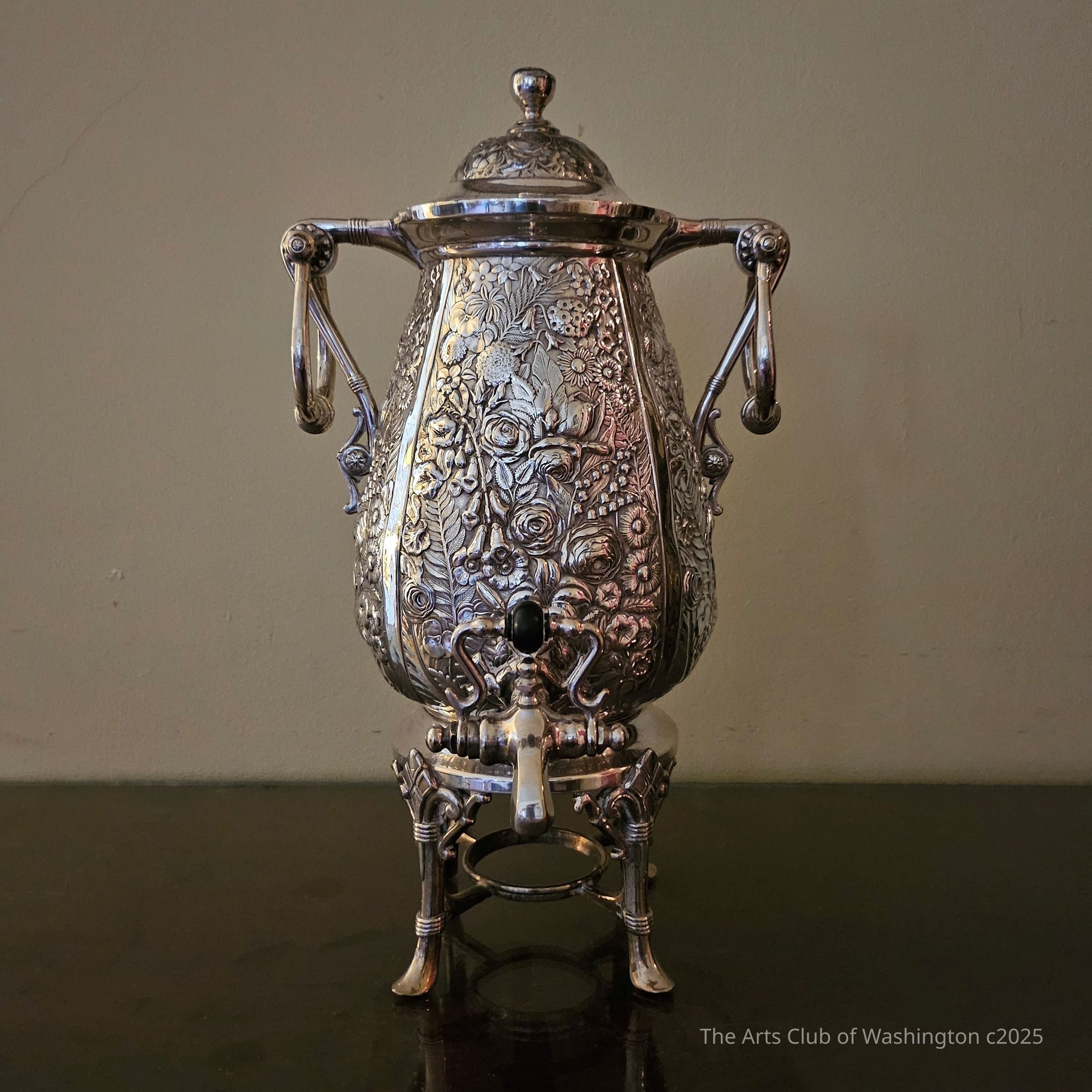
Urn, Coffee, Reed and Barton, silverplated metal, 1876.: Four straight bound and scrolled legs with slipper feet connect to a central fuel holder and support a bulbous lidded body heavily embossed with  roses and other flowers and having a spigot with a handle formed by opposing "S" shapes. A pair of "akimbo" arms with elongated rings attach to each side.
Urn, Coffee, Reed and Barton, silverplated metal, 1876.

Four straight bound and scrolled legs with slipper feet connect to a central fuel holder and support a bulbous lidded body heavily embossed with roses and other flowers and having a spigot with a handle formed by opposing "S" shapes. A pair of "akimbo" arms with elongated rings attach to each side.

Name/Title

Urn, Coffee

Context

The coffee urns on view in the Club public rooms are decorative; modern urns with warming mechanisms are used for buffets meals and receptions.

Made/Created

Artist

William C. Beattie

Manufacturer

Reed & Barton

Date made

Jul 25, 1876

Time Period

19th Century

Notes

Patented by William C. Beattie and assigned to the Reed & Barton Company, Taunton, Massachusetts July 25, 1876 (Design Patent document in PDF format attached to Beattie's Profile).

Dimensions

Height

16-3/4 in

Width

9 in

Depth

10 in

Location

Building

202 Parlor

Acquisition

Acquisition Method

Gift

Date

1920

Acquired From

Cora E. Fuller

Notes

Source: Arts Club of Washington, Records and History, Vol. I," 1954, p.20 A: "1920 December, Silver Coffee Urn, given by Mrs. H. W. Fuller. No descriptive detail given in record of thanks by the Board, but it is apparently the one gallon size, silver plated, rose design, urn which we have".

General Notes

Note

The word ‘urn’ describe the tapering shape of an object, typically with handles and legs, rather than its use. Coffee drinking began to spread in European society in the mid-15th century, and by the 17th century large coffee pots with spouts were being modified to have a small tap near the bottom of the device and the coffee urn was born. The shape of the coffee urn started out as resembling a pear, but by the eighteen century had changed to a more traditional vase shape in the court of Louis XIV of France. A large coffee urn may have multiple spouts and hold enough liquid to serve 100 cups, and is often called a samovar.

Update Date

January 4, 2026