A brief history of the manufacture of traditional Sheffield Scissors
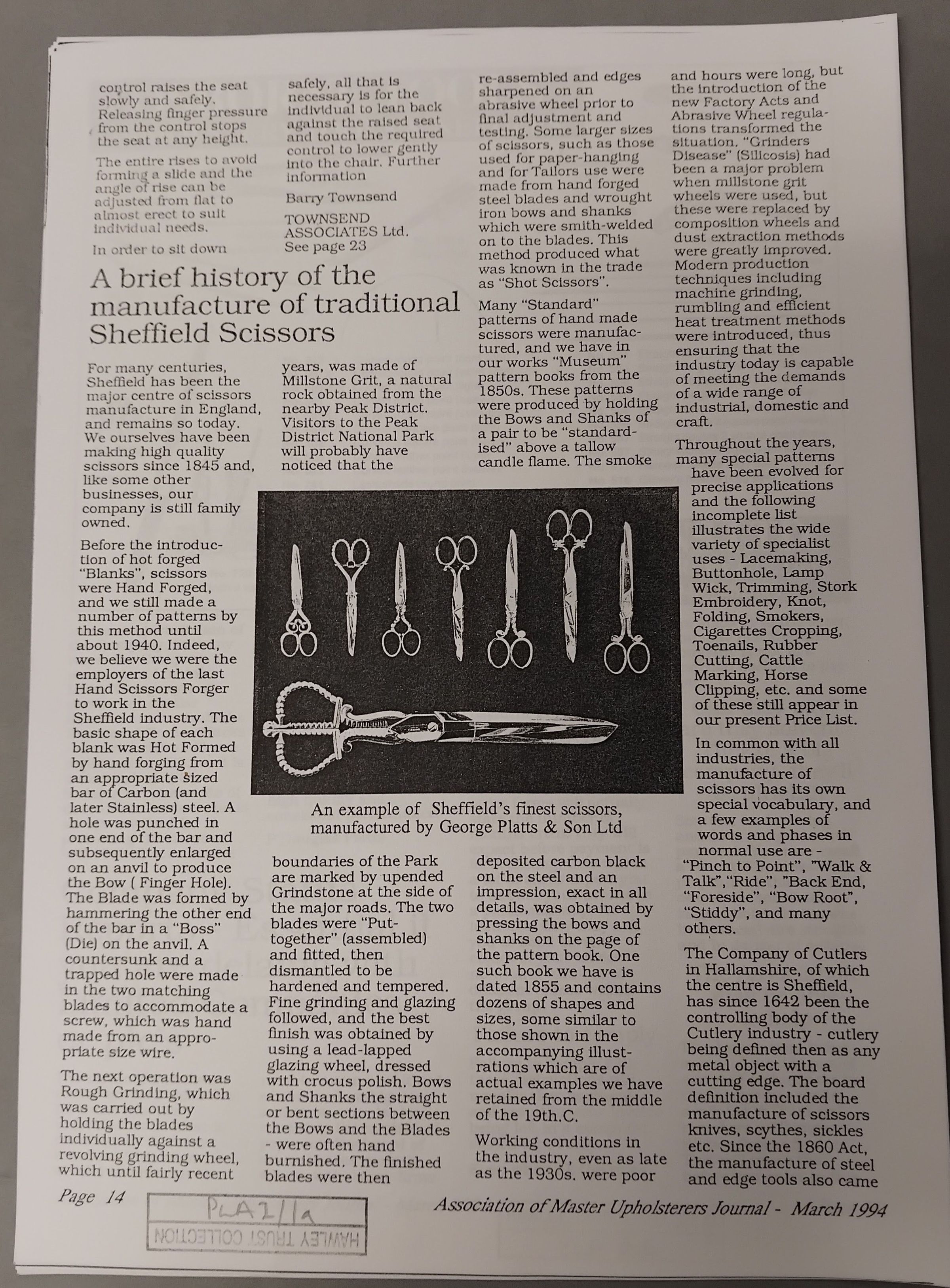
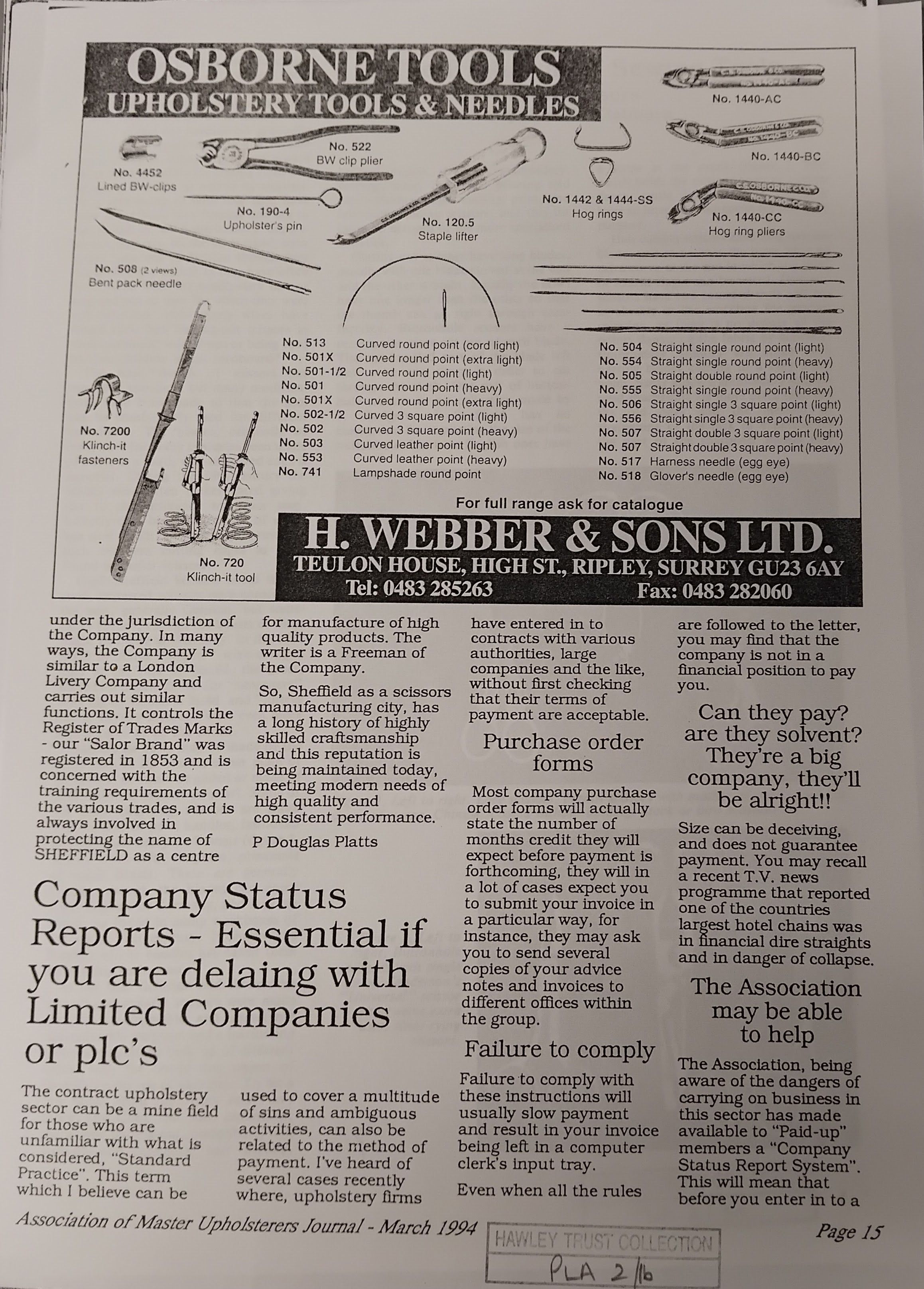
Article
An image of the article as it appeared in the journal, from a photocopy held by the Ken Hawley Collection Trust in Sheffield.
Name/Title
A brief history of the manufacture of traditional Sheffield ScissorsEntry/Object ID
2025.8.50Tags
sheffield, scissors, platts, manufacturing, history, smoke print, smut printDescription
(This article appeared in the March 1994 edition of the Association of Master Upholsterers Journal, and is reproduced here with the kind permission of the Association of Master Upholsterers and Soft Furnishers Ltd. A photocopy of the article is held by the Ken Hawley Collection Trust in Sheffield.) A brief history of the manufacture of traditional Sheffield Scissors For many centuries, Sheffield has been the major centre of scissors manufacture in England, and remains so today. We ourselves have been making high quality scissors since 1845 and, like some other businesses, our company is still family owned. Before the introduction of hot forged “Blanks”, scissors were Hand Forged, and we still made a number of patterns by this method until about 1940. Indeed, we believe we were the last Hand Scissors Forger to work in the Sheffield industry. The basic shape of each blank was Hot Formed by hand forging from an appropriate sized bar of Carbon (and later Stainless) steel. A hole was punched in one end of the bar and subsequently enlarged on an anvil to produce the Bow (Finger Hole). The Blade was formed by hammering the other end of the bar in a “Boss” (Die) on the anvil. A countersunk and a trapped hole were made in the two matching blades to accommodate a screw, which was hand made from an appropriate size wire. The next operation was Rough Grinding, which was carried out by holding the blades individually against a revolving grinding wheel, which until fairly recent years was made of Millstone Grit, a natural rock obtained from the nearby Peak District. Visitors to the Peak District National Park will probably have noticed that the boundaries of the Park are marked by upended Grindstone at the side of the major roads. The two blades were “Put-together” (assembled) and fitted, then dismantled to be hardened and tempered. Fine grinding and glazing followed, and the best finish was obtained by using a lead-lapped glazing wheel, dressed with crocus polish. Bows and Shanks - the straight or bent sections between the Bows and the Blades - were often hand burnished. The finished blades were then re-assembled and edges sharpened on an abrasive wheel prior to final adjustment and testing. Some larger sizes of scissors, such as those used for paper-hanging and for Tailors use were made from hand forged steel blades and wrought iron bows and shanks which were smith-welded on to the blades. This method produced what was known in the trade as “Shot Scissors”. Many “Standard” patterns of hand made scissors were manufactured, and we have in our works “Museum” pattern books from the 1850s. These patterns were produced by holding the Bows and Shanks of a pair to be “standardised” above a tallow candle flame. The smoke deposited carbon black on the steel and an impression, exact in all details, was obtained by pressing the bows and shanks on the page of the pattern book. One such book we have is dated 1855 and contains dozens of shapes and sizes, some similar to those shown in the accompanying illustrations which are of actual examples we have retained from the middle of the 19th C. Working conditions in the industry, even as late as the 1930s, were poor and hours were long, but the introduction of the new Factory Acts and Abrasive Wheel regulations transformed the situation. “Grinders Disease” (Silicosis) had been a major problem when millstone grit wheels were used, but these were replaced by composition wheels and dust extraction methods were greatly improved. Modern production techniques including machine grinding, rumbling and efficient heat treatment methods were introduced, thus ensuring that the industry today is capable of meeting the demands of a wide range of industrial, domestic and craft. Throughout the years, many special patterns have been evolved for precise applications and the following incomplete list illustrates the wide variety of specialist uses - Lacemaking, Buttonhole, Lamp Wick, Trimming, Stork Embroidery, Knot, Folding, Smokers, Cigarettes Cropping, Toenails, Rubber Cutting, Cattle Marking, Horse Clipping, etc, and some of these still appear in our present Price List. In common with all industries, the manufacture of scissors has its own special vocabulary, and a few examples of words and phases [sic] in normal use are - “Pinch to Point”, “Walk & Talk”, “Ride”, “Back End”, “Foreside”, “Bow Root”, “Stiddy”, and many others. The Company of Cutlers in Hallamshire, of which the centre is Sheffield, has since 1642 been the controlling body of the Cutlery industry - cutlery being defined then as any metal object with a cutting edge. The board definition included the manufacture of scissors, knives, scythes, sickles, etc. Since the 1860 Act, the manufacture of steel and edge tools also came under the jurisdiction of the Company. In many ways, the Company is similar to a London Livery Company and carries out similar functions. It controls the Register of Trades Marks - our “Salor [sic] Brand” was registered in 1853 and is concerned with the training requirements of the various trades, and is always involved in protecting the name of SHEFFIELD as a centre for manufacture of high quality products. The writer is a Freeman of the Company. So, Sheffield as a scissors manufacturing city, has a long history of skilled craftsmanship and this reputation is being maintained today, meeting modern needs of high quality and consistent performance. P Douglas Platts Association of Master Upholsterers Journal - March 1994Category
Scissors, Manufacturers