Screws
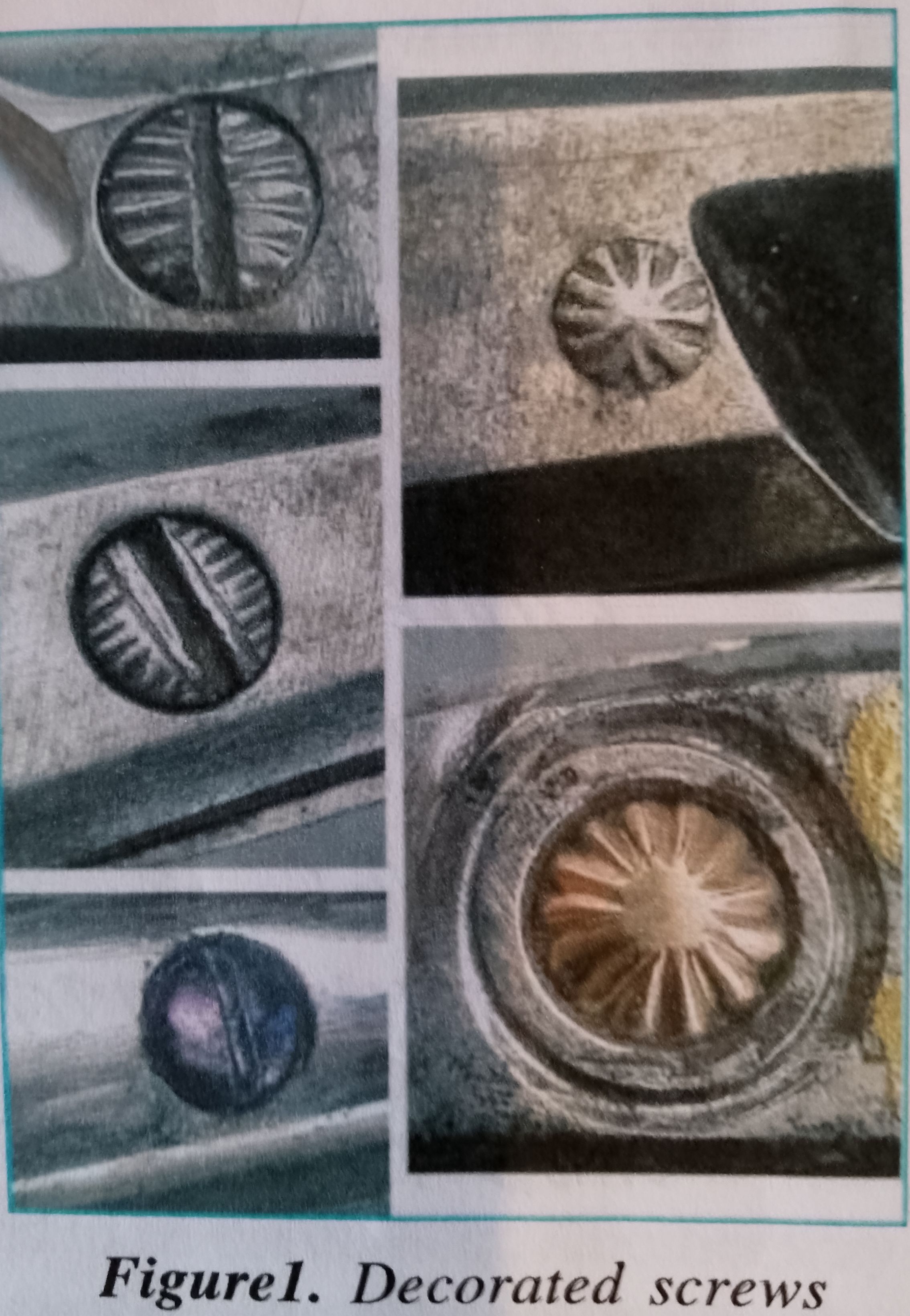
Decorated screws
An image of some scissor screws that have been filed with decorative patterns. Image taken from Meacham (2006).
Name/Title
ScrewsEntry/Object ID
2025.8.2Tags
screw, manufacturingDescription
Until the early 18th century, rivets were used more commonly than screws (Meacham). The additional expense of making screws meant that they became an indication of quality, and sometimes riveted pivots had a false 'gate' filed into the head to imitate a screw. In the 18th and 19th centuries, Common scissors usually had plain screw heads but filing and embellishing the screw heads for 'Fine' and 'Fancy' scissors was common in both France and England: - In Sheffield, the most common pattern for screw heads was 'Shell'. A set of parallel grooves was filed into the head, perpendicular to the gate (Ragg, pA33). The finest work had even, tight, parallel lines even on tiny screw heads. Originally they were engraved and filed free hand but as they became more popular a specific file was designed to speed up the job and make it more economical: "... the Putter made special files, to which, instead of the file face being flat, it has hollow groove in its length, this was to conform to the radius of the raised head screw. In the hollow groove were a series of teeth, which, in use cut the grooves in the screw head, of constant pitch ... the Shell File" (Hawley, cited in Smith, appendix iv). - 'Best Shell' was similar to 'Shell' but had a parallel groove on each side of the gate. Because of this feature, it could not be made using the Shell File and had to be done free hand, which was expensive. - 'Cockle Shell' screw heads also feature a series of grooves but these are in a radial pattern. This is another design that had to be created free hand and had generally fallen out of favour by the mid 1800s. Other decorations include Close Plating the heads with gold or silver, and decorating the surface immediately around the screw head although both of these are more commonly seen in French scissors rather than English (Cayla Morel). Up until the early 1900s (the adoption of Europe-wide standardisation of screws and bolts) most scissor makers in Sheffield would make their own. Scissor makers (or the 'Putter' in large companies) would use wrought iron or low carbon steel rods and file or turn down the threaded length ('shoulder' it) and put in the slot ('gating'). The thread was then tapped into the stem. Early screw plates were just hardened steel with a threaded hole but after 1900 more workers started drilling clearance/cutting holes on the edge of the threaded hole - similar to modern, commercially available, rapping dies. These screws would have been case hardened: "Batches of wrought iron screws were put in a tin (eg, an old tobacco tin) with a piece of leather, sealed, and heated in a fire. The leather added carbon allowing the iron screws to convert to steel. The tin was then quenched in the normal way." (Smith, p30). Although it seems counterintuitive, the pivot hole does not need to be in the centre on the scissors. Deliberately off centre screw holes are designed for cutting material that might slip out between the blades - the off centre pivot means that the blades interact with the material at different rates (see image of design 1917). The most common way to prevent the screw from working its way loose during use is to star punch the outside of the thread before the final reviewing of the tail. The slight interruption to the edge of the hole is enough to hold the screw thread. In Sheffield, the flat area surrounding the pivot is known as the 'Nail Hole' or 'Nail Whole' (Smith, p26).Category
History