Name/Title
S02.05.019Description
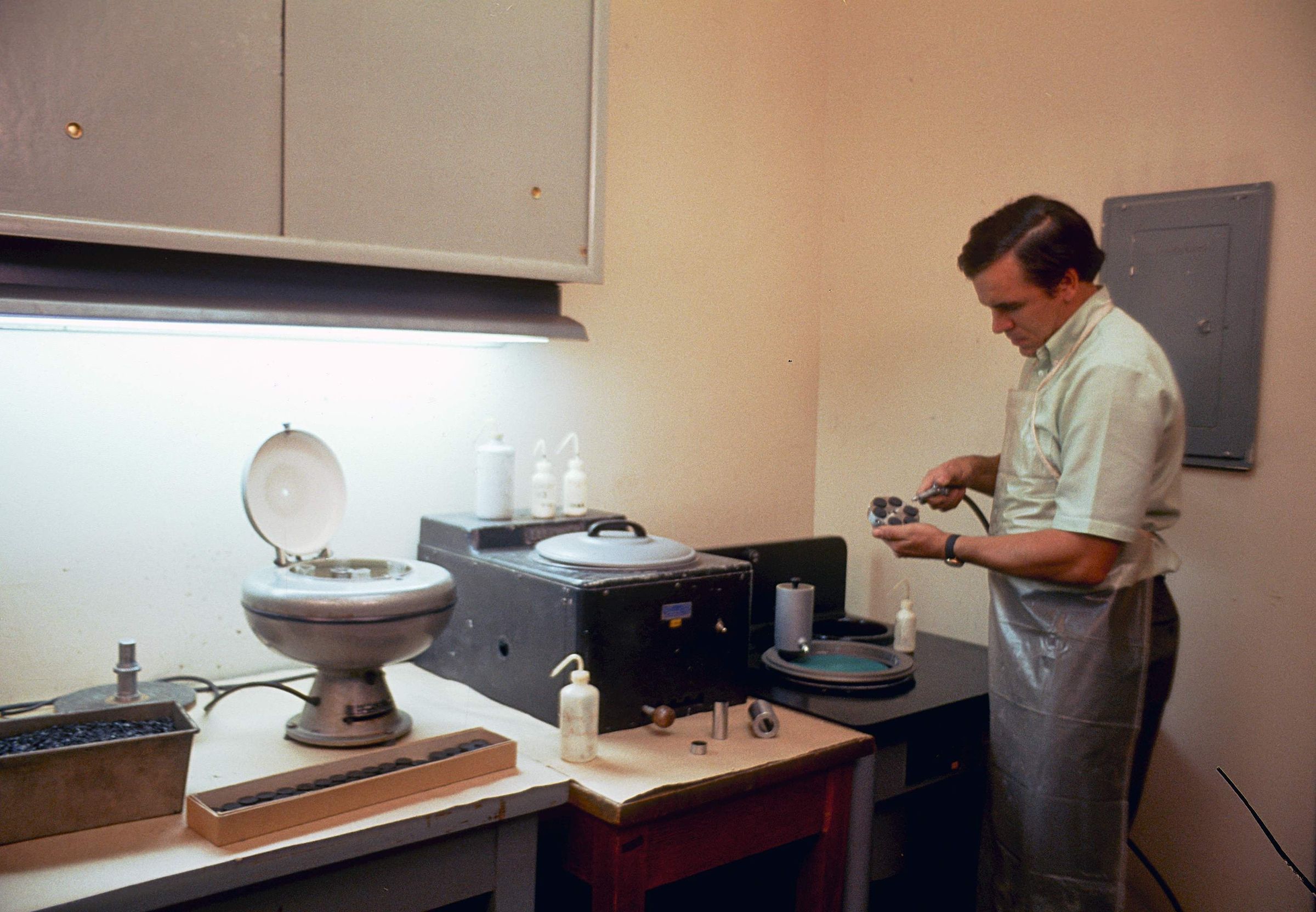
Douglas L. Kohout polishing coal briquettes. In order to study coal with a light microscope, the coal is coarsely ground and mixed with epoxy cement, placed in a cylindrical mold and compressed to a fairly high pressure. After it is cured and extruded from the mold, the result is a briquette containing ground up coal. The briquette is polished to obtain a very smooth, flat planar surface. The microscope has a finite depth of field. If the briquette is not polished, there would be microscopic “hills and valleys,” and the surface of the briquette would go in and out of focus as the surface is examined. Also, coal is made up of different types of particles, each of which has different hardness. The three primary particles are exinite, vitrinite and fusinite, but pyrite and quartz may also be embedded in the coal. Geologists need to be able to see the fine details of each particle. If not polished, the harder grains would stand out like microscopic mountains. Douglas worked in the Regional Geology Section of the Ohio Geological Survey. This picture was taken at the Grandview Avenue Offices in 1970.
This slide image included in the USGS National Digital Catalog for NGGDPP Grant G15AP00115 in FY2015.Context
Man using metal brushing tool to polish coal pieces; he is also within close distance of another round machine that holds test tubes. Laboratory at the Grandview Heights Office in Ohio.