Name/Title
S02.08.028Description
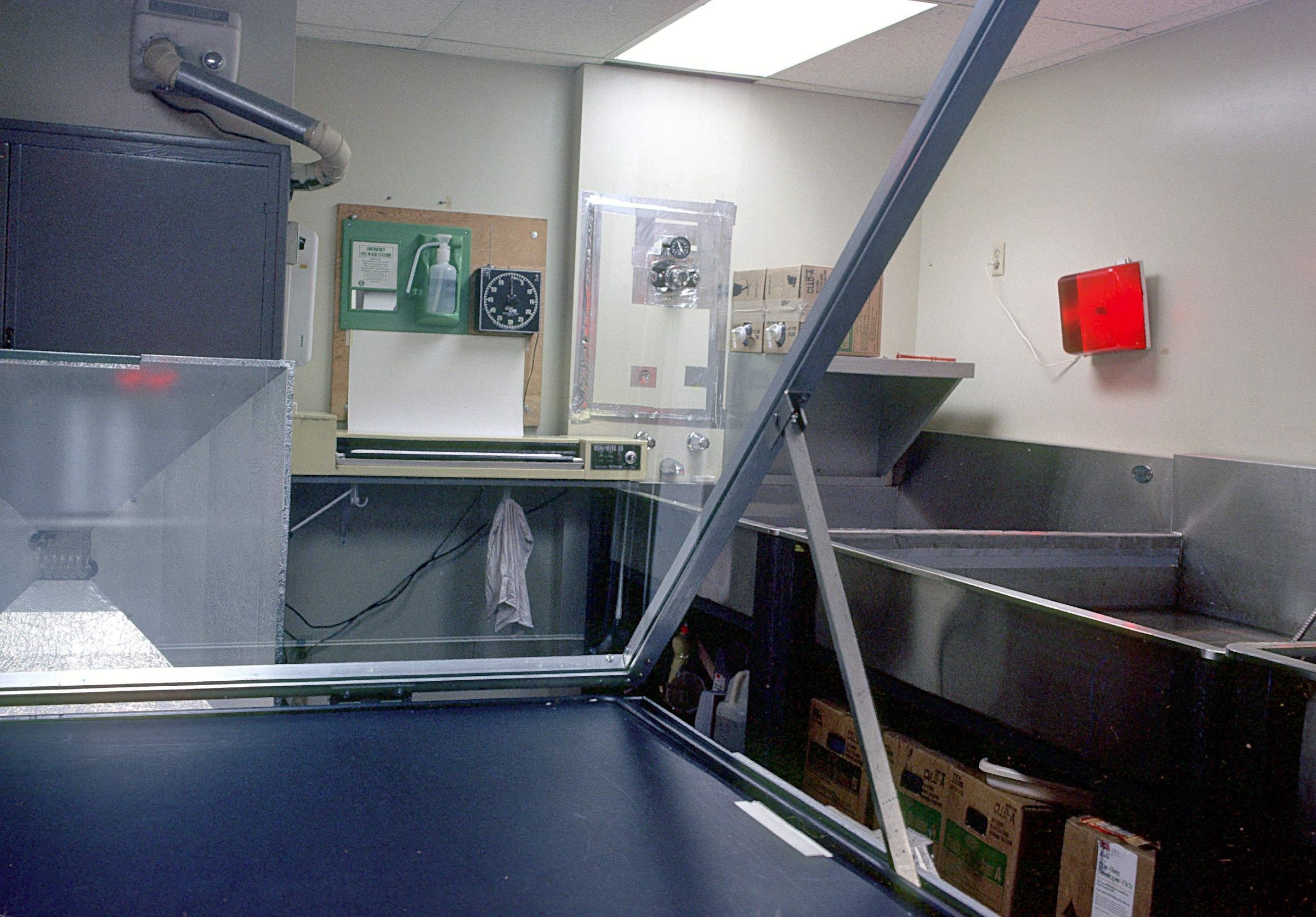
The Ohio Geological Survey's photograhy laboratory at the Fountain Square campus on Morse Road, Columbus, Ohio in 1980. The cartograhers in the Technical Publications Section used the laboratory to process the negatives and film coats during the map production process. Geologic contact lines were originally hand drawn by the geologist to depict the geology being mapped. Cartographers would make a negative of the hand drawn lines in the photography laboratory. The negative would be placed over the scribecoat and exposed, or burned, on the vacuum frame. When the scribecoat was washed with water afterwards, the image of the scribed lines remained.
The Ohio Geological Survey's main office was located at Fountain Square on Morse Road, Columbus, Ohio 43229 from May 1973 to the present. The Geological Survey's offices were on the first and second floors of Building B from May 1973 until a move to the first and second floors of Building C in January 2005.
In an e-mail from Lisa Van Doren on July 21, 2016 for image S02.08.028: Our photo lab had three connected rooms, each could be shut off from each other by doors. While the other two rooms and equipment were for film exposure only this room had an exposure method and was also used to develop and dry the film. I’ve added numbers for explanation below:
1) This is the vacuum frame I’ve already explained in a previous image.
2) This is the arc light used for long exposures on the vacuum frame.
3) This was a hand made film dryer. Note the hand dryer connected to it by tubing—makes me laugh.
4) A commercially made film dryer.
5) Timer. We mostly developed film based on time recommended by the manufacturer (sometimes tweaked by us due to our lab environment).
6) These boxes held the chemicals we mixed together with water to make the film developing bath. The extremely large stainless steel sink below it was used for this developing.
7) When working with film all the normal lighting was turned off and these red lights were the only light available.
8) There are 3 stainless steel tanks for the developing process. The first one (furthest left) is for the actual developing. When time was up we’d transfer the film to the third sink (not shown except a corner at right) that had another chemical that would stop the developing process (this was a reusable chemical that was kept in a large container under the sink until needed). The middle sink just had water in it and was used to rinse the film of all chemicals before drying.
This slide image included in the USGS National Digital Catalog for NGGDPP Grant G15AP00115 in FY2015.Context
Metal sinks on the left and navy blue table in the foreground. Lab coat can also be seen nearby. Taken at the Fountain Square location on Morse Road in Columbus, Ohio.