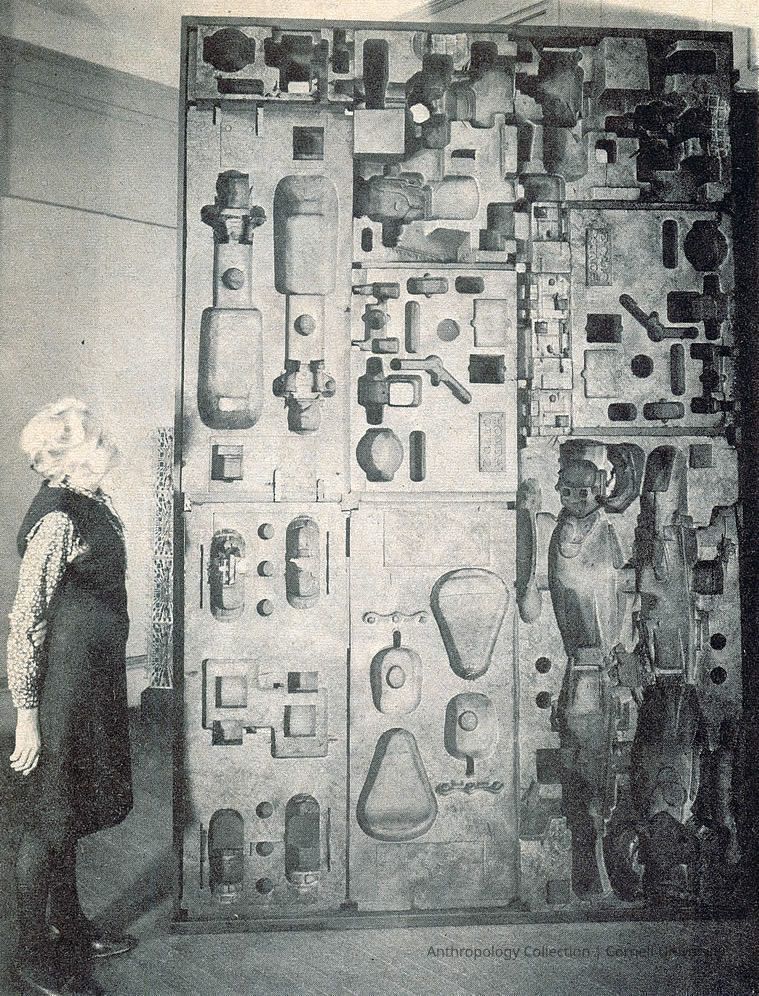
Doors from Villa at Atraxos
![DOORS FROM VILLA AT ATRAXOS | Photo by Marilyn Rivchin, circa 1969-71 | ©2026 Norman Daly Art: Black and white photo of large, intricate relief object that occupies the majority of the image. It appears to be an assemblage of various geometric and organic shapes, reminiscent of mechanical parts or molds, tightly packed together within a large rectangular frame. The artifact features an industrial aesthetic, suggesting themes of ancient machinery and technology. The contrasting textures and forms create a visually complex surface, inviting contemplation and study. The setting suggests an art exhibition or gallery.
---------------------------------------------------------------
MOVE THIS TO A PDF
[1972 Exhibition Catalog]
These doors are believed to be those which led to the private gambling casino in the underground winter villa of the tyrant Kai Preiden.
Historically, the addition of other metals to pure copper (bronze) produced different degrees of strength, hardness, malleability (the bronzes of Llhuros were often hammered), and ranges of color. Metallography on these doors shore the composition of tin (a metal of 10 percent in most bronzes) to be 22 percent
with no presence of zinc. The flatus common in casting large objects were caused by insufficient gas tran-spiration, too rapid heating and/or cooling, and the slipping or misregistering of the mold sections. The latter flaw is usually overcome by the use of chaplets (holding pins joining mold and core) which must be cut off later causing marks on the surface of the cast object. Another difficulty in casting large objects is the resultant shrinkage and cracking, especially in parts which are alternately thin and thick. Remarkably, these doors are not only free of these flaws but are astonishingly smooth and solid, and even close observation fails to reveal the use of chaplets although the Llhuroscian casting method is believed to have been a combination of solid and hollow casting.
The heavy doors were opened and closed by the use of colipiles (ancient rotor motors powered by steam condensed in radial pipes usually above a boiler connected with them) infused by palyrix, a distillate of ammonia. There is evidence the doors were damoscened in silver, a practice common in Islamic casting.](https://d8e7jbdw4fu0e.cloudfront.net/13541/03edfb70-6b27-11f0-a6ae-33bacbc3e5b0-wx3P28F.lg-nt@2x.jpg)
DOORS FROM VILLA AT ATRAXOS | Photo by Marilyn Rivchin, circa 1969-71 | ©2026 Norman Daly Art
Black and white photo of large, intricate relief object that occupies the majority of the image. It appears to be an assemblage of various geometric and organic shapes, reminiscent of mechanical parts or molds, tightly packed together within a large rectangular frame. The artifact features an industrial aesthetic, suggesting themes of ancient machinery and technology. The contrasting textures and forms create a visually complex surface, inviting contemplation and study. The setting suggests an art exhibition or gallery. --------------------------------------------------------------- MOVE THIS TO A PDF [1972 Exhibition Catalog] These doors are believed to be those which led to the private gambling casino in the underground winter villa of the tyrant Kai Preiden. Historically, the addition of other metals to pure copper (bronze) produced different degrees of strength, hardness, malleability (the bronzes of Llhuros were often hammered), and ranges of color. Metallography on these doors shore the composition of tin (a metal of 10 percent in most bronzes) to be 22 percent with no presence of zinc. The flatus common in casting large objects were caused by insufficient gas tran-spiration, too rapid heating and/or cooling, and the slipping or misregistering of the mold sections. The latter flaw is usually overcome by the use of chaplets (holding pins joining mold and core) which must be cut off later causing marks on the surface of the cast object. Another difficulty in casting large objects is the resultant shrinkage and cracking, especially in parts which are alternately thin and thick. Remarkably, these doors are not only free of these flaws but are astonishingly smooth and solid, and even close observation fails to reveal the use of chaplets although the Llhuroscian casting method is believed to have been a combination of solid and hollow casting. The heavy doors were opened and closed by the use of colipiles (ancient rotor motors powered by steam condensed in radial pipes usually above a boiler connected with them) infused by palyrix, a distillate of ammonia. There is evidence the doors were damoscened in silver, a practice common in Islamic casting.