Esnontos (Urn)
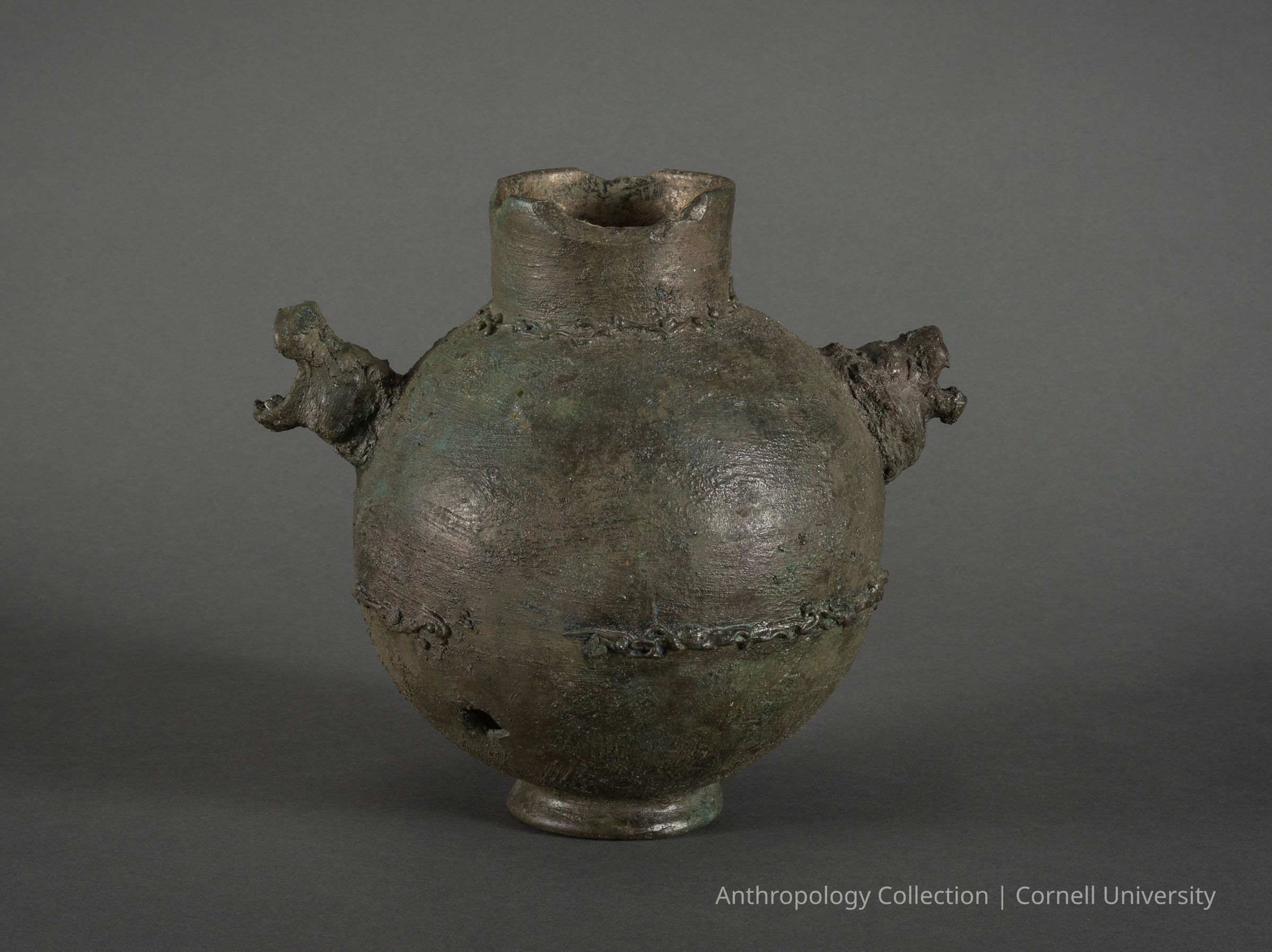
ESNONTOS (Urn) | circa 1966-71 | Photo by Ann Cady, 2024 | ©2026 Norman Daly Art
This image displays an ancient, dark bronze vessel with a large, round body and two protruding handles on either side, resembling animal heads (hippo and lion) Its rough, textured surface and craftsmanship, suggesting historical significance or ceremonial use, possibly in rituals or as a utilitarian item.
Name/Title
Esnontos (Urn)Entry/Object ID
COL.70Description
"Esnontos" (urns) were most commonly used as water containers, although other uses are attested. Typically, the body was hammered metal and the animal-headed handles (hippo and lion) were cast separately and attached by soldering. The heavy, bulbous proportions and absence of tongue are typical of the latter part of the Archaic period, but the naturalistic rendering of the animals indicate that a Lamplӧ dating would be anachronistic.Category
Middle Period, Uoyab
Made/Created
Artist
Norman DalyDate made
circa 1966 - 1971Place
Academic Institution
Cornell UniversityCity
Ithaca, New YorkContinent
North AmericaEthnography
Cultural Region
Region
Asia MinorCulture/Tribe
Llhuros
Dimensions
Height
10-1/4 inWidth
10-1/2 inDepth
7-1/2 inMaterials
Material
BronzeMaterial Notes
Fictional medium as described by Norman Daly in the 1972 catalog and exhibition tags. The actual media is plaster cast with a painted faux surface and hand-sculpted animal head handles (hippo and lion)Acquisition
Notes
This object is a unique element of the "Civilization of Llhuros" collection given to the Cornell University Anthropology Collaboratory in 2026.Exhibitions
Akron Art Institute (1972)
Cornell University | A.D. White Museum of Art (1972)
Cornell University, Herbert F. Johnson Museum of Art (2004)
Indianapolis Art Museum (1972)
Istanbul Biennial, 16th | "The Seventh Continent" (2019)
La Panacée, centre d'art contemporain | "Plurivers" | Montpellier, France (2017-18)
Memorial Art Gallery | University of Rochester (1972)
Roberson Center for Art and Science, Binghamton, NY (1974)
Romische-Germanisches Museum | "Projekt '74" | Cologne Germany (1974)
SUNY Albany | Art Gallery (1973}
University of Pennsylvania Art Museum, Philadelphia (1974)