Lacunarium (Decorative Shield with Salamanders)
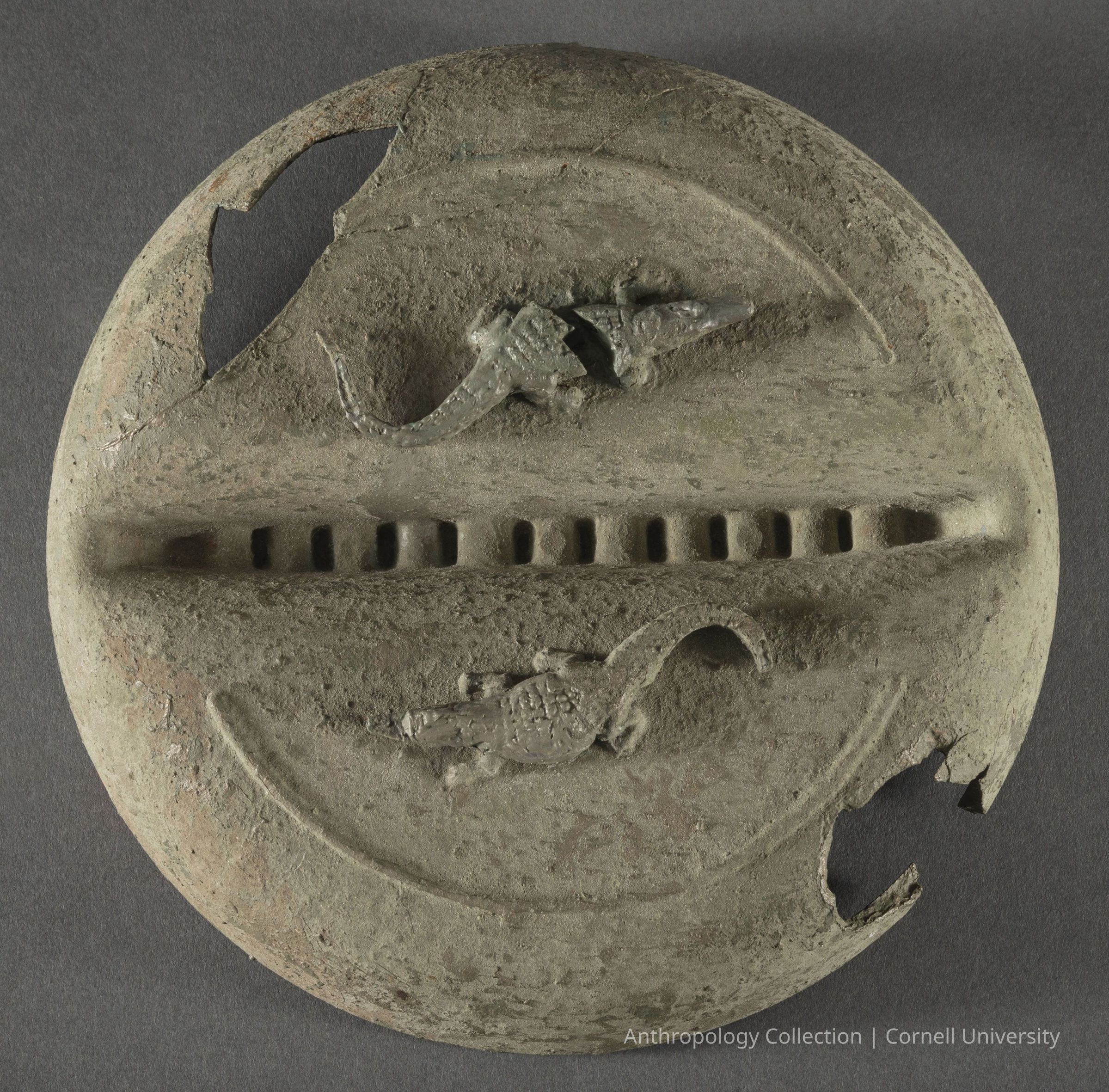
LACAUNARIUM (Decorative Shield with Salamanders) | 1966-71 | Photo by Ann Cady, 2024 | ©2026 Norman Daly Art
The photo depicts an ancient, circular, clay artifact that appears to be a damaged, bas-relief, characterized by a series of small, rectangular indentations running across the center, with two carved salamanders positioned symmetrically around the indentation, which has jagged missing sections on opposite sides, possibly indicative of wear or breakage over time.
Name/Title
Lacunarium (Decorative Shield with Salamanders)Entry/Object ID
COL.92Description
Such shields, around 7-inches in diameter, are obviously too small and delicate to have been used in battles. Instead they were used as newel posts on large, elaborate funerary couches for temple priests. Bartholomew Black traces them to a workshop in Ronup (<em>The Priest in the Llhuroscian World</em>, p. 106). Eric Froehner argues for an Atraxos origin (<em>Kunst and Leben der Llhuros</em>, p. 153).Category
Middle Period, Trolydos
Made/Created
Artist
Norman DalyDate made
circa 1966 - 1971Place
Academic Institution
Cornell UniversityCity
Ithaca, New YorkContinent
North AmericaEthnography
Cultural Region
Region
Asia MinorCulture/Tribe
Llhuros
Dimensions
Height
1-3/4 inDiameter
7-1/2 inMaterials
Material
BronzeMaterial Notes
Fictional medium as described by Norman Daly in the catalog and exhibition tags (1972-2019) [See General Notes below for more detail]Acquisition
Notes
This object is a unique element of the "Civilization of Llhuros" collection given to the Cornell University Anthropology Collaboratory in 2026.Exhibitions
Akron Art Institute (1972)
Cornell University | A.D. White Museum of Art (1972)
Indianapolis Art Museum (1972)
Istanbul Biennial, 16th | "The Seventh Continent" (2019)
Memorial Art Gallery | University of Rochester (1972)
Roberson Center for Art and Science, Binghamton, NY (1974)
Romische-Germanisches Museum | "Projekt '74" | Cologne Germany (1974)
SUNY Albany | Art Gallery (1973}
University of Pennsylvania Art Museum, Philadelphia (1974)