Miethymiaterion
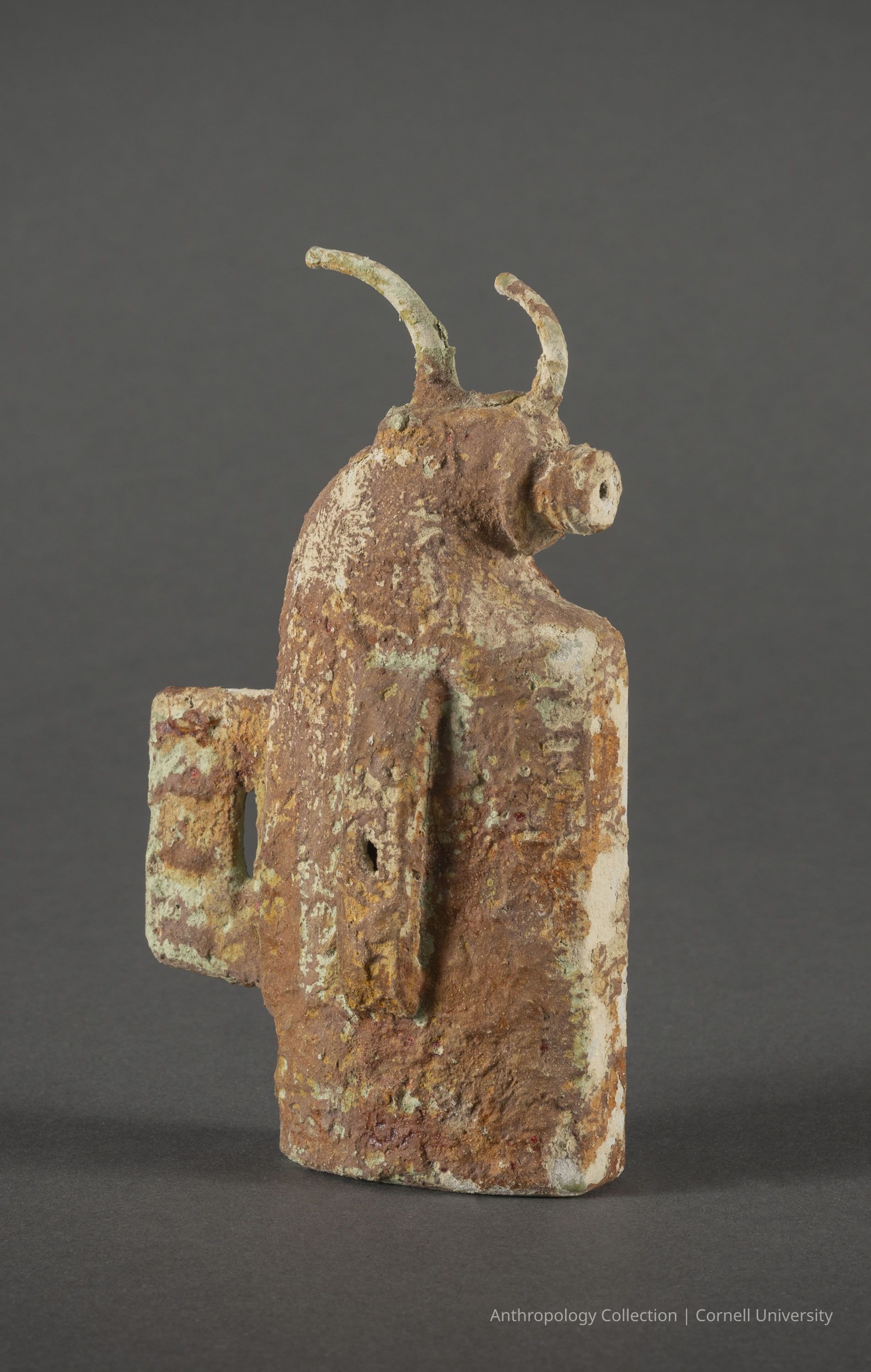
MIETHYMIATERION (Candelabra-vaporizer-incense burner) | circa 1966-71 | Photo by Ann Cady, 2024 | ©2026 Norman Daly Art
The photo shows a weathered, ancient Llhuroscian artifact characterized by its rough, rusted surface and patina that suggests age and exposure to the elements over time; it resembles a stylized bull with prominent curved horns and a simplistic form, indicative of early artistic expression, from the archaic civilization. It captures both the strength and cultural significance of the animal in its time, while the muted hues of brown and green reveal its antiquity, creating an evocative representation of historical artistry.
Name/Title
MiethymiaterionEntry/Object ID
COL.102Description
This multipurpose artifact was found at Houndee in 1966, and, though classified here as Sivadian, a Naciremian (Middle Period) dating should not be precluded. While it is a form of incense-burner, it is called, properly speaking, a rniethyrniaterion because of its different uses. Parts of the Viiben birds whose skeletons served as the grids for the empty effigy chairs were used in these objects. The container or flask is a ceramic frame over which was stretched Pruii bird skin (see catalog page 10 and object number 135), prized for its elasticity. The vaporific effect resulted from the sides of the container being squeezed in a hand-grasping action. The incense holder and candle holder are actually the small sections or parts of the vertebrae of the Viiben bird. A Miethymiaterion in the VIlla Feoli collection is close enough in all appearance to be from the same workshop (see Jandolo, <em>L'Arte Llhurosciana</em>, pp. 212-14) The principle difference is that the Feoli has a single horn on which the incense was impaled while burning.Category
Decline, Sividian
Made/Created
Artist
Norman DalyDate made
circa 1966 - 1971Place
Academic Institution
Cornell UniversityCity
Ithaca, New YorkContinent
North AmericaEthnography
Cultural Region
Region
Asia MinorCulture/Tribe
Llhuros
Dimensions
Height
6 inWidth
3-3/4 inDepth
2 inMaterials
Material
Ceramic, Viiben vertbrae and Pruii bird skinMaterial Notes
Fictional media as described by Norman Daly in the catalog and exhibition tags (1972-2019)Acquisition
Notes
This object is a unique element of the "Civilization of Llhuros" collection given to the Cornell University Anthropology Collaboratory in 2026.Exhibitions
Akron Art Institute (1972)
Cornell University | A.D. White Museum of Art (1972)
Indianapolis Art Museum (1972)
Istanbul Biennial, 16th | "The Seventh Continent" (2019)
Memorial Art Gallery | University of Rochester (1972)
Roberson Center for Art and Science, Binghamton, NY (1974)
Romische-Germanisches Museum | "Projekt '74" | Cologne Germany (1974)
SUNY Albany | Art Gallery (1973}
University of Pennsylvania Art Museum, Philadelphia (1974)