Reliquary of the Sacred Ape
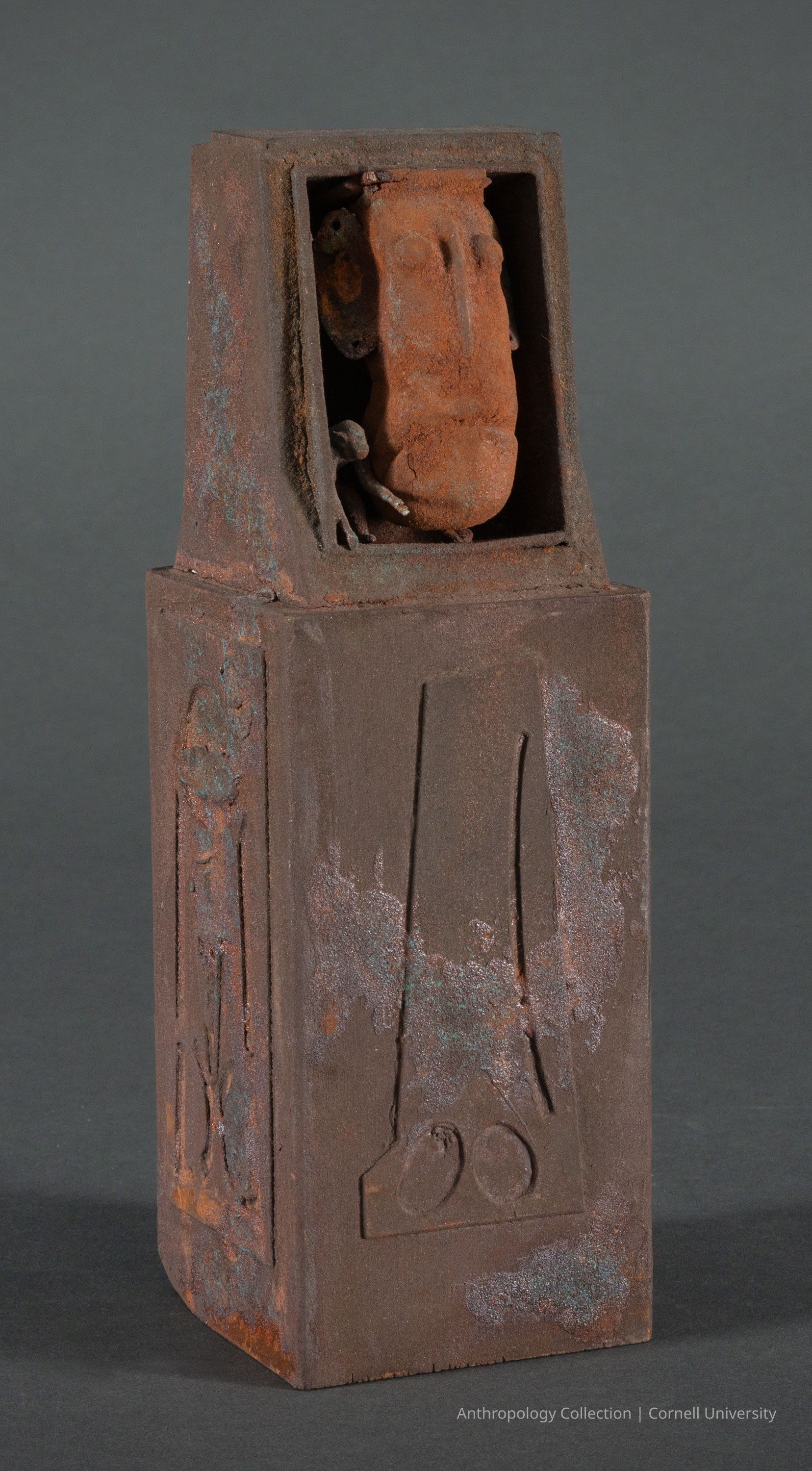
RELIQUARY OF THE SACRED APE | circa 1974-1981 | Photo by Ann Cady, 2024 | ©2026 Norman Daly Art
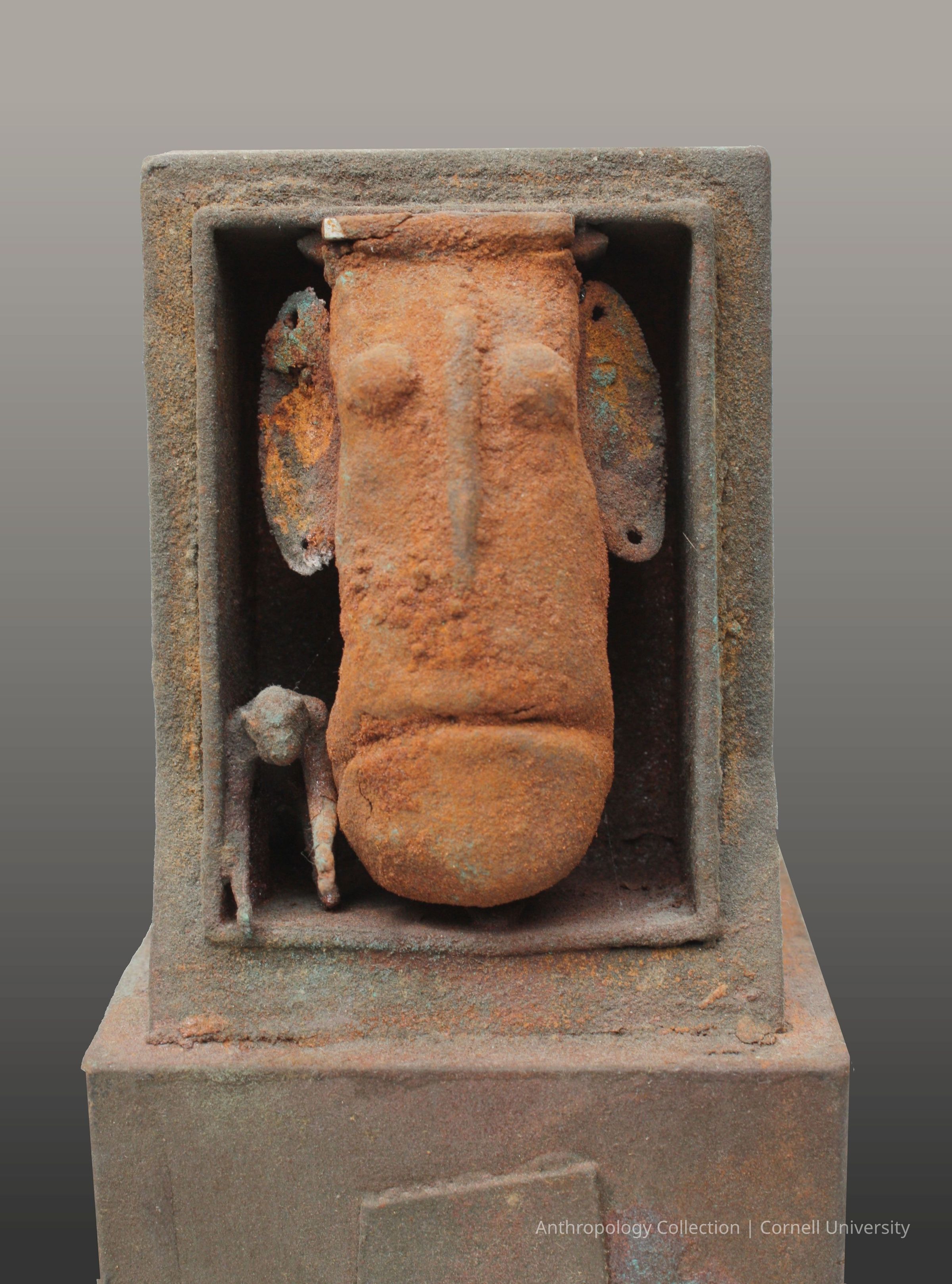
In the "boremor" or base of the reliquary (funeral urn) are the navicular and the internal cuneiform bones of the left foot. The "quatrine" or box like upper truncated openings contains a crude icon of an ape's head and a small figure of an ape extending its hand.
Name/Title
Reliquary of the Sacred ApeEntry/Object ID
COL_RO.1Description
In the "boremor" or base of the reliquary are the navicular and the internal cuneiform bones of the left foot. The "quatrine" or box like upper truncated openings contains a crude icon of an ape's head and a small figure of an ape extending its hand. Adolph Hagengrieffen, author of "Llhuroser Antike Kunstwerke," identifies the urn, from the Temple of Shoo-Noo, as a memorial to a Sacred Ape. The Temple priests arranged liturgical banquets for the sacred apes whose seasonal appearances served as a harbinger of the gastronomic rituals. As a consequence of these recurrent visits, strong attachments were often formed between the visitors and the Temple priests. Eventually all arboreal hermitages were closed. Eric Froehner ("Kunst und Leben der LLhuros,") places the urn in the Lamplӧ or Late Archaic Period chiefly on the basis of the curvilinear treatment of the Orant Figure on the back of the "quatrine." He believes the discordance of the small figure suggests it had been added later, probably by Naciremian craftsmen who developed a naturalistic manner of depicting animals. Professor Froehner offers no explanation, however, of the iconographic ambiguity of the sides of the "boremor." [<em>Ex. Collection: Viscount Jean Louis Bernardy</em>]Category
Late Archaic, Sarnak
Made/Created
Artist
Norman DalyDate made
circa 1974 - 1981Place
Academic Institution
Cornell UniversityCity
Ithaca, New YorkContinent
North AmericaEthnography
Cultural Region
Region
Asia MinorCulture/Tribe
Llhuros
Dimensions
Height
11 inWidth
3-1/2 inDepth
3-1/2 inMaterials
Material
Bronze, hollow cast; surface spotted from sporadic repatinationMaterial Notes
Fictional medium as described by Norman Daly for the 1981 Tyler School of Art and 1983-84 Rotterdam exhibition materials.Acquisition
Notes
This object is a unique element of the "Civilization of Llhuros" collection given to the Cornell University Anthropology Collection in 2026.Web Links and URLs
Rotterdam: Exhibition photoExhibitions
Cornell University, Herbert F. Johnson Museum of Art (2004)
Istanbul Biennial, 16th | "The Seventh Continent" (2019)
Museum Boijmans Van Beuningen | Rotterdam, The Netherlands (1983-84)
Tyler School of Art | "Imaginary Civilizations" | Temple University, Philadephia (1981)