Trophy in the Form of Suizon Playing Court
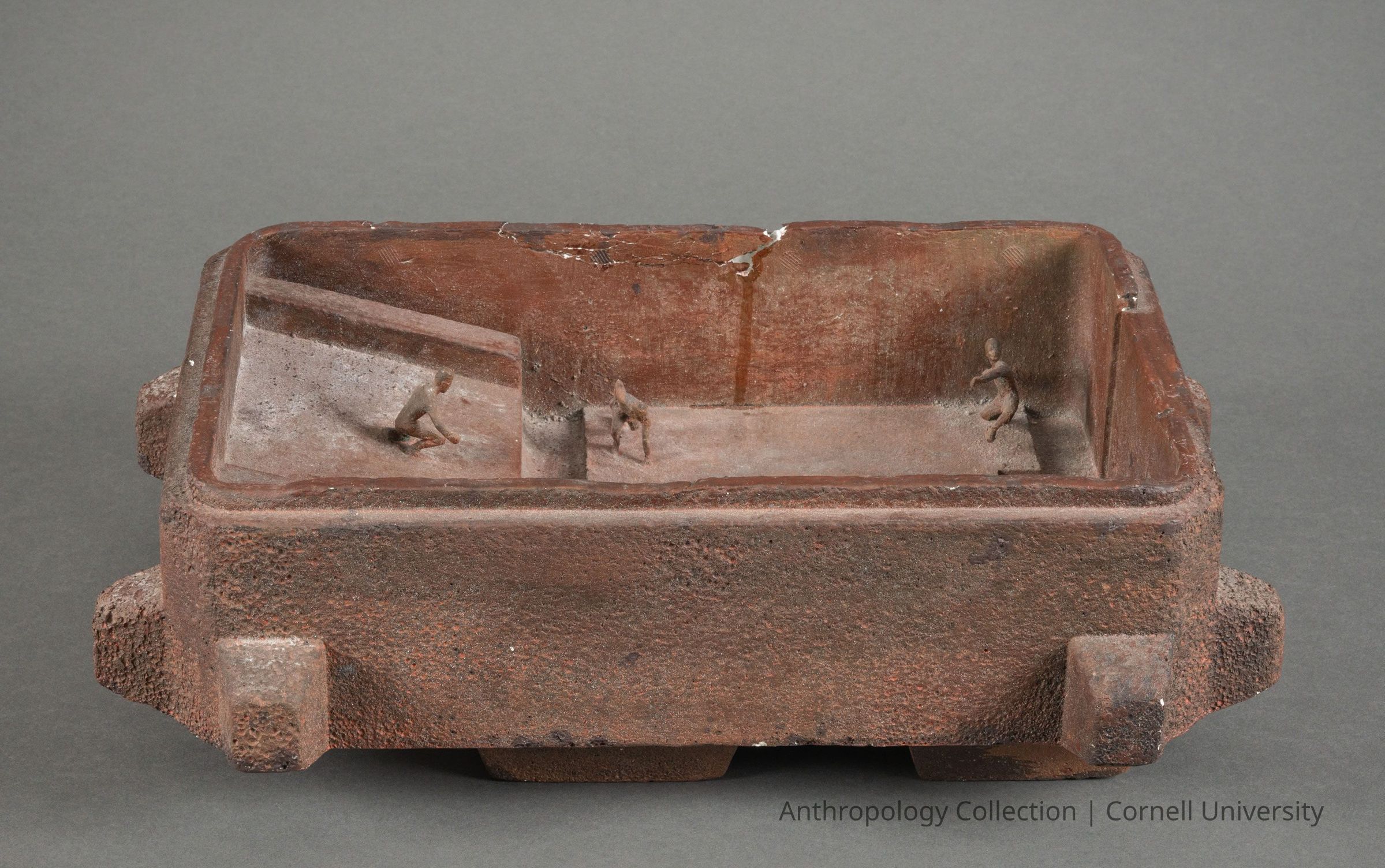
TROPHY IN THE FORM OF SUIZON PLAYING COURT | circa 1966-69 | Photo by Ann Cady, 2024 | ©2025 Cornell University
The photo depicts a rectangular, ceramic artifact that has a deep, rusty red color with noticeable wear and fading. It features intricate, small figurines in various stances, possibly playing a game. The structure, suggestive of a model of a ball court, is elevated on squat legs.
Name/Title
Trophy in the Form of Suizon Playing CourtEntry/Object ID
COL.130Description
This is a miniature model of the game of "suizon" as it was played by robot players and directed and refereed by a scientist or intellectual. The trophy was awarded in alternate years to the outstanding director-referee. Suizon was a fast, complex, difficult game that was controlled by the director-referee and involved a pitcher and several runners, calculated angle shots, and possible rebounds. Most importantly, the players had to avoid the collisions and the physical hazards of depressed and channeled floor areas. Having the heightened exhilaration of playing a kind of solitaire, the director¬-referee sent from the raised inclined area second-by¬second instructions, via a thought-transference device worn on his forehead, to the receivers permanently located in the middle of the robots' heads. From an early age the players were trained exclusively in sports and in all phases of physical development. When their bodies neared the peak of fitness in middle adolescence, these splendid specimens, with the eager consent of their sports-conscious parents were lobotomized to become, hopefully, "suisonok" or sports robots. The director-referee was expected to be totally objective in declaring points and errors since he was, in effect, competing against himself. Because the robots were performing mindlessly--they were unaware of fatigue and had no resistance to the competitive urge--he had some responsibility not to kill them with overexertion. In social deportment and appearance the players were indistinguishable from non-robots and, despite the mental impairment, were not only accepted fully in society but, as a matter of fact, were much preferred to the scientists and intellectuals who, having the facility of total recall, were carefully avoided at any and all social gatherings.Category
Decline, Ronup, Decline, reign of Fakka
Made/Created
Artist
Norman DalyDate made
circa 1966 - 1969Place
Academic Institution
Cornell UniversityCity
Ithaca, New YorkContinent
North AmericaEthnography
Cultural Region
Region
Asia MinorCulture/Tribe
Llhuros
Dimensions
Height
13-1/2 inWidth
17-1/2 inDepth
5-3/4 inMaterials
Material
CeramicMaterial Notes
Fictional medium as described by Norman Daly in the catalog and exhibition tags (1972-2019). Note: also see General Notes for descriptions of the fictive and actual media.Acquisition
Notes
This object is a unique element of the "Civilization of Llhuros" collection given to the Cornell University Anthropology Collaboratory in 2025.Exhibitions
Akron Art Institute (1972)
Cornell University | A.D. White Museum of Art (1972)
Indianapolis Art Museum (1972)
Istanbul Biennial, 16th | "The Seventh Continent" (2019)
Memorial Art Gallery | University of Rochester (1972)
Roberson Center for Art and Science, Binghamton, NY (1974)
Romische-Germanisches Museum | "Projekt '74" | Cologne Germany (1974)
SUNY Albany | Art Gallery (1973}
University of Pennsylvania Art Museum, Philadelphia (1974)