1805 Spanish 8-Reale [Coin]
Name/Title
1805 Spanish 8-Reale [Coin]Description
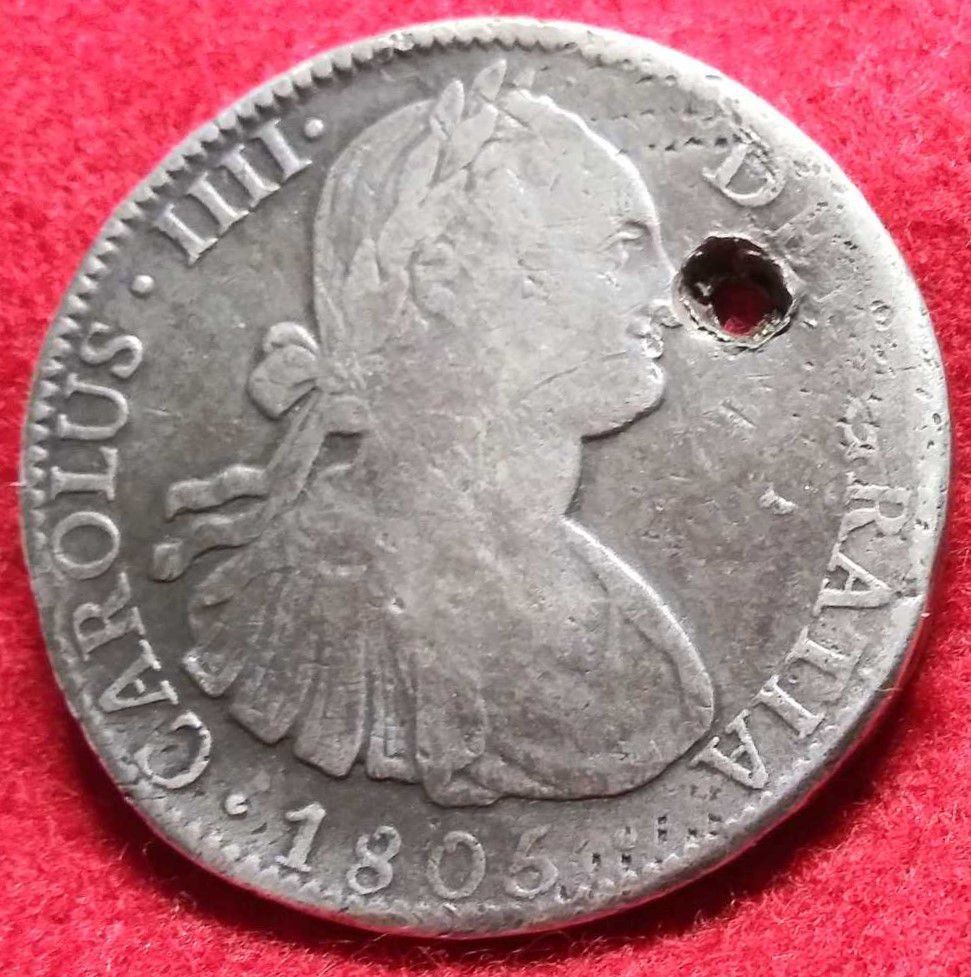
Spanish 1805 silver 8-reale coin was excavated at San Felipe de Austin, Texas. Obverse: Bust of King Carlos IV facing right Lettering: "CAROLUS · IIII · DEI · GRATIA · 1805 ·" Translation: Carlos 4th by the grace of God Reverse: Hispanic arms - A pair of pillars separated by a crowned simple shield with lions, castles, pomegranate and three centralized Fleurs-de-Lis Lettering: "· HISPAN · ET IND · REX · Mo · 8R · T · H ·" Unabridged legend: Hispaniarum Et Indiarum Rex 8 reales Translation: King of Spain and the IndiesContext
At the time of the Texas Revolution, North American silversmiths working in the national workshops of Boston, New York, and Philadelphia operated without a centralized hallmarking system comparable to the Spanish, Mexican, or British assay-office network. Maker's marks were stamped at the craftsman's discretion, and purity was not legally enforced. Melting coins provided a de facto quality guarantee. New Orleans silversmiths Jean-Noel Delarue (active 1802–1842), Anthony Rasch, (active 1820–1857), and Hyde & Goodrich (active 1828–1861) marked their respective pieces simply with the maker's surname or initials, sometimes accompanied by the word COIN, PURE COIN, DOLLAR, or STANDARD — all indicating .900 silver. This Spanish specie is representative of coins melted into silver pieces.Category
Texas Silver, Mexican Texas
Bayou Bend, Becoming Texas, Bullock Museum