Bairfield Schoolhouse [Photograph]
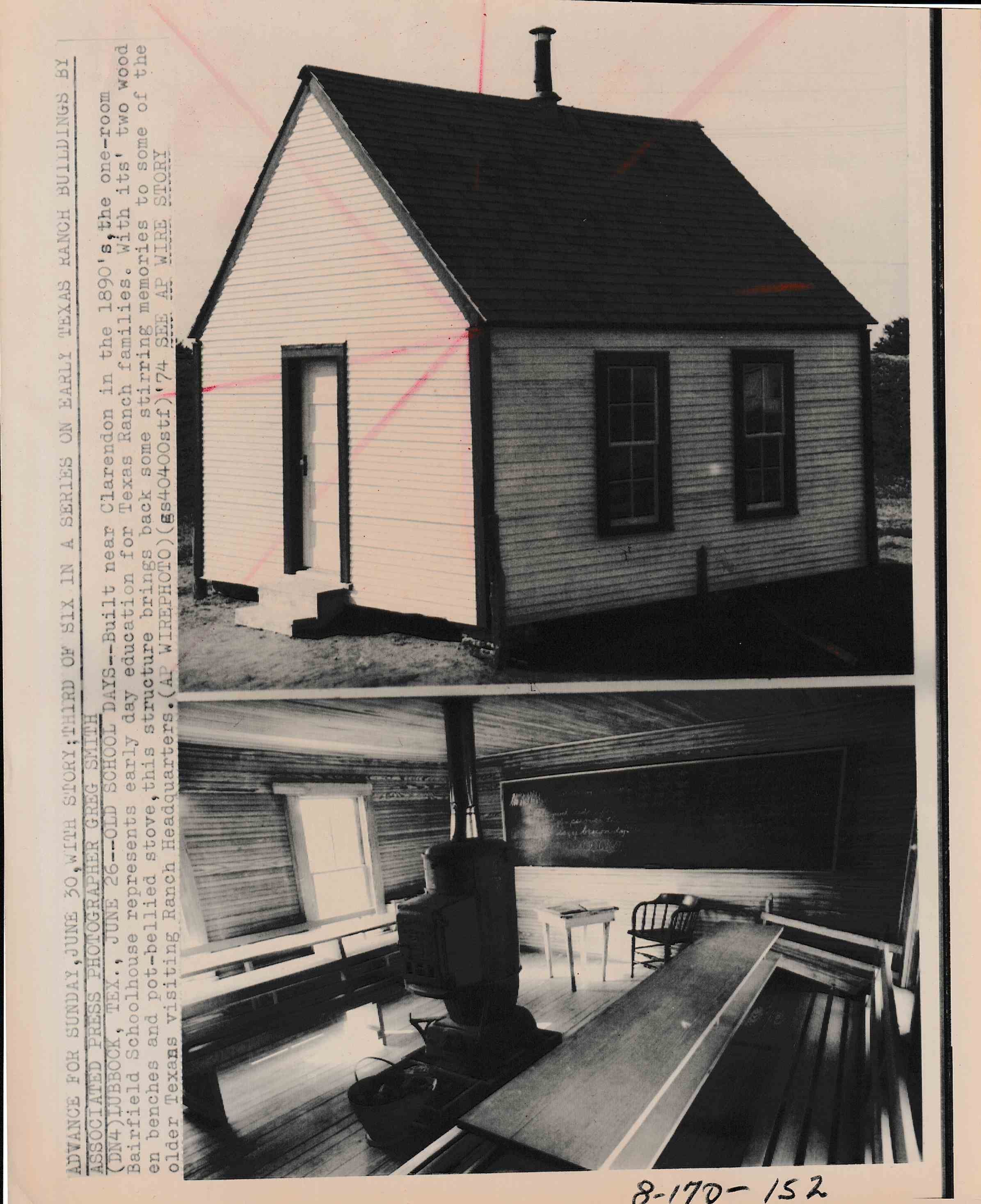
On the left, a 1974 press photo of the one-room Bairfield Schoolhouse. On the right, the interior with two wooden benches and a pot-bellied stove.
Name/Title
Bairfield Schoolhouse [Photograph]Description
"ADVANCE FOR SUNDAY, JUNE 30, WITH STORY; THIRD OF SIX IN A SERIES ON EARLY TEXAS RANCH BUILDINGS BY ASSOCIATE PRESS PHOTOGRAPHER GREG SMITH. LUBBOCK, TEX., JUNE 26 -- OLD SCHOOL DAYS -- Built near Clarendon in the 1890's, the one-room Bairfield Schoolhouse represents early day education for Texas Ranch families. With its' two wooden benches and pot-bellied stove, this structure brings back some stirring memories to some of the older Texans visiting Ranch Headquarters."Context
Wintry Bairfield built a one-room schoolhouse on the Beaty claim that served on occasion as a church and area social center. The usual ranch schoolhouse was a one-room building named for the rancher or the ranch. Others had colorful monikers like Lick Skillet, Possum Trot, Cedar Ridge, Hell Roaring Holler and Chicken Foot. The Bairfield Schoolhouse was briefly called Polecat University after an encounter with a skunk. Like the 16-by-16-foot Bairfield Schoolhouse from Clarendon, Texas, the schools remained as long as the children needed them. The Bairfield Schoolhouse was built to serve the children of homesteaders Fred Wiedman, Jim Porter and Joe Beaty. Then called the Porter School, it was situated beside a little creek on the Beaty homestead. C.E. Bairfield’s father, Wint, bought the Beaty claim at the turn of the 20th century. At some point, he put the schoolhouse on two wagons and moved it nearer to the Bairfield home. Subjects included arithmetic, geography, reading, writing, grammar and agriculture. Dr. Zell Rodgers SoRelle, later a professor of speech at West Texas A&M University in Canyon, Texas, was the last to teach in the one-room school. She recalled that five taxpayers, all ranchers, supported the school while she was there. “The happiest children I have ever seen,” SoRelle said. If the weather was good, she had the children take their lunches with them as they walked to a nice place to eat. Along the way, she taught them about history and the natural sciences. “We learned every Texas flower and everything that grew,” she added. Sometimes they saw wild turkeys or other animals and they always had to watch for snakes. School buildings historically were used for social gatherings, meetings, plays, parties and church services. One-room schools often were found on isolated ranches, but they fell into disuse as towns consolidated for the education of their residents’ children. By 1937, the last year the school was in operation, there was only one teacher and one pupil, a fact duly noted in "Ripley's Believe It or Not." The Bairfield schoolhouse was given by the family to the Ranching Heritage Center in Lubbock in 1972 and formally dedicated on April 16, 1973, by Charles E. Bairfield and his wife, Thelma.Category
Education
TSHA Categories