Name/Title
Augustus Baldwin Longstreet [Book]Description
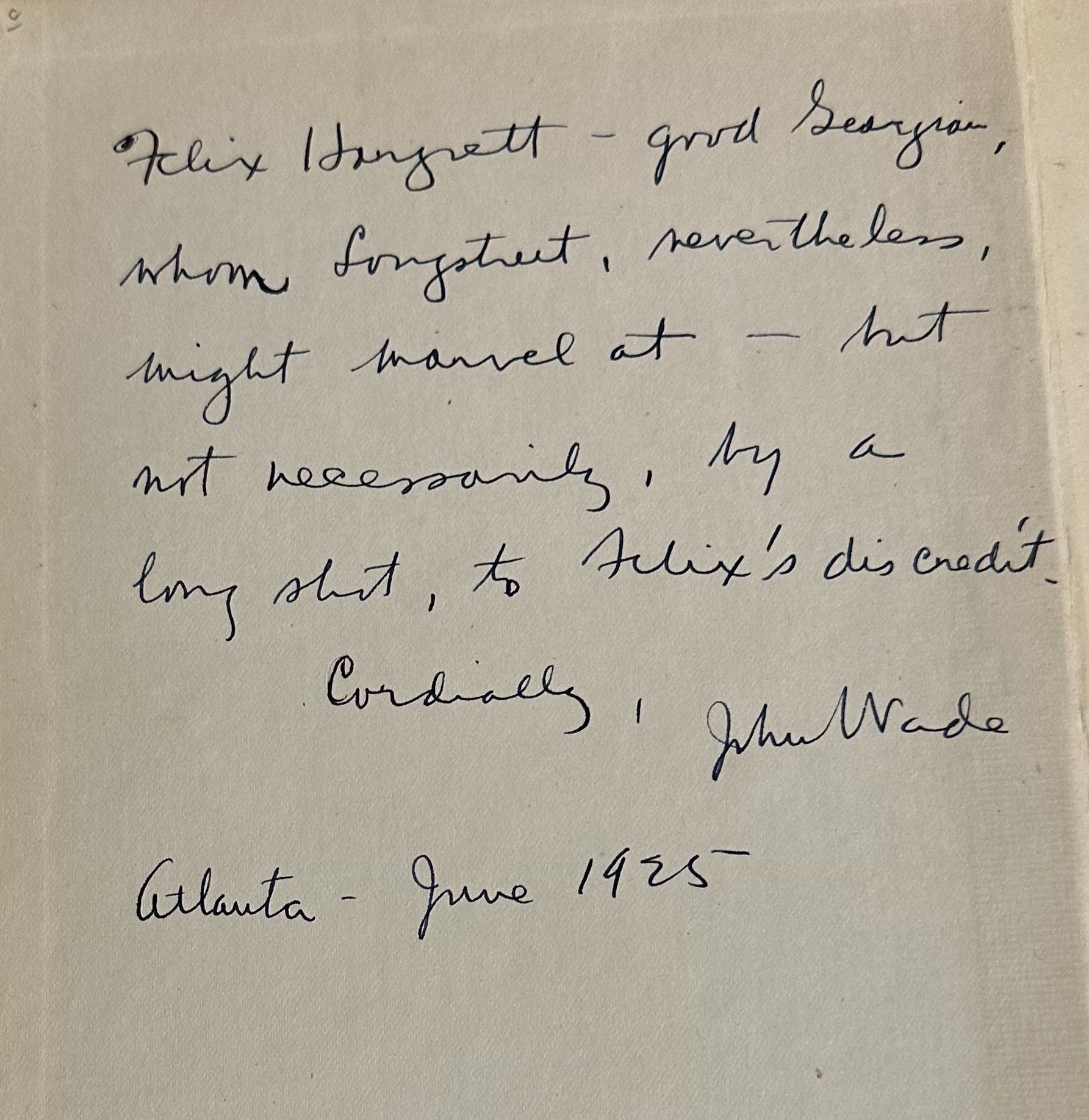
Inscribed first edition:
"Felix xx - good Georgian, whom Longstreet, nevertheless, might marvel at - but not necessarily, by a long shot, to Felix's discredit.
Cordially,
John Wade"Context
John Donald Wade taught at the University of Georgia while completing his dissertation, a lengthy work that would later be published as Augustus Baldwin Longstreet: A Study of the Development of Culture in the South (1924). At a time when philology had not yet relaxed its grip on academic writing, Wade’s biography of Longstreet, broke new ground by blurring the lines not only between history and literary criticism but also between scholarship and literature. In the opening chapter Wade announces his theme by saying that the history of Longstreet becomes “an epitome, in some sense, of American civilization.” The biography gradually narrows to a southern focus and as Inge remarks, Wade attempts “to take a panoramic view of the psyche of an entire society through one representative figure.” Vigorously researched, the book is nevertheless infused with humor and pathos, and it employs narrative devices verging on the novelistic, including imagined dialogue.
"Augustus Baldwin Longstreet: A Study of the Development of Culture in the South" is a comprehensive biographical and historical examination of one of the most influential figures in the antebellum American South. Written by John Donald Wade, this work explores the multifaceted life and legacy of Augustus Baldwin Longstreet - lawyer, judge, minister, second president of Emory College in Oxford (1840 - 1848), and pioneering humorist. Through the lens of Longstreet's varied career, Wade provides a profound analysis of the social, political, and intellectual evolution of Georgia and the surrounding region during the nineteenth century.
The study delves into Longstreet's most famous literary contribution, "Georgia Scenes," and evaluates its role in establishing a distinct tradition of Southern realism and frontier humor. By tracing Longstreet's path from his education at Yale to his leadership at several prominent Southern universities, the book captures the shifting values and cultural aspirations of a society in development. Wade's narrative serves not only as a portrait of a remarkable individual but also as a critical look at the cultural foundations of the South. This scholarly work remains an essential resource for those interested in American literary history, regional identity, and the development of educational and religious institutions in the Old South.