Name/Title
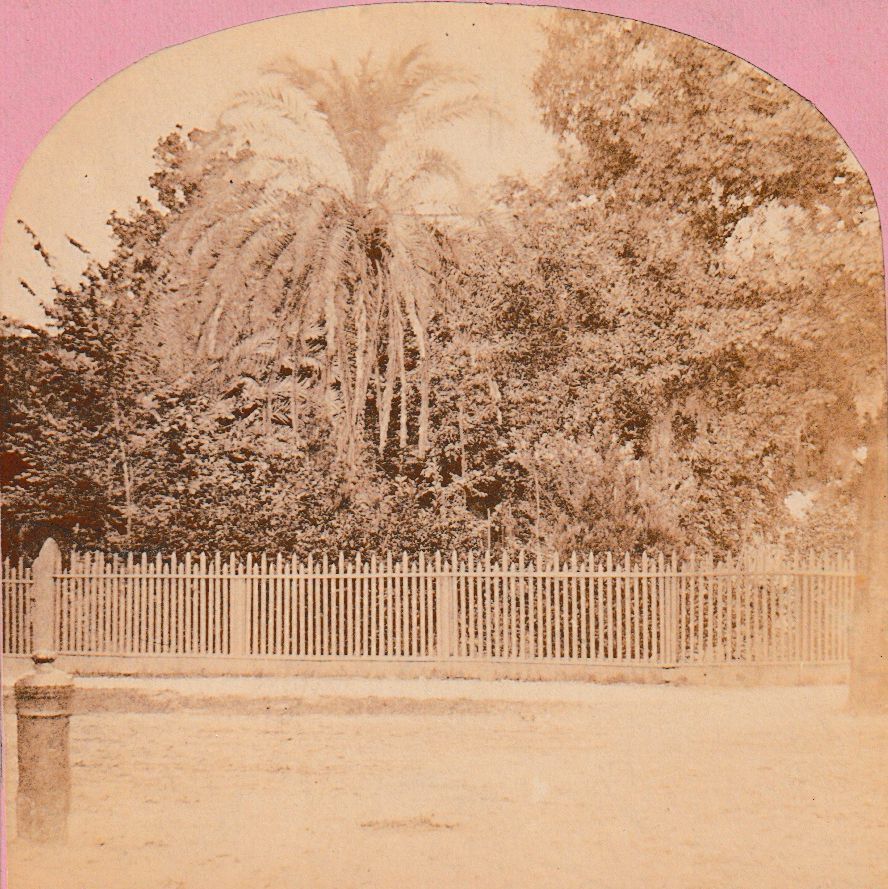
Date Palm Tree [Stereoview]Description
1880 - 1900 stereoview of a date palm tree in St. Augustine, Florida.Context
The date palm's existence in St. Augustine is confirmed from at least the 1740s. In the spring of 1788, during the Second Spanish Period of Florida history (1784–1821), the French botanist André Michaux visited northeastern Florida. In addition to collecting many local plant species new to science, he confirmed the presence of a single, pistillate date palm in St. Augustine, described as being 40 feet in height. There is no doubt about this identification; Michaux knew date palms from prior botanical exploration in the Middle East.
Date palms typically grow at a rate of about one foot of trunk per year. Planted from seed,
which would have been the case in St. Augustine, the young plant would have required a few years before forming a trunk. Therefore, the date palm Michaux identified would have been about 40–50 years old in 1788, indicating it was germinated circa 1740, within the First Spanish Period of Florida history (1565–1763).
Two other historical references tend to support the early existence of the date palm in
northeastern Florida, although the chronology is imprecise. The American naturalist William
Bartram botanized in 1774 along the St. Marys River, now part of the Florida-Georgia border. His travels were financed by the wealthy English merchant John Fothergill and facilitated by the brief British Period (1763–1784) of control over Florida. Bartram encountered Muskogee Creek indigenous people in their original homeland on the savannas of the St Marys River. They related to him a tale of attractive indigenous women providing lost hunters with provisions of oranges, dates and corn cakes so they could safely find their way out of the dense Okefenokee Swamp. Francis Harper, in his scrupulously annotated naturalist edition of Bartram’s travels, states that the reference to date palms growing in the Okefenokee Swamp was in error. Nevertheless, it does not rule out the possibility that the dates in question
came from elsewhere in northeastern Florida. Interestingly, in the Muskogee language, the
word sevapho, referring to fruit of the native saw palmetto, is also applied to the date fruit. These references suggest that the indigenous agriculturist people of northeastern Florida knew of the date palm and possibly had planted it to a minor degree, along with their documented cultivation of orange and peach trees.
The earliest illustration of a date palm in St. Augustine, Florida is from 1872. Stereographic images from the late 1800s show a date palm in the garden of the city’s purported oldest house and a pair of date palms in another private garden.
Florida horticulturists in the early 1900s expressed a resurgence of interest in date palm
as a fruit crop, which was likely stimulated by the U.S. Department of Agriculture program
importing offshoots of known date varieties from the Middle East and North Africa for trials
in Arizona and California. A comprehensive review of Florida ornamental palms mentions
that the date palm grew well, and that many large palms were present in gardens, grown
earlier by settlers from seeds of imported dates.