Name/Title
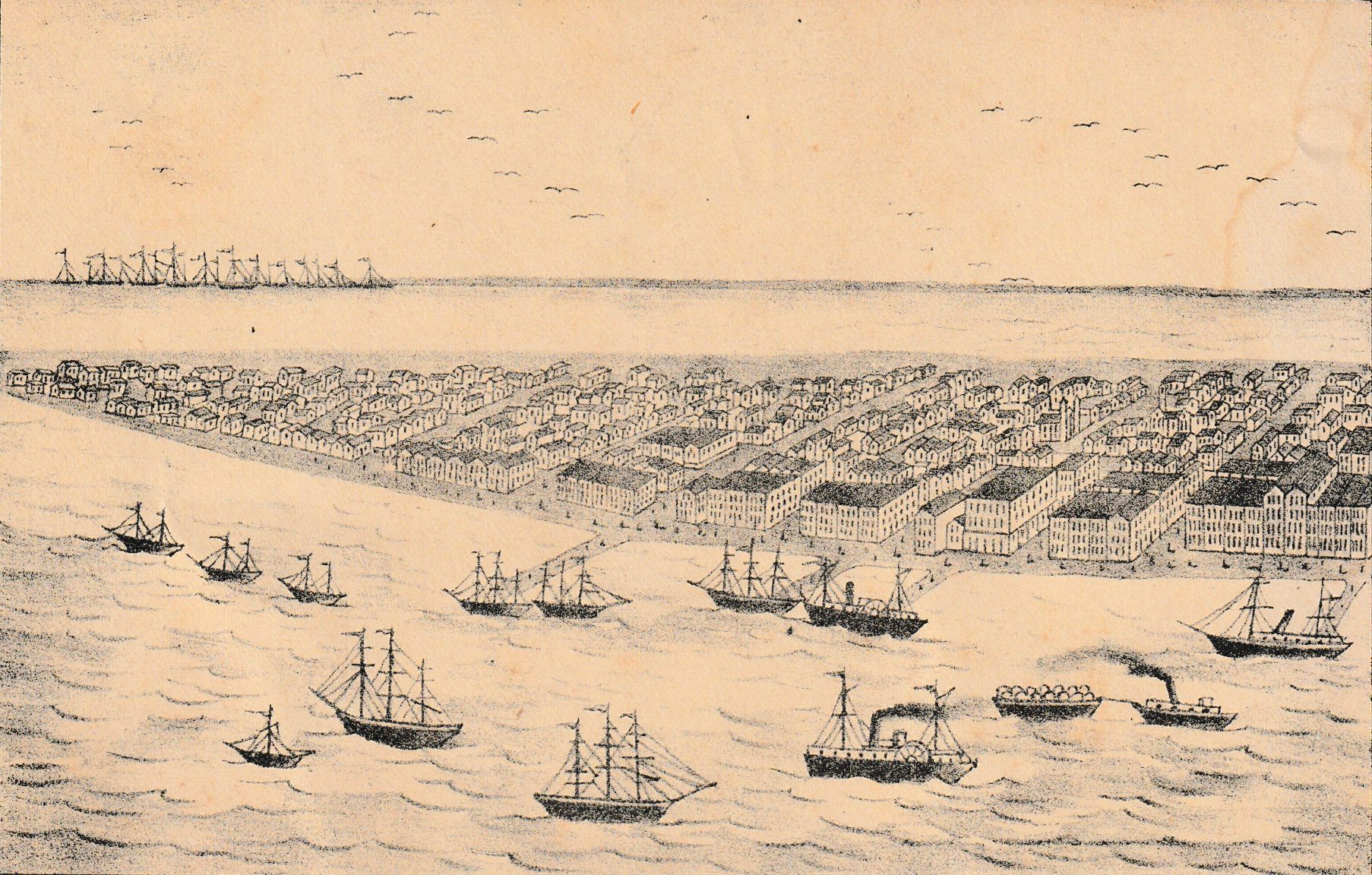
"Galveston" [Lithograph]Description
An 1876 lithograph of "Galveston" from the Galveston, Harrisburg & San Antonio Railway Company’s book “A Description of Western Texas.”Context
Throughout the nineteenth century, Galveston ranked as the largest city in Texas and the the Strand (pictured; usually referred to the five-block business district situated between Twentieth and Twenty-fifth streets) was known as the "Wall Street of the Southwest," serving as a major commercial center for the region. At that time a majority of goods and people came through Galveston to get to Texas, making the city and the Strand a vibrant, vital, and bustling place where deals were made, goods bought and sold, ships supplied, and people served. In the late nineteenth century Galveston harbor annually hosted between 700 to 1,400 vessels. Major businesses included the shipping and trading firm of McKinney and Williams as well as the state's five largest banks. Wholesalers, commission merchants, cotton brokers, attorneys, and (prior to the Civil War) slave auctioneers all had offices on the Strand. Businessmen included Pierre J. Menard, Michel B. Menard, Samuel M. Williams, William L. Moody, Thomas F. McKinney, Gail Borden, Jr., James M. Brown, George Ball, and William Hendley. In 1881 $38 million worth of merchandise and services were sold through the various establishments in the district.
Early buildings on the Strand were usually wooden and thus vulnerable to the frequent fires and storms that plagued the island throughout the nineteenth century. Eventually, owners began to replace the frame structures with iron-front brick buildings. Most historic buildings date back to the 1870s and 1880s. Nicholas J. Clayton, Galveston's premier architect, designed fifteen commercial structures on the Strand - all of them are pictured, eight of them still stand.
“A Description of Western Texas" is an extensively illustrated guide for prospective immigrants to western Texas. Published by the Galveston, Harrisburg & San Antonio Railway Company in 1876, the text provides descriptions of the cities, towns, and counties of western Texas, complemented by additional information on a variety of topics of interest for those considering a move to the region. Executed in an accomplished, understated style, the lithographs serve as a marvelous invitation to the region.
Eberstadt called the book "a valuable description of the lands, towns, agricultural prospects of West Texas, of high interest for the lithographic views."