Judge Roy Bean [Photograph]
Name/Title
Judge Roy Bean [Photograph]Description
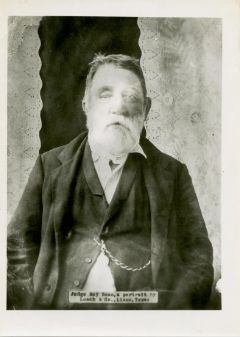
Photograph on Velox photographic paper of" Judge Roy Bean, a portrait by / Leach & Co., Llano, Texas." , likely produced ca. early 20th century. Authorization stamp present on verso.Context
Original photograph circa 1890 of Roy Bean, a frontier justice of the peace known as the "Law West of the Pecos," Early in 1882, Bean arrived at the site of Vinegarroon, just west of the Pecos. Crime was rife at the end of the track; it was often said, "West of the Pecos there is no law; west of El Paso, there is no God." To cope with the lawless element the Texas Rangers were called in, and they needed a resident justice of the peace in order to eliminate the 400-mile round trip to deliver prisoners to the county seat at Fort Stockton. The commissioners of Pecos County officially appointed Roy Bean justice on August 2, 1882. He retained the post, with interruptions in 1886 and 1896, when he was voted out, until he retired voluntarily in 1902. By 1884 Bean was settled at Eagle's Nest Springs, some miles west of Vinegarroon, which acquired a post office and a new name, Langtry. Bean claimed credit for naming the town after English actress Emilie Charlotte (Lillie) Langtry, whom he greatly admired. Actually, railroad records indicate that the town was named for George Langtry, a railroad construction foreman. Bean's fame as a bizarre interpreter of the law began in the 1880s. There was, however, a sort of common sense behind his unorthodox rulings. When a track worker killed a Chinese laborer, for example, Bean ruled that his law book did not make it illegal to kill a Chinese. Since the killer's friends were present and ready to riot, he had little choice. And when a man carrying forty dollars and a pistol fell off a bridge, Bean fined the corpse forty dollars for carrying a concealed weapon, thereby providing funeral expenses. He intimidated and cheated people, but he never hanged anybody. He reached the peak of notoriety on February 21, 1896, when he staged the Fitzsimmons-Maher heavyweight championship fight on a sandbar just below Langtry on the Mexican side of the Rio Grande, where Woodford H. Mabry's rangers, sent to stop it, had no jurisdiction. Fitzsimmons won in less than two minutes. Bean died in his saloon on March 16, 1903, of lung and heart ailments and was buried in the Del Rio cemetery. His shrewdness, audacity, unscrupulousness, and humor, aided by his knack for self-dramatization, made him an enduring part of American folklore.Category
Texas in Focus
Bayou Bend