Name/Title
Menéndez Turkish Knot [Button]Description
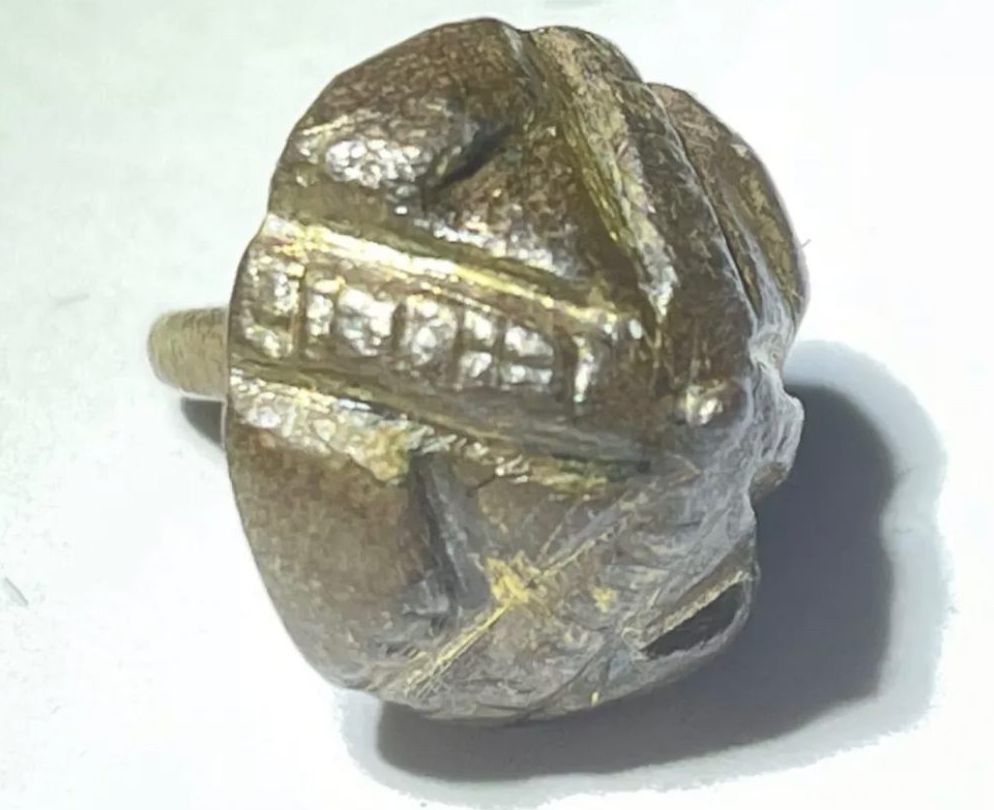
This solid cast brass doublet button typology, resembling a metallic version of an orate Turkish knot, strongly resembles and is probably very closely related to the Menéndez classification, has been recovered from the site of what is strongly believed to have been the location of the first occupation of St. Augustine by Pedro Menéndez de Avilés' expeditionary forces in 1565. This site is located on the present-day property of the city's Fountain of Youth historic park complex. Other examples of the same typology have been retrieved nearby. All examples are semispherical in cross section, with integrally cast perforated stem shanks. The obverse design features a central raised, nipple-like protrusion. Emanating from the center outward, however, are alternating raised lines and dots forming abstract cross-hatch patterns set in gently curving spirals extending from the domed facial apex toward a terminus at the button's lateral shoulders. The majority, but not all, of the observed examples of these buttons bear clearly visible traces of having originally been finished with a gilded surface. No examples of this form have yet been recovered outside the St. Augustine area.Context
On September 8, 1565, Pedro Menéndez de Avilés landed on the shore of what is now called Matanzas Bay and began the founding of the Presidio of San Agustin. Later the settlement would be called St. Augustine, Florida. Built on the site of an ancient Native American village, and near the place where Ponce de Leon, the European discoverer of Florida, landed in 1513 in search of the legendary Fountain of Youth, it has been continually inhabited since its founding.
Menéndez de Avilés named San Agustin for St. Augustine, bishop of Hippo, Algeria, upon whose feast day he had sighted the coast. The city was to serve important functions for the Spanish Empire, defending the primary trade route to Europe along the Atlantic Ocean's main west to east current, called the Gulf Stream. As the territorial capital, St. Augustine would also defend the Spanish-claimed land against invasion.
After eliminating the French Protestant presence and taking over their fort in September of 1565, Admiral Menéndez and Chief Seloy of the Florida Timucua Indians met one another at what is today St. Augustine. Menéndez and his group of some 800 colonists (including 26 women and an unknown number of African slaves) made their first settlement at Seloy’s town, and used Seloy’s council house as the first Spanish fort.