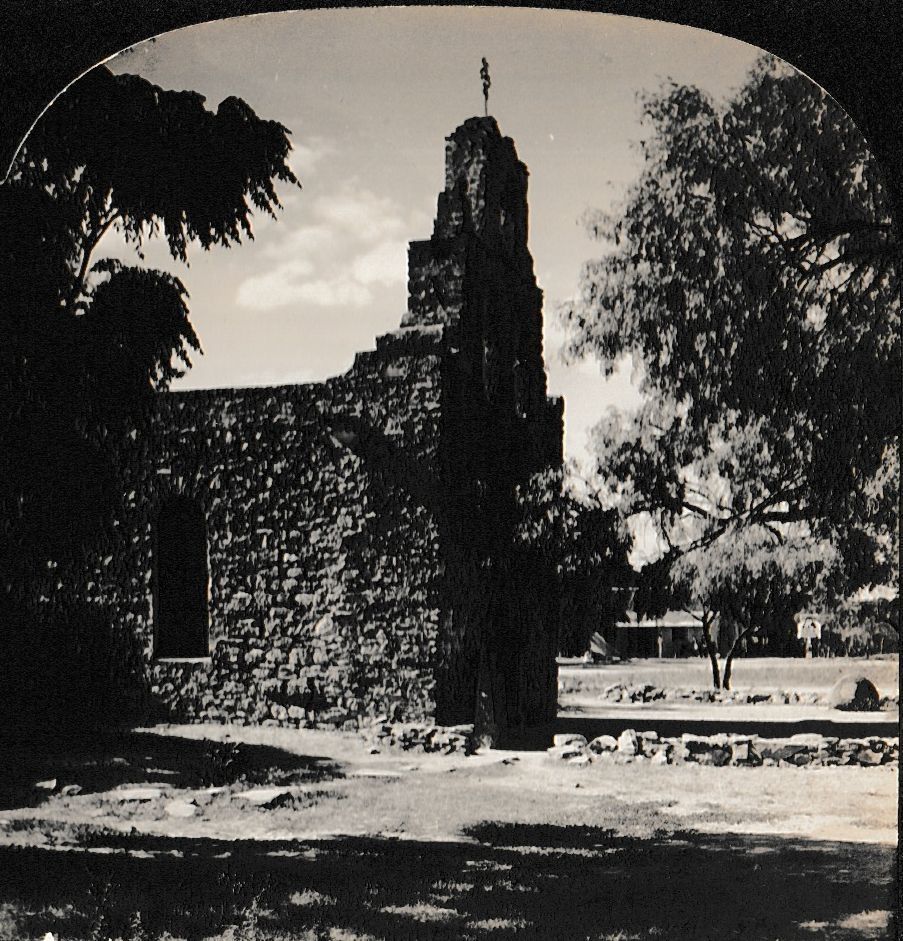
Mission San Francisco de la Espada [Stereoview]
Name/Title
Mission San Francisco de la Espada [Stereoview]Description
“ESPADA MISSION, SAN ANTONIO” stereoview, part of a set depicting Texas scenes in 1936, its centennial year.Context
"There is an interesting tradition connected with Mission Espada, the fourth and last of the San Antonio missions, that stirs the imaginations of visiting tourists. Consecrated in 1731 as Mission San Francisco de la Espada (St Francis of the Sword) it has been said that the old tower was built in the form of the hilt of a sword. Traditions further relate that the mortar used in building the walls was mixed with asses' milk to lend strength and permanence. The recorded history of this old mission, however, needs no coloring of the imagination. It dates back to the very beginning of Texas history when, in latter part of the seventeenth century the Spaniards erected a number of missions in East Texas as a precaution against French intrusion and Espada was one of that group. It later was "re-established" in its present location. After Mission Espada had been in use for more than a century, it played a prominent role in the Texas revolution against Mexican tyranny. When the Texas colonists in October, 1835, realized that war was inevitable, they formed a volunteer army with Stephen F. Austin as their leader. Marching toward San Antonio, the troops went into encampment at Mission Espada, which served as their base while preparations were made for the capture of the city. Mission Espada enjoys still another distinction. It was here that the first textbook ever written in the province of Texas was used. Father Bartholome Garcia of the mission was the author. The book, written in Spanish and Indian dialect, was published in Mexico City. The date of the publication was about 1760. Services are still held regularly in the mission chapel. The square, where the Texas army once assembled, is now enclosed by rows of stone and adobe houses, some of which are still in use."Category
Spanish Dominion
Becoming Texas, Bullock Museum