Name/Title
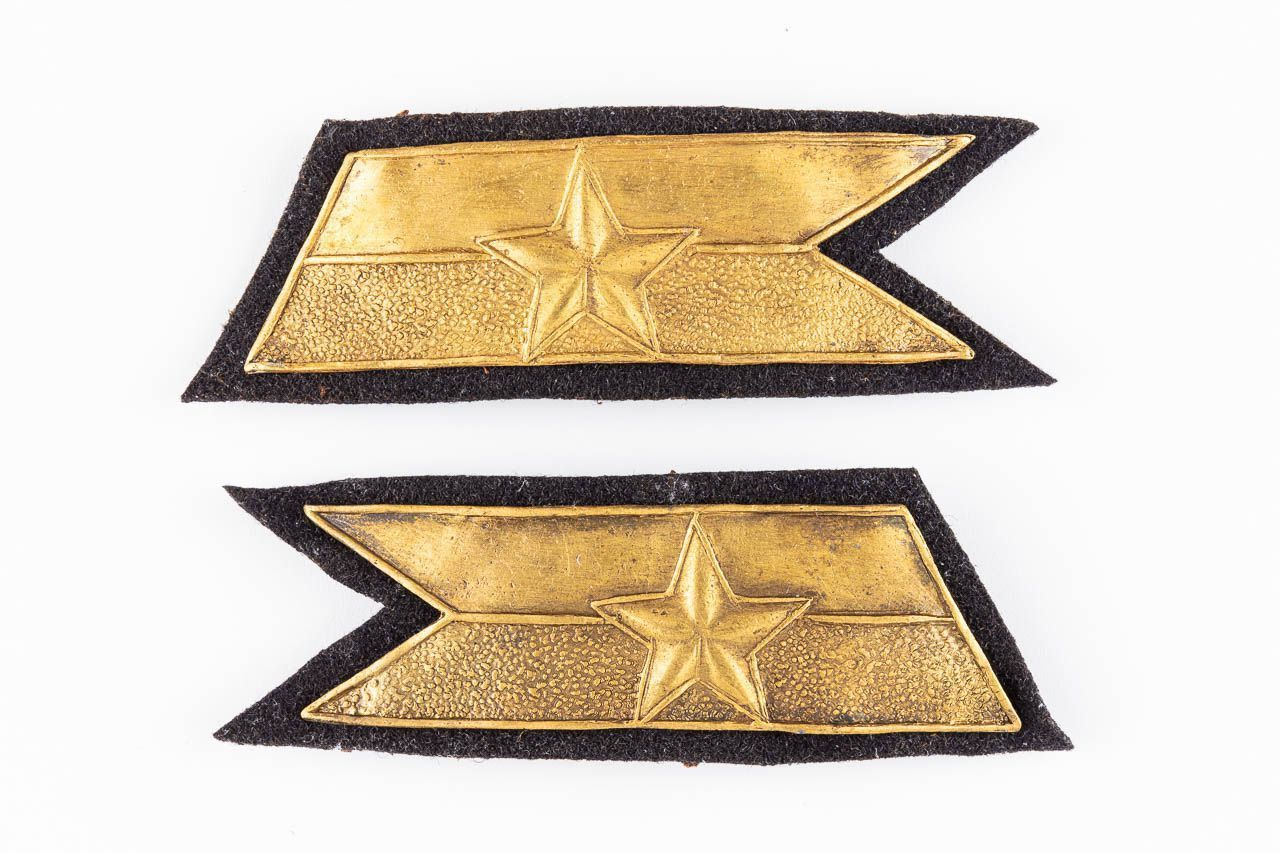
Commodore [Collar Insignia]Description
Collar insignia shaped as a long pennant. The pennant consists of two textures, representing colors. The top half is smooth and the bottom half is stippled. Die-struck and made of gold.Context
The commissioning of officers has a long history and can be traced back to the Roman Empire. In the Middle Ages, sovereigns would offer noblemen commissions to raise armies to protect the realm. The commission was a lawful extension of sovereign power. The granting of commissions became more commonplace under the British Empire. After the American war for independence, the Continental Congress recognized the need to continue the practice. Because there was no unitary executive during the second Continental Congress, authority to grant commissions was somewhat clumsily shared between Congress and state governments.
This group of officers were at first appointed to a ship for particular commissions and were ranked according to seniority of first appointment in that rank. They led Navy ships and consisted of the captain, his lieutenants, as well as embarked Marine officers. Officers led the sailors in fighting the ship when an enemy was engaged.
In 1690, the British Navy gave the title of Commodore to the senior Captain of a small squadron, involving extra responsibilities. It was considered as a temporary rank which once the circumstances had passed meant reversion to Captain and officers retained their seniority position in the Captain’s list. In 1747, the first list of “equivalent ranks” between army and navy were produced and the Admiralty proposed that Commodores should rank with Brigadiers. This was accepted although in reality the “rank” of Commodore did not exist. In 1805, this anomaly was redressed by creating First Class Commodores, ranked and paid as Rear-Admiral if of sufficient importance to have a separate Captain under him, and Second Class Commodores if he commanded the ship himself and not ranked as Rear Admiral.
The current practice of prescribing one uniform for all officers of the United States Navy with a standard system of rank insignia and the use of devices to show the specialties of the staff officers was introduced in 1830 by a uniform order of 1 May. While it would take years for the present system to develop, a start had been made. The full and undress coats of the combatant officers from captain to master, and of the older staff corps, medical and purser, were a blue frock coat, identical in cut. As under earlier orders, the amount and location of gold embroidery was used in full dress to determine rank.
Texas' Lone Star identity was formed during the Texas Revolution. This insignia is believed to have been manufactured of scrap copper pieces used to sheath the Texas Navy ships in the Algiers Shipyard, New Orleans, Louisiana, and plated with melted gold coins and/or scrap.