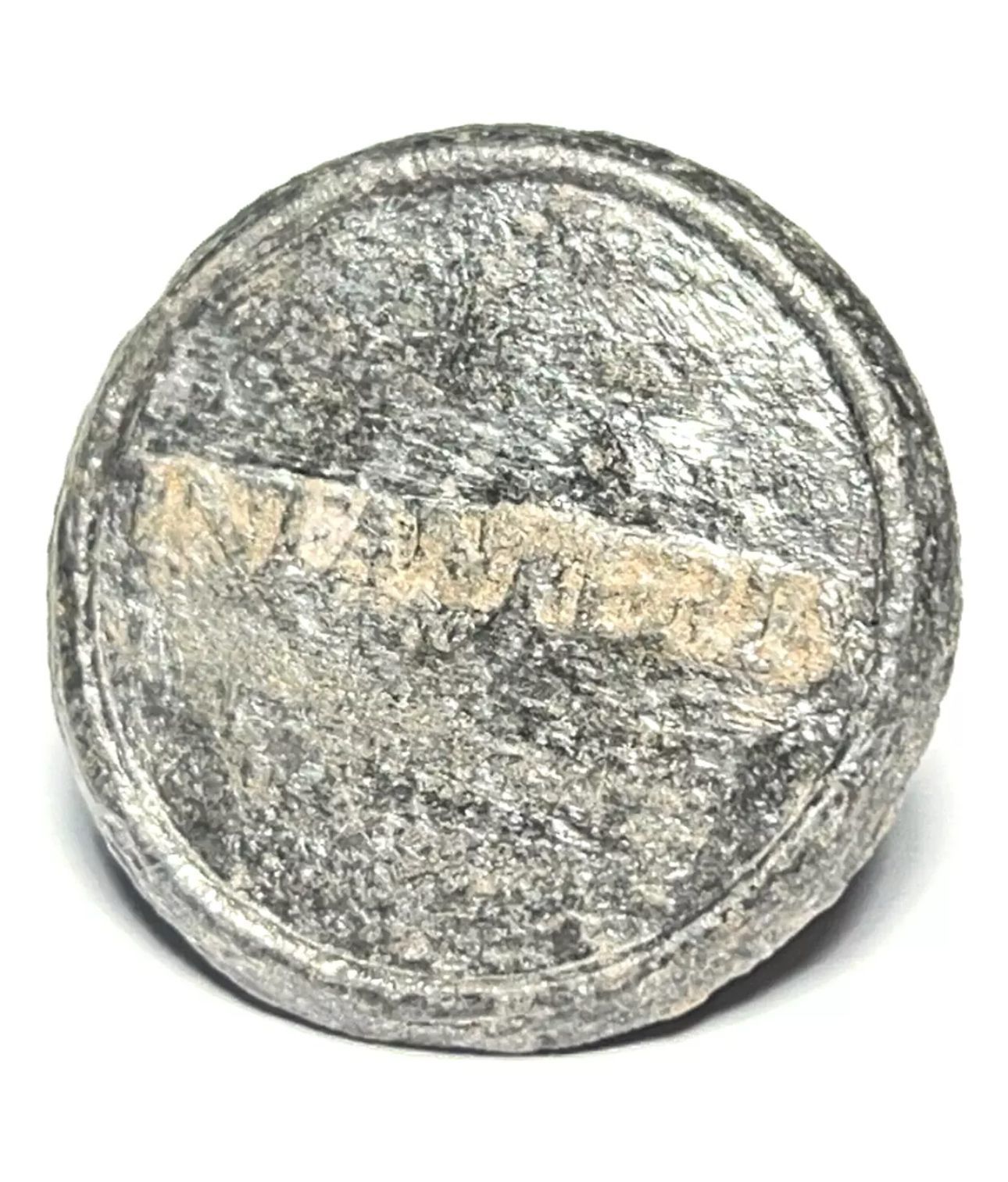
Name/Title
Spanish Louisiana Regiment [Button]Description
Enlisted issue infantry “INFANTERIA" coat button, recovered in Louisiana, hand casted of pewter, and may have originally been coated in tin.
During Spain's 1808-1814 War of Independence against the occupation forces of Napoleonic France, the Spanish military establishment issued generic cast pewter "YNFANTERIA" and "INFANTERIA" buttons to its regiments of infantry to avoid the complexities inherent to the manufacture and issue of unit-specific devices or designs. This mentality was and remains mirrored by the United States beginning with its War of 1812 issue of pewter script "I" buttons to its enlisted infantrymen. The examples shown here were recovered from sites occupied by the Luisiana Infantry Regiment in Florida, and it is likely that these remained in use by this unit until the end of its existence in North America.Context
Initially established and manned by peninsular Spanish regulars in 1765 as an infantry battalion to occupy Luisiana, acquired from France three years earlier, what would ultimately become the veteran and professional Regimiento de Infantería de Luisiana formed the core of Spain's military establishment in Louisiana and, later, in the Spanish Floridas until it faded into oblivion during the terminal period of Spain's colonial tenure in North America.
Reorganized after its arrival in North America in 1769, the battalion's detachments performed garrison duties at outposts in Spanish Louisiana as far north as Illinois. In 1779, when Spain joined France in an alliance against England during the American War for Colonial Independence, the unit was enlarged to regimental strength through the addition of a second battalion and participated with distinction in the 1779-1781 conquest of then-British West Florida under the leadership of Louisiana Governor Bernardo de Gálvez. Spain's official repossession of Florida by the terms of the 1783 Treaty of Paris resulted in a third battalion being added to the regiment for service in the Floridas in 1786. This seemingly impressive force was, however, a "paper tiger." It never achieved its newly authorized strength in manpower, nor did it enjoy adequate supplies of material provisions to properly maintain itself.
After the retrocession of Louisiana by Spain to France in 1800 and that territory's subsequent purchase by the United States in 1803, the unit served exclusively in the Spanish Floridas. Soon, Florida itself began to yield to the pressures of American nationalism, military aggression, and demographic expansion, a process that was accelerated by Spain's rapidly deteriorating position in both Europe and its other New World colonies. By 1813, Florida—which had once extended westward to the Mississippi River and northward to a line extending eastward from the mouth of the Yazoo River—had been reduced to the size of that present state. Plagued by shortages of support, supplies and manpower, the Louisiana Regiment, like Spain's once-formidable presence in North America, steadily deteriorated. By 1816, the unit had dwindled to a single battalion with a strength of less than 200 men, and it is not clear if the once-proud Louisiana Infantry Regiment was still in existence as an autonomous unit when Spain ceded Florida to the United States in 1821.
The uniform colors of the Louisiana Regiment remained constant from the unit's inception to its end. Officers and men wore French-like white coats with dark blue collars, cuffs, and linings; blue waistcoats and breeches; white hat lace; and white metal (pewter for enlisted men and silver or silver plated for officers) buttons. The use of white metal buttons and trim was unusual in the region's Spanish colonial military establishment; most units used "yellow metal," or brass/gilt buttons and insignia. The regiment's uniform coat buttons were all on the wearer's right side, and the cockades were, like those of other Spanish units, red.